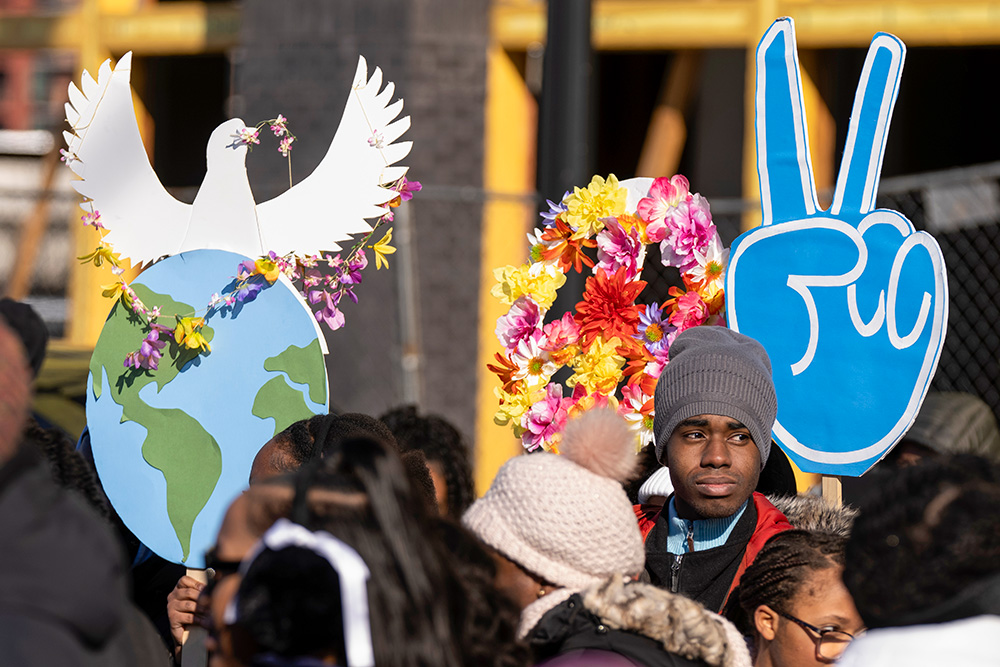
Participants hold peace signs as they gather before the District of Columbia's annual Martin Luther King Day parade Jan. 19, 2026, in Washington. (AP/Mark Schiefelbein)

As the new year began with the leader of our country turning his sights on the international stage, I wondered: Where can we find hope in a government increasingly unmoored from law and decency? Then I realized that January gives us an opportunity to restore the possibility of who we can be as a people by celebrating the national holiday honoring Martin Luther King Jr.
It seems more important than ever to remember his words, experience his spirit, and give witness to the values that reflect the possibility of who we are and what kind of world we can render.
King was a Baptist minister who, in his commitment to nonviolence, became the most visible spokesperson and leader in the Civil Rights Movement, advocating for racial equality through nonviolent resistance. Because of his vision and his life, he was assassinated in 1968 at the age of 39.
As the current administration rewrites our history, trying to remove the struggle and the achievements of U.S. citizens varied in color, class and gender, it is imperative that we continue to teach and lift up the values and possibilities of who we are as a nation and as a people throughout the world.
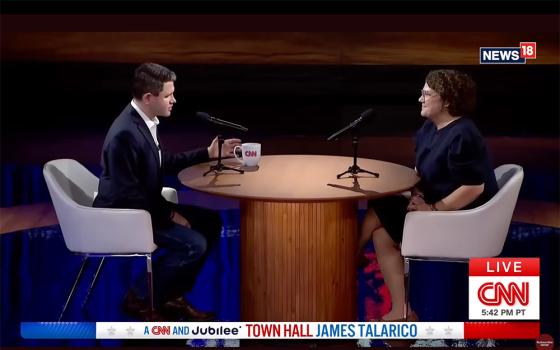
If we listen only to Stephen Miller, the White House deputy chief of staff, as he said in an interview with CNN, we hear that "we live in a world ... that is governed by strength, that is governed by force, that is governed by power. These are the iron laws of the world that have existed since the beginning of time."
Might makes right; bullies win; power over. Certainly, that has been operative within human history. It is behavior that has been part of our evolutionary past as we struggled for survival. Emerging from our apelike ancestors, our behavior resembled theirs. The stronger male would fight the weaker; the male would dominate the female of the species; the male leader of the tribe would fight off the alien attackers to protect his own.
Advertisement
But over time we continued to evolve physically and emotionally, becoming more conscious of who we are and how we can behave in new ways that embody the realization that we have more in common with each other as a species than we have differences. We need new ways of responding as we realize that we are all interconnected on this planet Earth.
The desire for survival continues but now, given the increasingly sophisticated weaponry, violence is not an option. As King spoke in his "I've Been to the Mountaintop" speech, "It is no longer a choice between violence and nonviolence in this world; it's nonviolence or nonexistence."
If we listen to the current elected leader of our country, we hear him tell The New York Times that the only restraint on his will for power is his own mind, his own morality. No law — federal or international — has any influence on his behavior.
His mind, his morality, feeds his need to take over countries by force, punish his enemies, reward those who acclaim him, and accumulate fortunes for his own family. A transactional leader, he remains in Kohlberg's earliest stages of moral development. His inchoate thinking and speech mask his insidious behavior and manipulate us to believe what he is saying.
Such a way of being is not normal nor is it acceptable, as shown by the fact that 68% of all U.S. eligible voters in 2024 did not vote for him. Most of us have been influenced by another morality — one that has its roots in what is called the Axial Age of Religion.
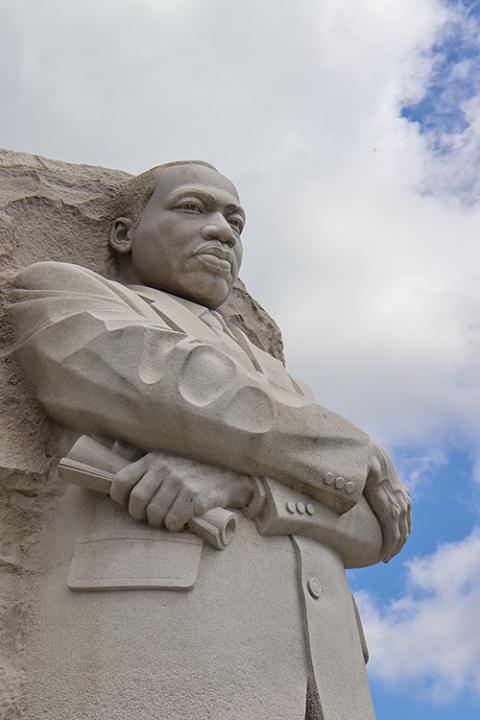
The Martin Luther King Jr. Memorial is seen in Washington, D.C. (NCR photo/Teresa Malcolm)
Around 800 to 200 B.C., there was a shift from localized tribal deities to universal, transcendent truths and ethical frameworks. There was a radical shift from "might makes right" and the use of unrestrained power toward loving one's neighbor. Virtues such as compassion, self-discipline and altruism came to be seen as central to a good life and to human happiness. The Golden Rule was articulated: Treat others as you would want to be treated, thereby refraining from what you would not want done to you.
Jesus' took this teaching further, advocating love for one's neighbor and even one's enemy. Jesus lived a new way of being, respecting all people regardless of status, gender or religion. He prayed that we all might be one, as his Abba God and he were one. He broke boundaries and challenged the status quo of the Roman Empire, which continued to operate from an earlier consciousness — the "iron laws" that still prevailed.
King, a Baptist minister steeped in that tradition, left words that continue to challenge us to love:
"Nonviolence is absolute commitment to the way of love. Love is not emotional bash; it is not empty sentimentalism. It is the active outpouring of one's whole being into the being of another." (1957)
"I am convinced that love is the most durable power in the world. It is not an expression of impractical idealism, but of practical realism." (1957)
"If we are to have peace on earth, our loyalties must become ecumenical rather than sectional. Our loyalties must transcend our race, our tribe, our class, and our nation; and this means we must develop a world perspective." (Christmas 1967)
We need to remind ourselves that evolution is slow and that how we live and what we believe helps to shape the future. During 2026, let us renew our commitment to reflect on what we still find attractive about behaviors that hark back to an earlier time, and let us make conscious choices to embrace new behaviors that embody love.
Let us remember that we are not alone.
"We cannot walk alone. And as we walk we must make the pledge that we shall always march ahead. We cannot turn back." (Martin Luther King Jr., "I Have a Dream," 1963)