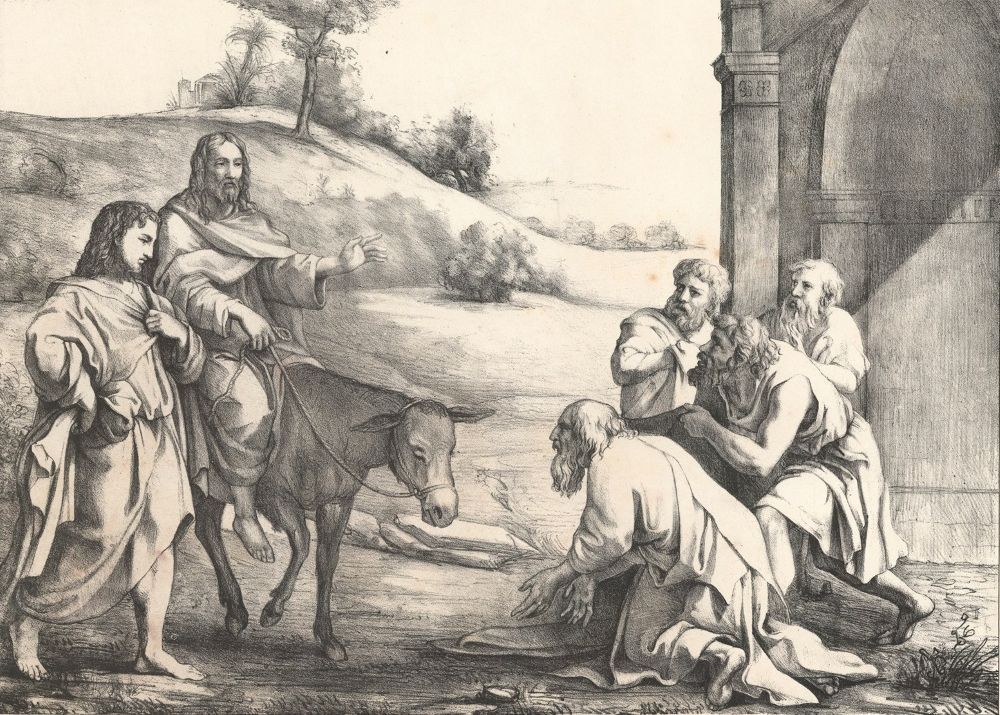
"Entree de Jesus-Christ dans Jerusalem" (1890) by P. Bineteau (Artvee)

by Sr. Mary Nzilani Wambua
Editor's note: Welcome to Theologians' Corner, where each week a different woman theologian from around the world offers a fresh reflection on the Sunday readings.

14th Sunday in Ordinary Time
July 5, 2026
The readings today paint a beautiful picture of God's style of working in the world as gentle, humble, life-giving and deeply personal. They invite us to rediscover what kind of God we worship and what kind of disciples we are called to become. The Word of God gently shifts our attention from pressure and striving to trust, humility and surrender to God's way of working.
At the center of all the readings is a surprising message. That is, God saves not through force or complexity, but through humility, closeness and the quiet power of his Spirit.
In the first reading, the prophet Zechariah presents a king who comes humbly riding on a donkey. This is a striking image because it overturns human expectations of power. We expect God to arrive dramatically, forcefully, or with overwhelming signs. But God's king arrives differently, on a donkey, a sign of peace and humility. This is not just a poetic detail; it reveals God's entire way of acting in that he does not impose himself through force. But he enters human history gently, respectfully and peacefully. His strength is not in violence, but in the power of peace, reconciliation and truth, and it already prepares us for the Gospel which says: If God is humble, then we must be humble to recognize him.
The question remains: Am I able to recognize God when he appears in ordinary, even humble situations?
The psalm deepens this image of God saying, "The Lord is gracious and merciful, slow to anger and rich in compassion." This brings to our attention that God is not distant or indifferent. He is near to those who call on him sincerely. This means that no prayer is wasted, no cry is ignored and no moment of struggle is unseen. But there is a condition of having a sincere heart, for God does not force himself into closed hearts, but he draws near to those who open themselves in trust.
In the second reading from the Letter to the Romans, we listen to these words: "If by the Spirit you put to death the deeds of the body, you will live." In these words, St. Paul reminds us that being a Christian is not just about belief, it is about indwelling. The Spirit of God lives in us and changes everything, for we are not meant to fight sin and struggle alone, but we are empowered by God's own Spirit. Paul here gives a challenge: If we live according to selfish desires, we close ourselves to life. If we live by the Spirit, we experience true freedom. So, the spiritual life is not about perfection but about direction: Am I moving toward God or away from him?
Advertisement
The Gospel brings everything into a personal invitation: "Come to me, all you who labor and are burdened, and I will give you rest." Jesus does not promise a life without burdens. He promises a different way of carrying them. The key word is not "removal" but "exchange." He says: "Take my yoke upon you … and learn from me, for I am meek and humble of heart." A yoke here means a shared burden. Jesus is not removing responsibility; He is refusing to let us carry it alone. He reveals something essential about his heart in that he is gentle and humble. This is not weakness; it is divine strength expressed in love.
Again, from the Gospel, we find this saying: "You have hidden these things from the wise and the learned; you have revealed them to little ones." Jesus prays in thanks to God, who has revealed himself to the lowly. As we grow in our faith and our commitment to the Lord Jesus, we know that few people will understand us. Jesus condemns no one, but he invites us to live in certain ways which bring true life to us. What we need to know is that the Gospel is not always an acceptable way to live, but once we embrace Jesus and begin to walk with him, he makes all things possible.
And so, looking at all the readings, they converge on a simple spiritual truth. That is, God comes in humility, He is near to the sincere and the humble, he gives us his Spirit to live a new life, and he offers rest to those who come to him. What we may ask ourselves is not whether God is present, but whether personally I am attuned to his way of being present. We pray for the grace to recognize him in the humble, to follow him in the Spirit, and to rest in His gentle heart.