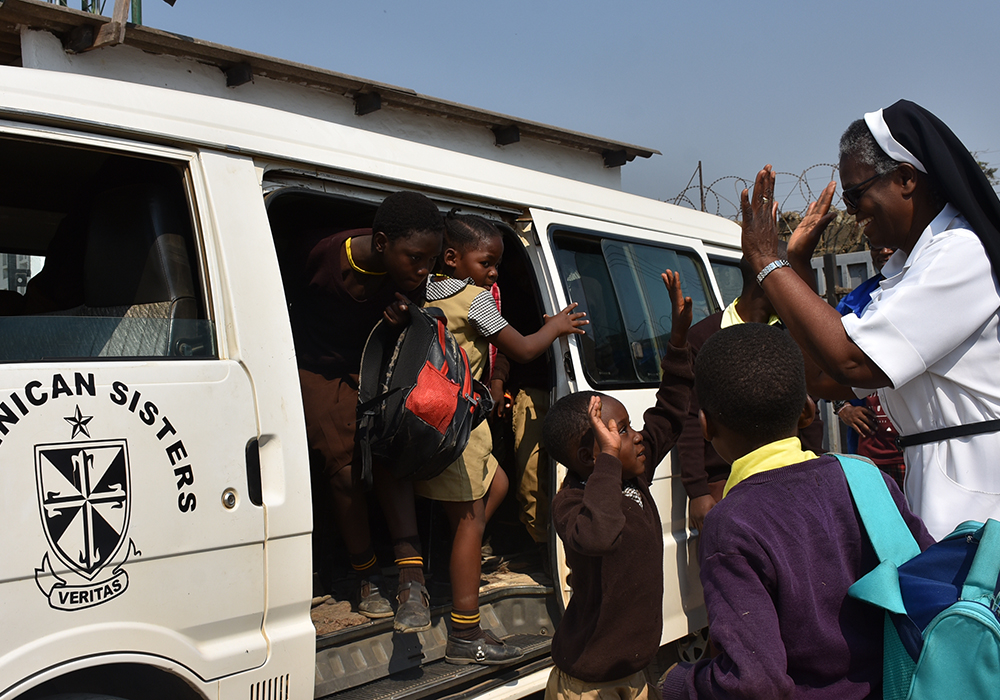
St. Anthony Children's Village program manager Dominican Sr. Bernadette Mwita welcomes pre and primary school children. The Dominican Missionary Sisters of the Sacred Heart of Jesus manage St. Anthony Children's Village in Ndola, Zambia. (Derrick Silimina)

by Derrick Silimina
In the heart of Ndola, a mining town about 300 kilometers north of Zambia's capital of Lusaka, Kelvin Mambwe recalls his turbulent childhood filled with family conflict and abandonment.
"My mother's family wanted to abort me due to tension between my parents' families who almost prevented me from ever being born. But by God's grace, I survived that conflict and came into this world," Mambwe told Global Sisters Report.
Born in 2003 at Kitwe Teaching Hospital to an HIV-positive mother, Mambwe lost his mother in infancy as antiretroviral therapy was unavailable at that time. Left to face an uphill struggle for survival, his early life was defined by the painful reality of family rejection.
Mambwe said that his father lacked the resources to care for him after his mother died. Fortunately, a foster parent employed at the Dominican convent assumed responsibility for his care until he reached 3 years old, when he was transferred to St. Anthony Children's Village in Ndola, managed by the Dominican Missionary Sisters of the Sacred Heart of Jesus.
"As a child, I believed Madam Maureen — a caregiver at St. Anthony's Children's Village — was my biological mother because of how deeply she cared for me. The love she showed me was something I had never felt within my own family."
Mambwe, 23, completed Grade 12 in 2024 and is pursuing a degree in civil engineering at Northrise University in Ndola through a sponsorship from Seeds of Hope Children's Ministry. Guided by a desire to give back, he actively volunteers at the children's home that raised him and hopes to one day support the Dominican sisters who cared for him.
Since opening in May 2003, St. Anthony Children's Village has cared for 4,620 children, helping many transition to independence or reunite with their families, according to child and youth care manager Patience Moonga. The facility currently supports 104 residents, ages 5-36, providing specialized care for children with diverse needs, including cerebral palsy and mental disabilities.
As the prevalence of HIV/AIDS intensified in Zambia in the late 1990s, many children were left orphaned or abandoned, while others found themselves living on the streets without food, shelter, healthcare or education.
In response, the Dominican Missionary Sisters of the Sacred Heart of Jesus opened two transient homes in Ndola in 2000 to provide temporary care and protection for displaced children. With support from St. Anthony Parish in Italy, the sisters established St. Anthony Children's Village in 2003, where babies and children with special medical needs were transferred, while the transient homes continued to serve school-going children.
"We provide care for vulnerable children coming from diverse backgrounds and admitted for various reasons," said St. Anthony Children's Village program manager Dominican Sr. Bernadette Mwita. "A significant number of our residents are children with cerebral palsy who have been neglected or abandoned, often following the death of their mothers."
Mwita said that the children require constant care, as some guardians, out of desperation and poverty, leave them locked all day indoors without food or water while searching for a livelihood.
Advertisement
"Some of these children are referred to us through the Department of Social Welfare. Others are babies born to mothers with severe mental disabilities who are unable to care for them," Mwita said. "We also provide temporary protection for children who have experienced physical or sexual abuse, family crises, or other forms of neglect."
Mwita, a retired nurse, explained that fewer babies are now born to HIV-infected mothers as the AIDS crisis recedes. Still, St. Anthony Children's Home continues to deliver complete rehabilitative care, nutrition and early schooling, while sending older youth to local secondary schools.
For Clementina Chola, losing her parents in grade three and subsequently losing touch with her extended family, could have defined her path. Instead, she was welcomed into St. Anthony's Children's Village by the sisters, whose life-changing care and guidance she credits for where she is today.
"The Dominican sisters have really done a great job because they've helped me a lot. And the only thing I can say is thank you for giving me a life, a home and a career," Chola said.
Chola said she never knew her biological mother, and after her father died in 2013, she struggled to fit in with extended family, making St. Anthony's Children's Village her only true home.
At 22, Chola is now pursuing a nursing course at Chilonga College of Nursing and Midwifery in Mpika, sponsored by the Dominican sisters. She aspires to specialize in pediatric care for children with cerebral palsy — a mission inspired by the very facility that gave her a second chance at life.
Mwita said that in order for the home to maintain vital services such as psychosocial counseling, educational assistance and efforts toward family reintegration, the center actively mobilizes resources from international and local organizations.
"One of my greatest joys is witnessing vulnerable children regain hope, recover their dignity, and eventually be reintegrated into loving families whenever possible," she said. "Following up on children after reintegration and seeing them thrive gives me immense satisfaction."
The facility still faces major hurdles, Mwita said, including a high demand for cerebral palsy care, the physical burden of supporting aging dependents, and family reluctance toward reunification. These issues are further compounded by a nationwide shortage of long-term rehabilitation centers for severe mental disabilities and a heavy reliance on donor funding for program sustainability.
After 45 years in religious life, Mwita said that her work at St. Anthony Children's Village is a living expression of Gospel values embodying the very heart of Dominican charism.
"We proclaim the Gospel not only through preaching but also through education, healthcare and social ministry," she said. "Our ministry is one of love, compassion, faith and hope. By meeting children's physical, emotional, educational and spiritual needs, we help restore their dignity and give them hope for a brighter future."