
by Kamran Chaudhry
A documentary about a German Catholic nun who devoted more than five decades to fighting leprosy in Pakistan has won third prize in a short-film competition held during the country's National Minority Week.
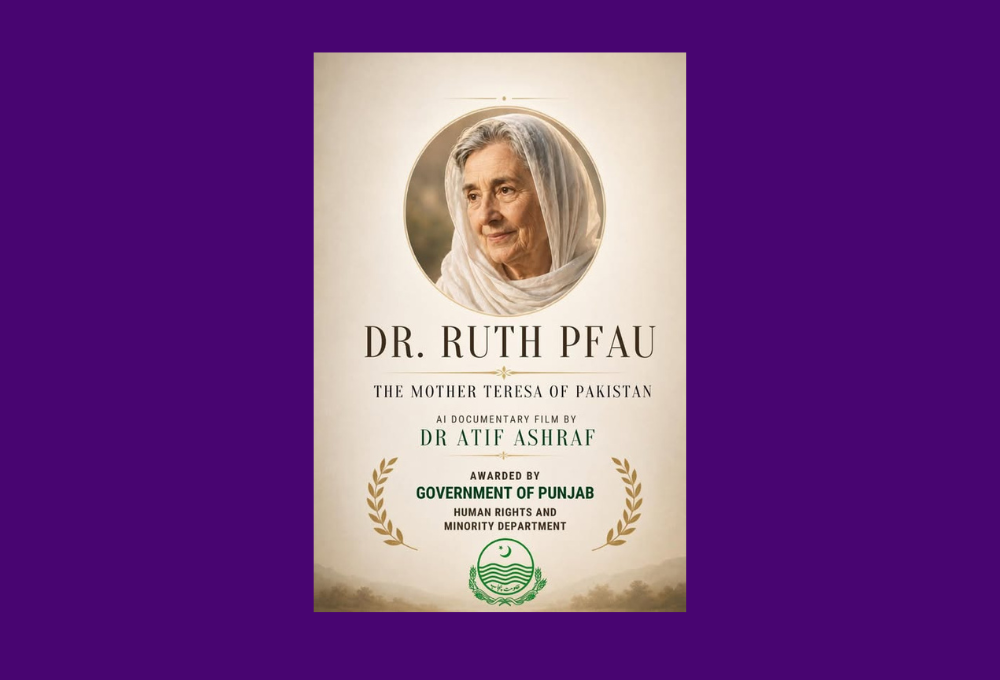
"Dr. Ruth Pfau — The Woman Who Defeated Leprosy in Pakistan," made by Muslim filmmaker Dr. Atif Ashraf, received a cash prize of 50,000 rupees (US$180) at the competition organized by the Punjab government's Human Rights and Minorities Affairs Department.
The department announced the winners on Aug. 10, the ninth anniversary of the death of Sr. Ruth Katherina Martha Pfau, a member of the Society of the Daughters of the Heart of Mary.
Pfau arrived in Pakistan in 1960 and became involved in the treatment of leprosy patients after encountering their dire conditions in Karachi, Pakistan's largest sprawling port city.
She went on to help establish the Marie Adelaide Leprosy Centre, which became the hub of a nationwide network of leprosy treatment centers.
Pakistan's Foreign Ministry credited Pfau's efforts, along with those of her colleagues and the national leprosy program, with helping the country eliminate leprosy as a public health concern in 1996.
Known affectionately as "Pakistan's Mother Teresa," Pfau spent most of her life caring for people affected by the disease, regardless of their religious or social background. She received Pakistan's second highest civilian honors, the Hilal-e-Pakistan and Hilal-e-Imtiaz.
"Your films remind us that every story of heritage, resilience, and humanity deserves to be seen and heard," the Punjab department said in a Facebook post announcing the winners.
The German Embassy in Islamabad also remembered Pfau on the anniversary of her death, sharing a quote she frequently cited: "It is better to light a candle than to curse the darkness."
"On her death anniversary, we remember Dr. Ruth Pfau with deep respect and gratitude," the embassy said. "A German-born doctor who made Pakistan her home, she devoted her life to serving those affected by leprosy."
Sr. Mariam Mehnga, a former superior of Pfau's religious congregation, said she was surprised to learn that the documentary had won an award.
"We had no idea about it. This is an honor for us as a religious community and as Pakistanis. She did all this in her life," Mehnga told Global Sisters Report.
"For us, it affirms the role of Pakistani Christians, not only in the Pakistan Movement but also in serving the country."
Born in Leipzig, Germany, in 1929, Pfau was initially traveling to India when visa complications left her in Karachi, where she visited a leprosy colony and encountered people living in extreme poverty and isolation.
"That changed her life," Mehnga said.
Pfau died in Karachi in 2017 at age 87 after spending more than five decades in Pakistan. She was given a state funeral with full national honors, including a 19-gun salute.
"She was very polite, always ready to help others and led a prayerful life devoted to religious life and leprosy patients without any difference of faith," Mehnga said. "It is a lesson for the whole of humanity."
Advertisement
Pfau's legacy remains visible at the Marie Adelaide Leprosy Centre, where staff still preserve commemorative 50-rupee coins issued in her honor in 2018.
"Treating leprosy is still a very neglected sector in Pakistan. Even educated people do not give enough attention to those affected," she said. "Despite government claims of being leprosy-free, the disease still exists in southern Sindh as well as in Afghanistan."
For Sohail Alam, a member of the Minority Advisory Council in Punjab, the documentary offers a reminder of the contributions made by religious minorities to Pakistani society.
"The fact that a Muslim doctor filmed it, a panel of Muslim judges from academia and the media selected it, and Muslim students at Punjab University watched it during the screening makes it even more interesting," he said.
“Unfortunately, there is still a mindset in the majority community, especially in rural areas and small towns, of categorizing people," he said. "The story of a nun born in Germany who was destined to heal Pakistan speaks volumes about serving above religion."
Alam told GSR that highlighting figures such as Pfau could help younger Pakistanis appreciate the contributions of religious minorities.
"It is a good tradition that such characters are being highlighted for the younger generation," he said. "The government should do more for the many other unsung heroes from minority faiths whose contributions should not be forgotten."