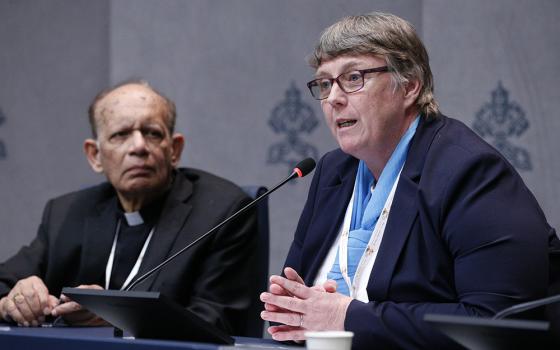
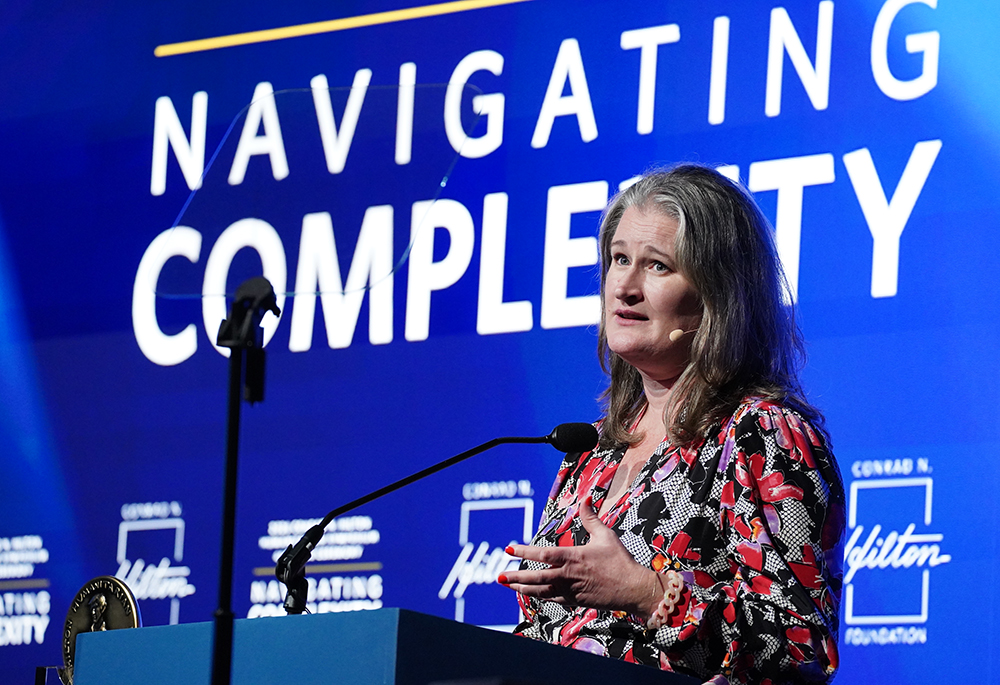
Lisha McCormick, the CEO of Last Mile Health, delivers acceptance remarks during the Oct. 6, 2026, ceremony at the Beverly Hilton that awarded her group the 2026 Conrad N. Hilton Humanitarian Prize. (AP Content Services for Conrad N. Hilton Foundation/Jordan Strauss)

An annual humanitarian prize ceremony this week recognized a group tackling what its CEO calls an enduring global problem.
"Illness is universal," said Lisha McCormick of Last Mile Health. "Access to healthcare is not."
In honoring Last Mile Health with the 2026 Conrad N. Hilton Humanitarian Prize, the Conrad N. Hilton Foundation affirmed the importance of community-based healthcare as a model for improving medical access in ignored "last-mile" communities.
Last Mile Health, formed in 2007 and based in Accra, Ghana, supports more than 20,000 community-level healthcare workers in four African nations: Ethiopia, Liberia, Malawi and Sierra Leone. It is working alongside government bodies in those countries to provide primary care, particularly in remote rural areas where access to basic healthcare is often spotty.
Hilton will provide the group with $3 million in unrestricted funding that McCormick told GSR will be used to expand programs and support community health workers in the countries where it works.
In acceptance remarks during a Tuesday, Oct. 6, ceremony at the Beverly Hilton, McCormick recalled visiting a group of a dozen mothers in a remote rural community in Liberia's Gboe district a decade ago. She asked the women how many of them had lost a child.
"Every single woman raised her hand," she recalled.
Mothers in Gboe, McCormick said, "are on the front lines of one of the most pressing humanitarian crises of our time: lack of access to healthcare."
Despite what McCormick said have been decades of research and medical advances, more than half of the world's population still lacks access to basic healthcare. McCormick called the result devastating, with nearly 9 million people dying of preventable causes every year, the majority being women and children under 5.
"What I find hardest to reconcile is how truly preventable these diseases are," she said in her remarks. "Three of the biggest drivers of child mortality are malaria, diarrhea and pneumonia — diseases we've known how to treat for over a century."
Her organization's governing philosophy is that the solution to this crisis is not a top-down approach from outside. Rather, she said, it must come within the communities themselves, with "neighbors serving neighbors as community health workers" and making "primary healthcare universal by training local people and professionalizing them as community health workers to deliver lifesaving care, door-to-door, in the hardest-to-reach places."
The progress has been startling.
Starting with 32 community health workers serving 15,000 people in rural Liberia, the group is now, a decade later, supporting more than 20,000 health workers serving 32 million people.
Such success was among the reasons that the Conrad N. Hilton Foundation (a major funder of Global Sisters Report) awarded the annual prize to Last Mile Health, said Peter Laugharn, the president and CEO of the Conrad N. Hilton Foundation.
In the initial announcement of this year's prize, Laughran said the group's work embodies founder Conrad N. Hilton's enduring belief "that improving the human condition is our shared responsibility."
'Good begets good'
Maggie Miller, who heads the Hilton Humanitarian Prize program, said in her introduction to McCormick that "good begets good," and praised Last Mile Health for seeing "a persistent problem that was causing suffering — a lack of access to healthcare — and developed a process to address it, one person, one community and ultimately one system at a time."
Sr. Joyce Meyer, a member of the Presentation of the Blessed Virgin Mary and a Hilton Foundation board member, is the international sister liaison for Global Sisters Report. She was one of eight prize judges this year.
She said Last Mile Health was chosen because of the group's "firm conviction that geography should not determine who receives healthcare" and its belief "that community members, when given tools, can keep communities strong by meeting its basic health needs."
Also important, Meyer said, is the group's practical commitment to working with governments, which she called "essential to sustainability of a country's health."
Advertisement
The group's model of training and paying community health workers, she noted, is now being taken up by at least 50 governments globally.
McCormick, who began her work with Last Mile Health as a community health worker herself, said she recently returned to the Gboe district and spoke to the same mothers she had met a decade ago.
"Instead of coming together in mourning, we came together in celebration," she said during the Oct. 6 ceremony. Since the Liberian national program was launched, the local community health worker working in the Gboe district "shared that she is tracking zero child deaths in the community."
Still, she said it is important to note that continued challenges remain, with child and maternal mortality rates still at unacceptably high levels globally and that the recent withdrawal of foreign aid assistance, especially by the United States, is threatening gains that had been made in the last decade.
"There's work to be done," she told GSR.
Aside from the prize ceremony, the Oct. 6 event featured a humanitarian symposium focused on the theme of "Navigating Complexity," with Laugharn noting that, despite challenges like the cutbacks in foreign assistance, "this is actually the time to be doing humanitarian work."
That theme was taken up by Dr. Raj Panjabi, a physician, co-founder of Last Mile Health and the author of Safer: A Playbook — Turning Fear into Action and Crisis into Community, a new book focusing on approaches to crises. He said it is "important to keep on fighting the moral fight" for better access to healthcare globally.
He also praised community health workers worldwide and lamented that their work is generally not given the recognition it deserves.
McCormick struck the same theme in her acceptance remarks.
"Community health workers are humanitarian heroes," she said. "When supported as professionals — with skills, supplies, supervision and salaries — they can make a transformational impact."