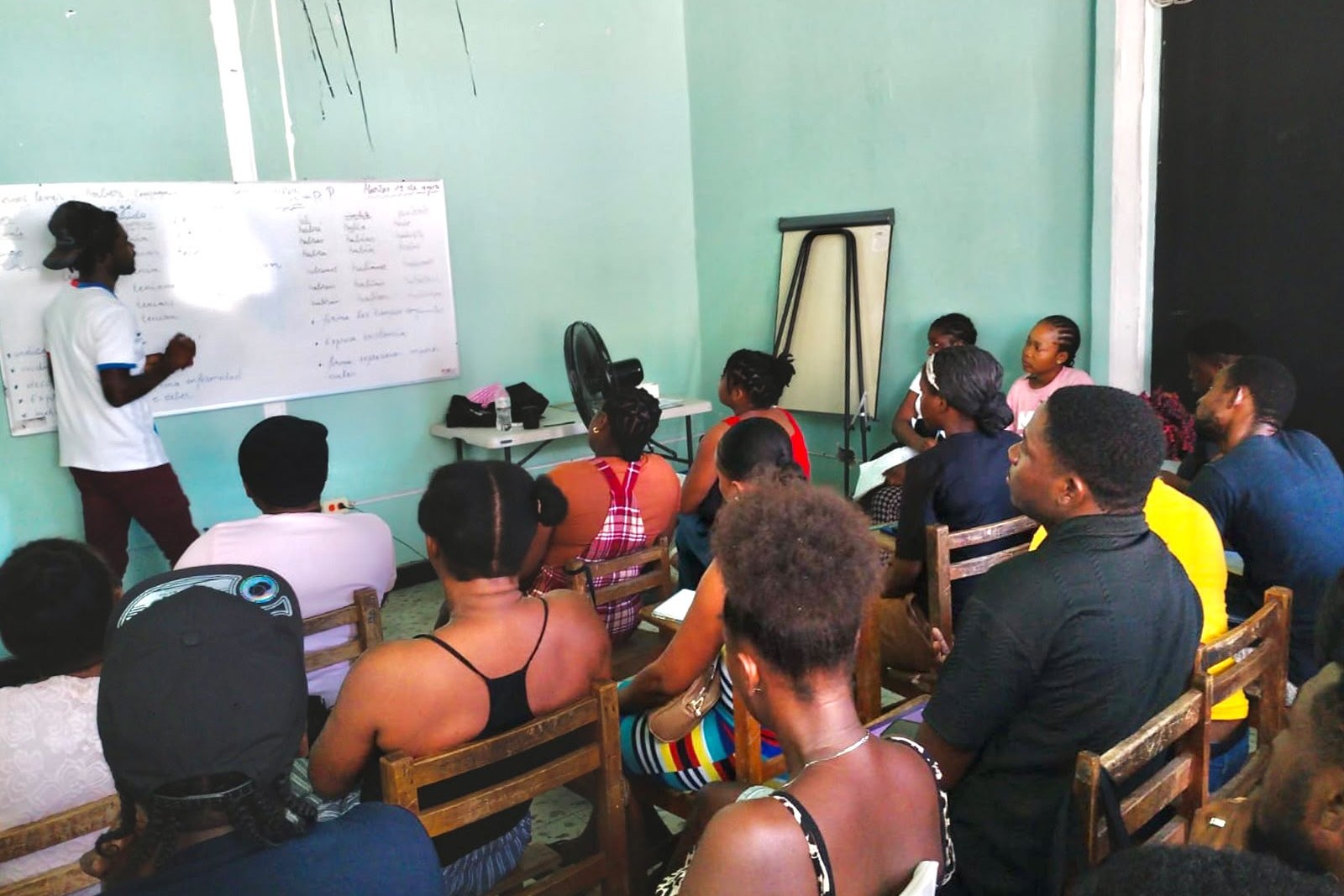
A volunteer teacher leads a Spanish class at the Intercultural Space for Basic Spanish in Tapachula, Mexico. (Courtesy of the Intercultural Space for Basic Spanish)

Ángel Adrián Huerta García
It is still dawn in Tapachula, Mexico. A few blocks from downtown, the doors of a house remain open. Those who arrive don't need to knock: They walk in, say hello, and find a place to sit. The house stopped functioning as a conventional home long ago. The rooms have been transformed into classrooms, and the kitchen into a gathering place where there's always water, coffee and something to share. Cookies, bread and other food items brought in each morning by students and volunteers pile up on a table.
Fans spin tirelessly as the rooms fill with conversations in Haitian Creole, French and Spanish. There are no bureaucratic records or reserved spaces. The walls are covered with messages, drawings and thank-you notes left by those who have passed through here. More than just a school, the house has become a gathering place for the Haitian community in Tapachula, Mexico. When GSR visited in April the groups were smaller than usual: In the days leading up to this, hundreds of people had left the city to join a new caravan heading north.
Sr. Ana Barboza is a member of the Apostles of the Heart of Jesus and has spent 42 years in consecrated life. She arrived in Tapachula 3 1/2 years ago. As part of her congregation's mission, she began touring the city to identify the population's most urgent needs. "The main goal of our congregation is to be attentive to the times and places where needs are most pressing, guided by our own charism, which is the most ardent love for Jesus and the highest regard for human dignity," she said.
It was during those walks through the neighborhoods that she encountered a situation that kept recurring: the difficulty in communicating with Haitians who did not speak Spanish. "Not being able to communicate with the non-Spanish-speaking migrant population was the catalyst that sparked this project," she said.
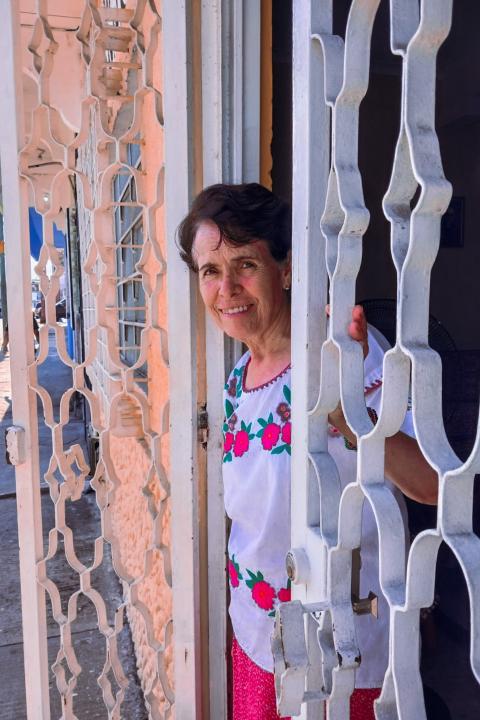
Sr. Ana Barboza of the Apostolic Sisters of the Heart of Jesus (Courtesy of the Intercultural Space for Basic Spanish)
Becoming their home
Founded by the Apostolic Sisters of the Heart of Jesus, the center offers Spanish language instruction and serves as a space for migrants — mostly Haitians — to meet, receive guidance and find support. According to Barboza, since its inception, the project has enjoyed the support of individuals, organizations and communities that have accompanied its growth. In the early months, the Jesuit Refugee Service provided basic furniture and the facilities where classes began. Over time, the support network expanded.
Currently, a local, Yamel Atie, and his family provide the home where the Intercultural Space for Basic Spanish operates. Barboza, who leads the Intercultural Space for Basic Spanish, lives there as well. The sister also highlighted the recent support of Msgr. Luis Manuel López Alfaro, bishop of the Diocese of Tapachula, whose assistance has helped provide food pantries for those participating in the project.
Over the years, Barboza discovered that the Spanish classes ended up becoming something more than just an educational space.
"This space became their home, where the family comes together," she said. People come to learn the language, but also to share information, seek guidance, or simply meet others going through similar experiences.
She observes these dynamics every day, in how students help one another understand documents, find housing, or identify job opportunities. She also witnesses simpler moments: a conversation over coffee, someone sharing bread with the rest of the group, or a person returning to share the news that they've found a job. "They give me so much hope and inspire me to keep taking action," she said.
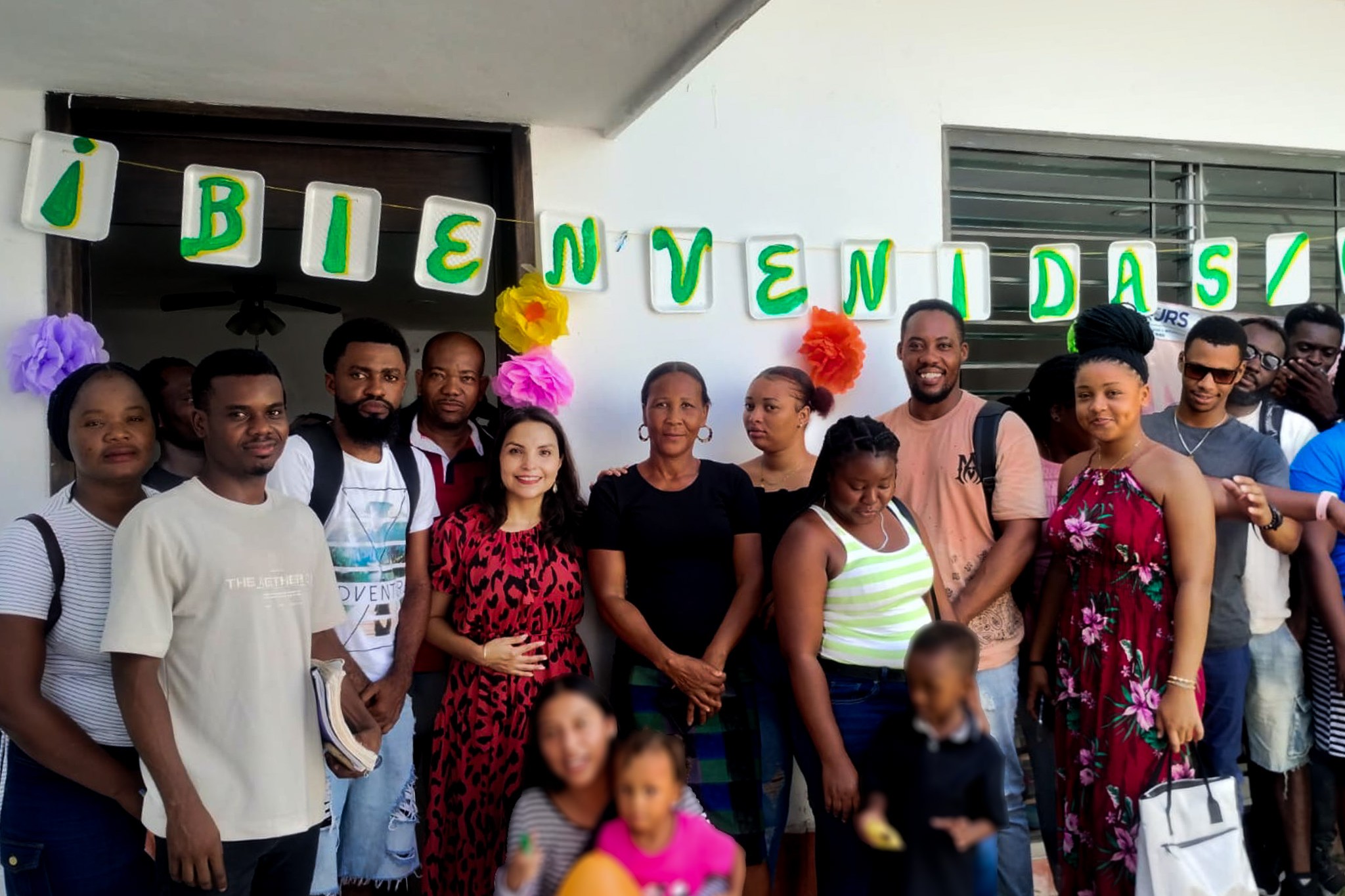
Teachers and students pose at the Intercultural Space for Basic Spanish in Tapachula, Mexico, where Haitian volunteers and teachers provide Spanish classes to migrants. (Courtesy of the Intercultural Space for Basic Spanish, some faces blurred to protect identities)
When speaking about the Haitian population, Barboza emphasized the importance of looking beyond prejudices. "If you meet someone from Haiti in your life, [I hope you'll] welcome them from the heart, not out of prejudice," she said. For her, that willingness to welcome others is part of the profound meaning of her vocation: "They restore my faith; they show me that another, more humane world is possible — a world built on brotherhood."
Among the first people to arrive at the Intercultural Space for Basic Spanish were Mildhed, accompanied by her children Adassa and Junior. The next day, they returned with others interested in learning Spanish. "It was through them that the program began to grow," says Barboza. Within a few weeks, the classes outgrew that first classroom. Three years later, the nun remains in touch with them — a connection that reminds her of the school's early days and of those who helped get it off the ground.
Much of the furniture at the Intercultural Space for Basic Spanish has come from donations. The chairs, fans, cabinets and tables previously belonged to other organizations or individuals who decided to leave them there. Barboza knows the story behind many of these items. "Who sent us that chair? Who sent us that cabinet? Because right now they may be for us, but soon they could be for another humanitarian organization," she said as she pointed to some of the furniture scattered throughout the classrooms.
Advertisement
A network of lay volunteers, teachers and nuns
The project operates thanks to a network of people who support its day-to-day activities. Currently participating are the nuns Ana Barboza and Verónica Hernández Alegría, three local volunteers — including Eric, originally from Guatemala — and 12 Haitian teachers. Most initially arrived as students and, over time, began assisting in the classrooms.
One of the teachers is Emmanuel Israel, who worked as a teacher in Haiti and, after being forced to leave his country, arrived in Tapachula, where he now teaches Spanish to other migrants. His classes focus on everyday situations: reading an official notice, applying for a job, renting a room, or understanding a document. "Knowing the language isn't just a right — it's a tool for self-defense," he said. His story reflects a dynamic that Barboza often highlights: those who went through the adaptation process first tend to become the best guides for those who arrive later.
Tapachula has become a waiting area for thousands of migrants. Miguel Hernández, head of the Tapachula Unit in Chiapas for the Coalition for Humane Immigrant Rights (CHIRLA), said that many describe it as a "prison city" because of the immigration checkpoints set up on the highways that make it difficult to leave the region. Josué Gómez, of the Fray Matías de Córdova Human Rights Center, said that proceedings before the Mexican Commission for Refugee Assistance can drag on for months and even more than a year, in offices where there are no official translators for Haitian Creole or French.
Inside Barboza's home, these difficulties arise every day in the form of specific questions: how to read a document, how to answer an interview, or how to ask for help at a government office. Daily life there is one of the things that surprises her most. After more than three years of classes, she says she doesn't recall ever witnessing a dispute inside the school.
During breaks, some students stay behind to chat in the courtyard while drinking coffee or water. Others take the opportunity to ask for directions, review a document, or exchange information about administrative procedures, jobs and places to rent a room. The lessons extend beyond the notebooks and the blackboard. These interactions remind Barboza of her first days at school and the journey taken by those who have passed through it.
As the sister wrapped up the conversation, a few people begin to arrive for the next class. A woman sets a bag of bread on the kitchen table, and the aroma of freshly brewed coffee mingles with the voices drifting from the classrooms. Outside, the heat hangs heavy over the streets of Tapachula. Inside, the house fills once again with people, conversations and new lessons.
This story was originally published in GSR en español July 13, 2026.