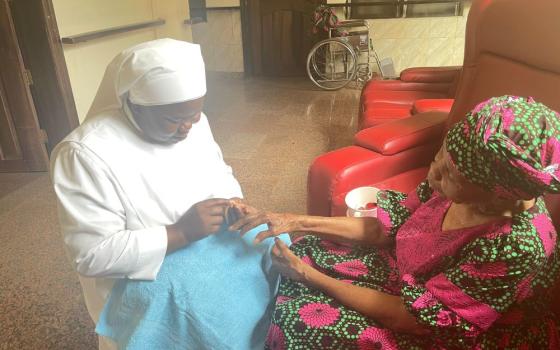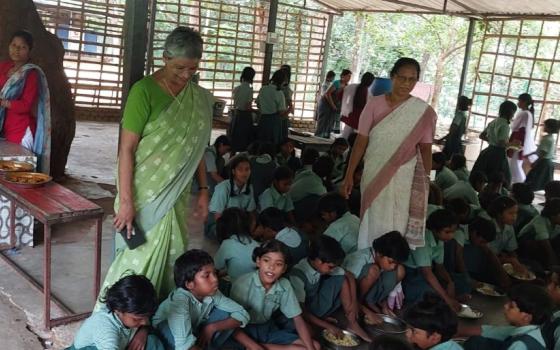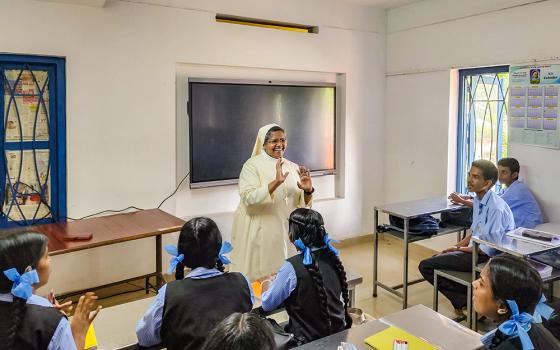
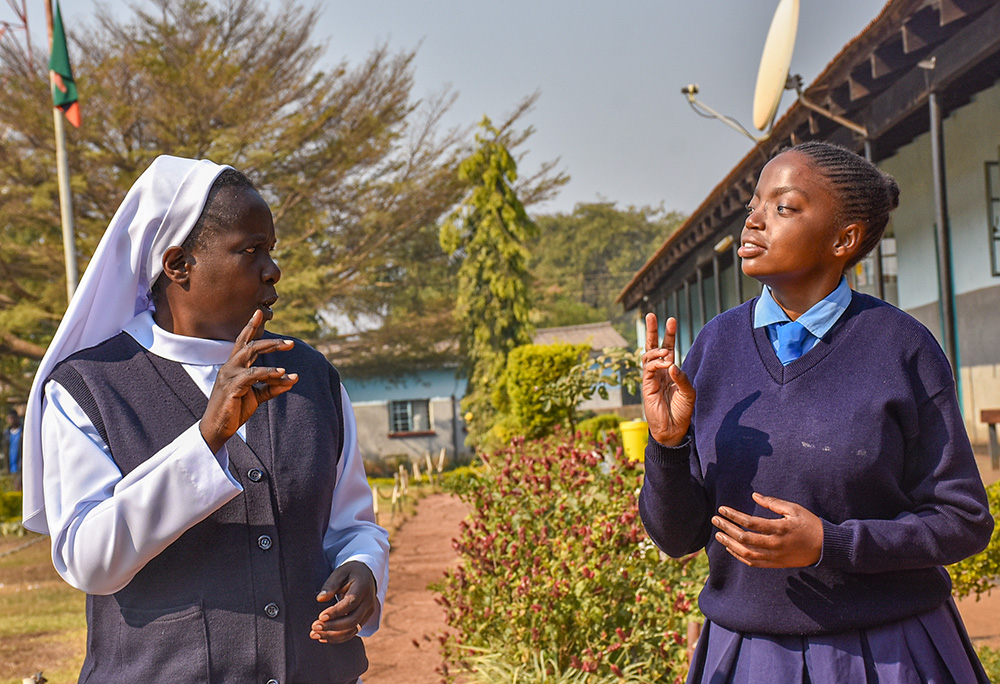
Baptistine Sr. Charity Kaloto engages with Kabwe Mukuka, a Grade 11 student at St. Joseph School for the Deaf in Lufwanyama, Zambia. (Derrick Silimina)
by Derrick Silimina
Deep in the emerald-rich Lufwanyama district, Claude Kayonga is mining a different kind of wealth: translating complex math into fluent sign language for deaf students at St. Joseph's School for the Deaf.
"When I first stepped into St. Joseph's, I wondered if I could make it. Today, as a math teacher, I spend every day reminding my students that they can," Kayonga told Global Sisters Report. "I've learned that silence is never a barrier; it's simply the quiet space where ambition begins."
Growing up deaf in nearby Kitwe, Kayonga constantly met closed doors, navigating a community that assigned low expectations to children like him.
Starting his schooling in Grade 3 at St. Joseph's School for the Deaf in 2002, he later studied mathematics at Kitwe College of Education. He now teaches at St. Joseph's School and aspires to pursue a degree at Kwame Nkrumah University.
"The Baptistine Sisters always pushed us to study hard and chase our dreams when my parents first brought me here," he said. "Today, I'm doing just that: living my dream by teaching and mentoring children with hearing impairments."
The school serves 120-130 students annually from nursery to Grade 12, building a strong reputation for practical skills, particularly in agriculture. Backed by the Rotary Club of Kitwe and the government's Constituency Development Fund, St. Joseph's School has actively worked toward becoming a dedicated center of excellence for special education in the southern African region.
"Growing up, I thought being deaf would limit my potential. Today, I know my dreams don't need sound to be heard," said Kabwe Mukuka, a Grade 11 student at St. Joseph's School. "Being here gave me the key, and Grade 11 is only the beginning."
Mukuka, a 17-year-old from Chingola, feels the school has redefined her trajectory by sharpening her academic focus, building her character and widening her perspective on life.
She noted that whether born deaf or having lost their hearing to childhood illness and trauma such as meningitis, students find both a supportive home and an education tailored to their needs.
"I arrived here confused and felt isolated after losing my hearing to childhood illnesses." Mukuka said. "But from my early age at this school gave me a safe place to grow, learn and realize that I am not alone."
A 2015 UNICEF study estimated that 4.4% of Zambian children live with disabilities — about 440,000 when applied to 2022 Zambia census figures. However, according to the Zambian Ministry of Education, fewer than 150,000 children with special education needs were in school in 2025. In rural communities, deaf learners are among the hardest hit, routinely excluded from education by distance, poverty and stigma.
Advertisement
Founded in 1972 as a joint initiative between the Sisters of St. John the Baptist (the Baptistine Sisters) and the Zambian government, the grant-aided school was established to meet the urgent needs of the Copperbelt's expanding population of deaf children.
During an era when children born with physical or hearing impairments were routinely drowned or abandoned due to local superstitions, the sisters, working with the Franciscan Fathers in Lufwanyama, began taking in these discarded children alongside orphans, offering them protection and care.
"Our work here covers a well-rounded education to deaf and hard-of-hearing children following the standard government curriculum, while also integrating them into the Catholic faith by offering religious instruction and sacraments directly in sign language," said St. Joseph School headteacher Sr. Charity Kaloto.
Kaloto, a member of the Baptistine Sisters, highlighted that the learning center sets itself apart by nurturing the natural talents of deaf students, who often excel in practical subjects such as home economics, agricultural science and computer studies.
"Our students actively engage in extracurricular activities such as the Junior Engineers, Technicians, and Scientists (JETS) and agriculture. We are proud to be the 2025 National Champions in Agricultural Production spanning grains, livestock and citrus cultivation after securing top honors at both the district and provincial levels," Kaloto said.
She said that even with the government's Constituency Development Fund covering tuition for needy students, the school is still struggling without adequate transport.
Kaloto emphasized that despite logistical hurdles, the organization remains dedicated to reaching rural communities. Through its "child find" initiative, religious sisters travel to remote areas like Lufwanyama and beyond to identify deaf children and connect them with an education.
"Many parents keep their children hidden at home due to stigma rather than sending them to school," she said. "As a result, our enrollment remains below our target capacity of 15 students per class each academic year. We urgently need to reach these families so more children can receive an education."
Aligned with the Baptistines' charism of bringing the Gospel to all vulnerable individuals, Kaloto explained that they treat children with special needs just like any other child, surrounding them with love to help them reach their full potential.
For science teacher Kaloto, her 19 years at St. Joseph's School is grounded in the inspiration she draws from Jesus Christ. She added that what keeps her passionate is the rapid progress of her students.
"When I started here in 2007, we have progressed in many areas and I am constantly humbled by the transformation of our students, who often arrive feeling lost and helpless but gain confidence and respond to sign language just days later," she said. "And when I begin my day with Mass and prayers, that gives me renewed strength every day."