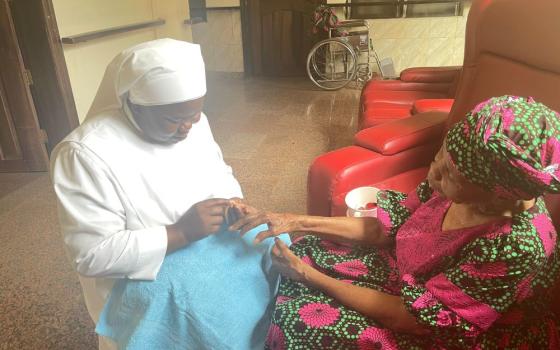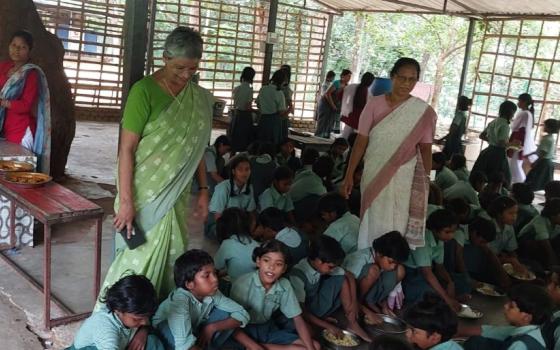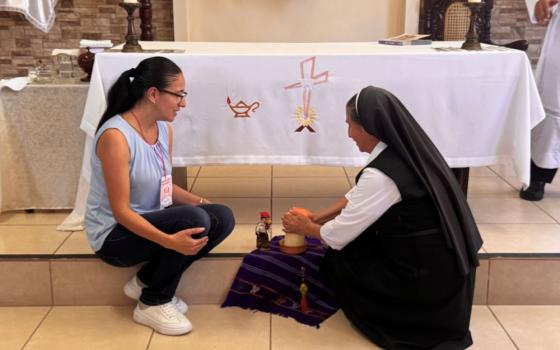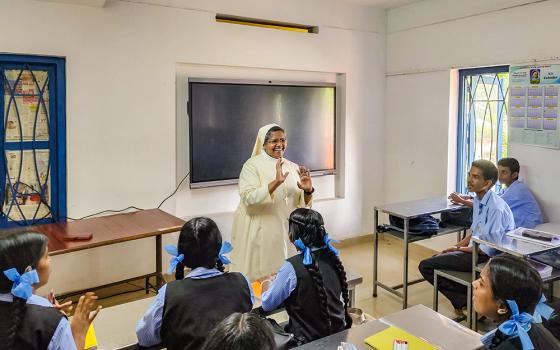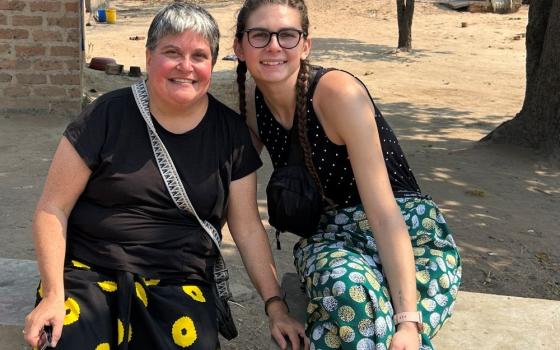
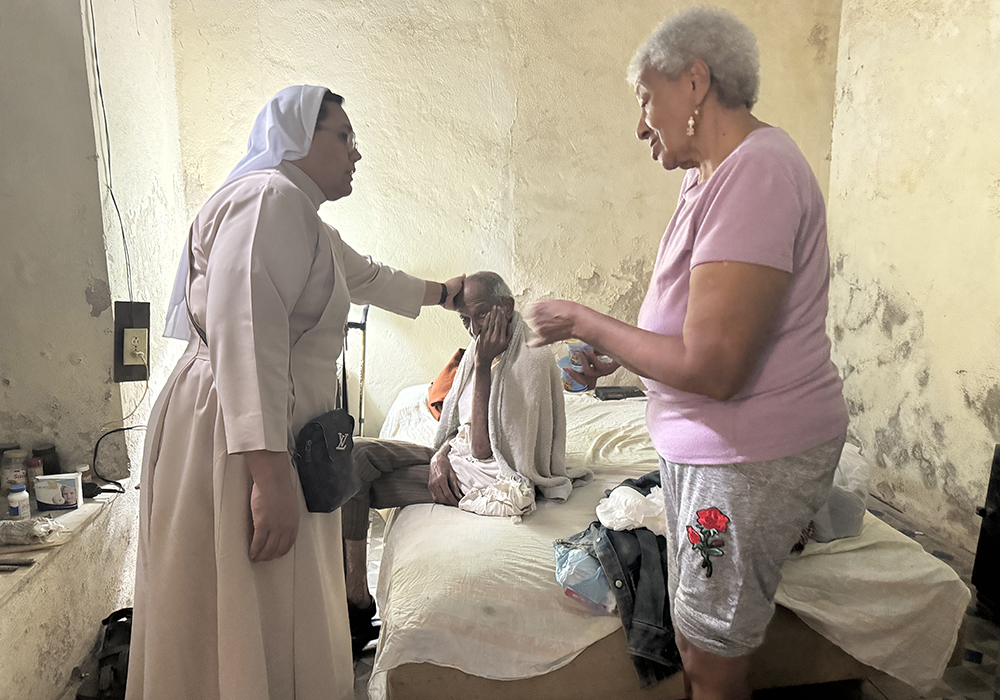
Carmelite Missionary of St. Joseph Sr. Noemy Ayala visits a family Nov. 12, 2025, in Havana. Though the sisters' mission focuses on children, the community also visits the elderly and used to be able to take meals to them, something that has become more difficult to do now because of food shortages and high inflation on the island. (GSR photo/Rhina Guidos)
by Rhina Guidos
Carmelite Missionary of St. Joseph Sr. Noemy Ayala admits that it's not always easy to be a missionary in Cuba. When her religious order arrived from El Salvador to Havana in 2016, she didn't imagine those would be the better days.
"Once a week, or more when we could, we'd visit the sick, the elderly, take them some food, whatever we had," she recalled. "Then, as time went by, we didn't have anything to take them and sometimes it was just a piece of candy. And then we didn't even have that and a sister asked me, 'What do we take them?' I told her 'Your presence and the presence of God, which is what's most important.' And that's how Sister went to her visit, with empty hands."
The island's severe food shortage this year, along with daily blackouts that make it difficult to preserve food, led Alena Douhan, special rapporteur of the United Nations Human Rights Council, to call on the United States in November to lift sanctions against Cuba, saying those conditions, along with soaring inflation, makes it difficult, particularly for the island's poor, to get proper nutrition.
A 2024 report by the Cuban Observatory of Human Rights estimates that 89% of the island's population lives in extreme poverty.
In addition to food, about 69% of the medicine needed in Cuba is inaccessible Douhan said in her report, leading to a growing mortality rate. If the shortages weren't enough, Cuba also finds itself grappling with outbreaks of mosquito-transmitted diseases like dengue and chikungunya, which have led to 33 documented deaths and tens of thousands of infections this season, the country's deputy minister of health said Dec. 1.
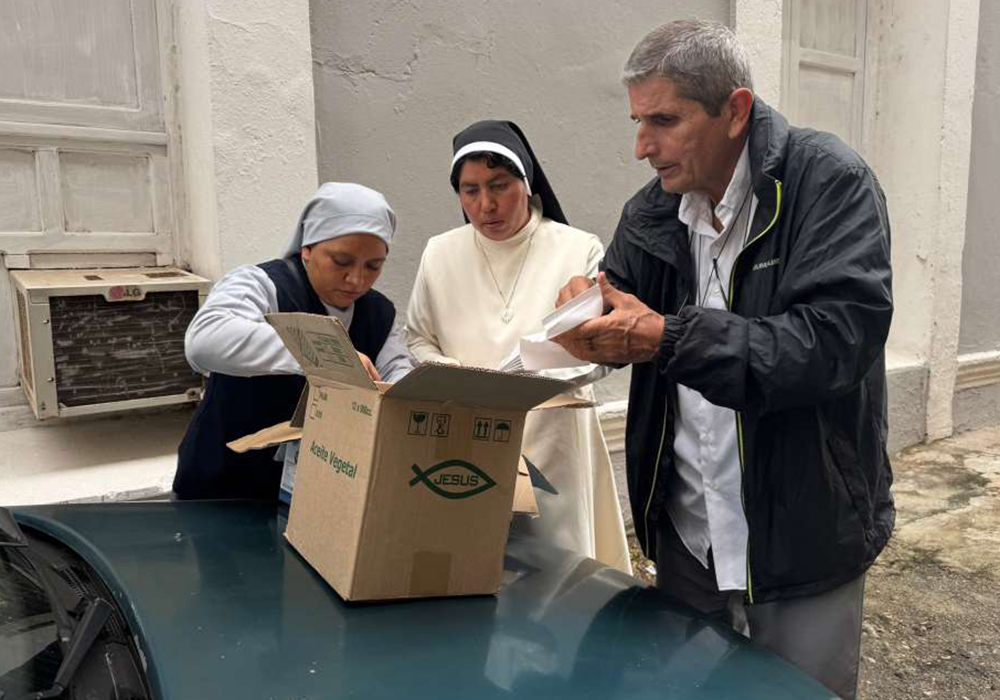
Sr. Glendes Romero Miguel, left, of the Congregation of Martha and Mary, Mercedarian Sr. María Luz Ramírez, and Auxiliary Bishop Marcos Pirán of the Diocese of Holguín, gently wrap eggs in tissue paper Nov. 14, 2025, in Ciego de Ávila, Cuba. The missionary sisters bought eggs before getting to the eastern part of the island, where damage from Hurricane Melissa in late October wiped out crops and sent food prices skyrocketing. (GSR photo/Rhina Guidos)
Those are the realities sisters like Ayala and her companion, Sr. Alicia Alvarado, face daily, and they worry about what's to come this Christmas season following large-scale crop damage from Hurricane Melissa, which tore through eastern Cuba in late October, destroying much of what little food is grown on the island.
Though a large part of the sisters' ministry focuses on caring for children in prekindergarten, they can't ignore the island's growing elderly population, concentrated in the capital city of Havana, where they serve. On their way home Nov. 12, a woman approached them for medicine and food but they had none to give.
"You wish you could help every person who crosses your path," said Alvarado. "But sometimes all we have are words and spirituality, because economically and materially, we're at a loss and sometimes you feel impotent, not being able to help."
But the sisters' presence and will to remain on the island, even though the majority aren't from there, has meant a lot to Cubans, said Auxiliary Bishop Marcos Pirán of the Diocese of Holguín, on the eastern part of the island. Women religious in particular have made great inroads, including among those without religious beliefs because they are known for caring for aging Cubans and listening to their daily struggles.
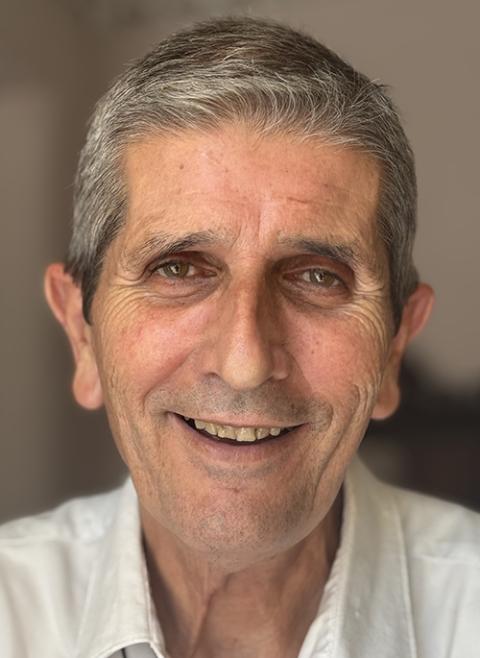
Auxiliary Bishop Marcos Pirán of the Diocese of Holguín, pictured a Nov. 17, 2025 photo in Holguín, Cuba (GSR photo/Rhina Guidos)
Pirán, head of the Cuban bishops' committee on religious life, said their choice to carry out lives of service in the scarcity that exists there hasn't gone unnoticed, and they've brought with them a wealth of a different sort.
"It's incredible. You can come into contact with people from five different continents … a great treasure," in such a small place, he said. "I would never have come into contact with people from India, Tanzania, various European countries and Latin America countries, in the same way I have here. And they come with great riches, with their culture, with their religious journeys and their experience of faith."
One of them is Sr. Esther Njoka, a member of the Missionary Congregation of the Evangelizing Sisters of Mary in Kenya. Njoka said she was happy to embrace the mission to go to Cuba, not just out of obedience but because she wanted to.
"It was a dream," she said.
There have been challenges, to be sure, she said, including learning a new language, but also ministering among a population not accustomed to going to church, she said.
Following the 1959 Cuban Revolution, the island-nation declared itself an atheistic state, appropriated church properties, closed Catholic schools, and expelled foreign-born women and men religious as well as priests. Catholics who remained practiced the faith in secret and could not be members of the Communist Party, which guaranteed better jobs or entrance into the country's best schools.
Though the relationship between the Catholic Church and the Cuban government improved after the first visit by a pope in 1998, the revolution's impact on religion, particularly Catholicism, has been long-lasting. Parishes struggle to attract new members and even Cubans who are baptized rarely step foot inside a church, something that seemed odd to Njoka, who was used to a vibrant parish life in her native Diocese of Kitale.
"The Christians, they are few," said Njoka. "They have faith but they don't go to church."
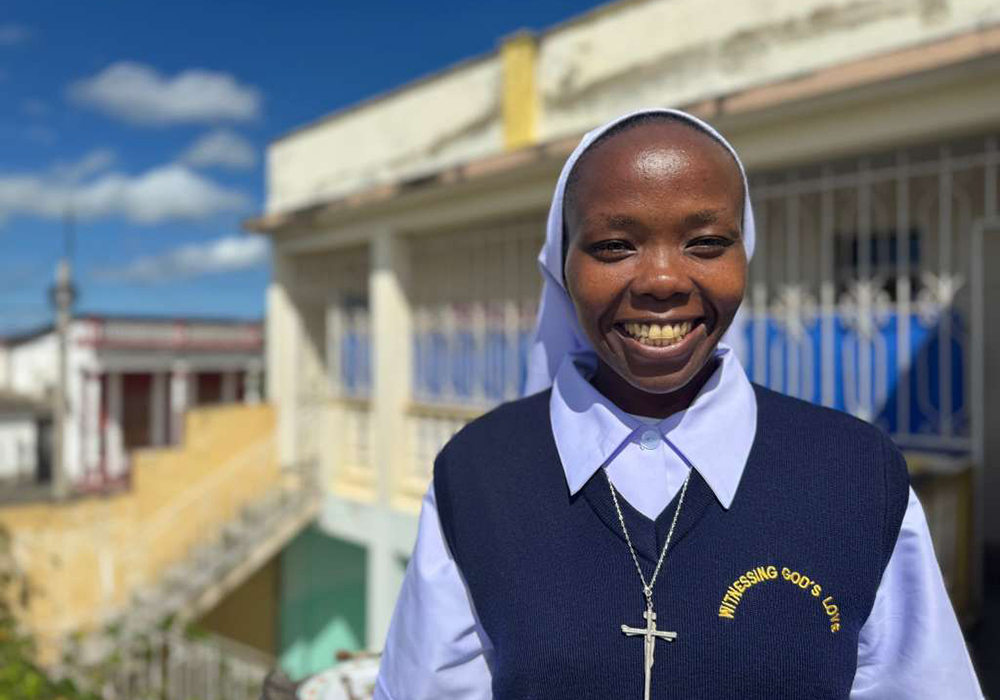
Sr. Esther Njoka, a member of the Missionary Congregation of the Evangelizing Sisters of Mary in Kenya, talks about her mission Nov. 15, 2025, in Puerto Padre, Cuba. Njoka said that serving a mission is a dream, even with some of the challenges that arise. (GSR photo/Rhina Guidos)
Instead, syncretism, a mix of Catholicism with African spiritual beliefs, has proliferated on the island, and nowhere is it more visible than at the Shrine of Our Lady of Charity of El Cobre, near Santiago de Cuba. While Catholics go to El Cobre to venerate the Virgin Mary as Our Lady of Charity, others who believe her to be a goddess named Oshun also flock to the shrine.
"Always it is full," Njoka said.
Cuban dioceses count on missionaries like Njoka to mingle among the population and their beliefs and then help with the church's catechetical work as well as tend to smaller rural communities hard to reach. With fuel shortages, many sisters board crowded buses, walk long distances, or sometimes take a horse and buggy to get from one town to the next. One sister remembers having to climb on a truck carrying a fuel pipe because it was the only way to get home.
"We understand and accept that it is a complex reality, with a set of shortcomings and difficulties," said Pirán, who is originally from Argentina. "When we write to superiors general asking that when they send [missionaries], it is not simply out of obedience, but that they send people who have a certain stability or maturity and have a desire to come to Cuba."
Even with its complexities, Mercedarian Sr. María Luz Ramírez, was happy to be making her way back to Cuba Nov. 14, a place she left four years ago after being called back to her native Mexico.
"I know people are waiting for me with open arms and I want to see the fruits of the seeds of faith sown four years ago," she said.
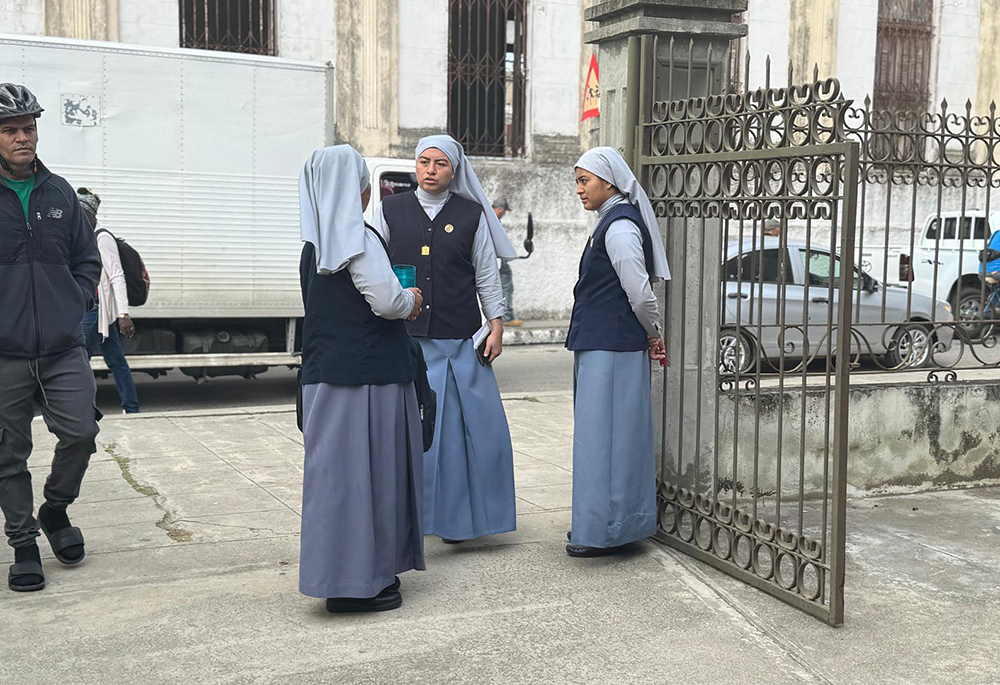
Three missionary sisters from Congregation of Martha and Mary have a conversation Nov. 14, 2025, as people file in to collect potable water from a church in Santa Clara, Cuba. Like the sisters who hail from Guatemala, most members of consecrated life on the island are from outside Cuba, said Auxiliary Bishop Marcos Pirán of the Diocese of Holguín, the head of the Cuban bishops' committee on religious life. (GSR photo/Rhina Guidos)
Already preparing for scarcity, she stopped to buy eggs on the road from Havana to Holguín, knowing the price of food would be much higher where she was going because of hurricane damage. But her love of the Cuban communities surpasses any material worries, she said.
"I return, full of joy, knowing that I'm helping to build God's love, returning to the countryside, to the fields, knowing that a community is waiting for me," she said. "I know many of them are thirsty for the word of God, and I'm happy to see them grow in faith each day."
But this may be a particularly hard season, particularly because the hurricane took what little people had, said Sr. Verónica Méndez Argueta, of Guatemala's Congregation of Martha and Mary, serving in Santa Clara.
Advertisement
"We were just saying that this might be a difficult Christmas throughout the country … and now we have all these people sick with the virus, a lot of people in bed and no medicine to give them," she said.
Some don't even have beds to return to.
Cuba barely finishes dealing with one difficult situation and another begins, said Méndez, but even with its difficulties, it's a place that teaches you to focus on the essential.
"Sometimes you don't need to help people materially. Sometimes they just need you to give them words of hope," Méndez said. "Sometimes you run into people who just want to tell you what they feel, what they're experiencing. … Sometimes the best you can do is to listen … so I carry out my mission with joy, with love and help wherever I can."