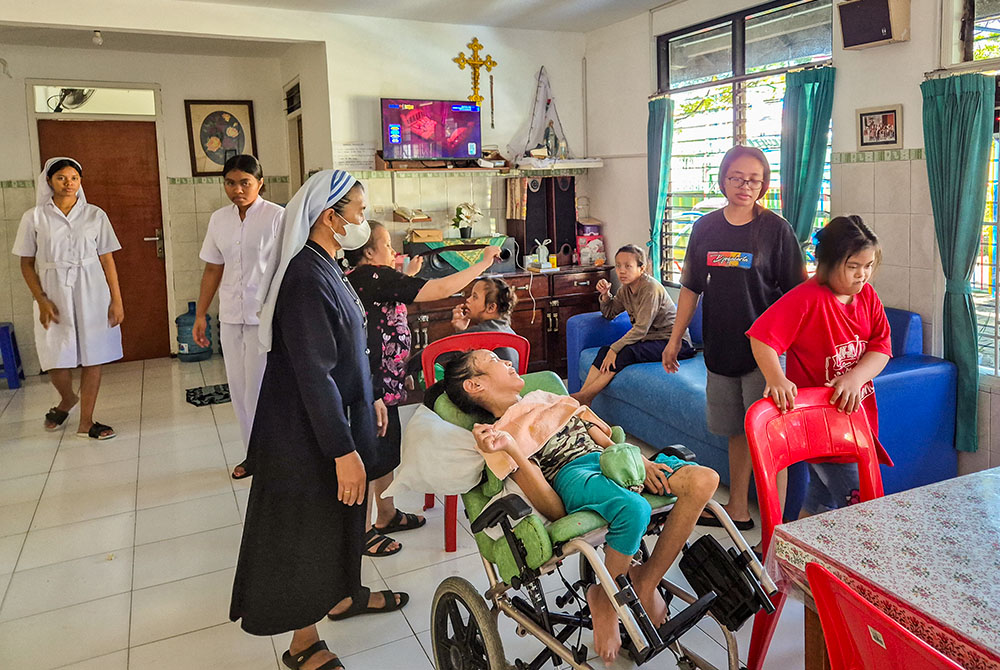
Sr. Catharina Ginah cares for children and adolescents with disabilities at Bhakti Luhur, a care home overseen by the sisters of the Association of Lay Missionary Institutions, while her lay partner assists in the background. (Jacobus Lato)
by Jacobus E. Lato
Fatigue and sorrow were palpable on the faces of Srs. Macaria Theresia Laiyan and Margareta Niga Bili when Global Sisters Report visited them on June 11, as they searched for Aldo, 18, who had been missing for nearly two weeks.
Aldo, whose full name is Vinsensius Rivaldo Rambi Putra, was last seen on a security camera walking away from the sisters' care home in Malang, East Java province, Indonesia, on the afternoon of May 30.
During the search for Aldo, GSR visited the care home and met with the sisters. After weeks of searching, the Catholic sisters who raised the teenager received a call from the police on June 15, saying he had been found in a nearby town.
The missing teenager, known to all as Aldo, is among some 300 children with disabilities who are cared for by the consecrated sisters and brothers of the Association of Lay Missionary Institutions, known as ALMA.
The sisters work alongside religious brothers and oversee a complex network of 32 boarding houses, collectively called Bhakti Luhur, spread over 2.5 hectares, where children of different ages, needs and abilities are cared for.
"We are deeply troubled by the disappearance of one of our children," said Laiyan, known as Sister Risye, 52.
"The thought of a missing child does not easily leave our minds," said Bili, 46, known as Sister Mega.
"Our emotional bonds are strong. They call us 'mother,' and the brothers 'father.' One can imagine a mother's and a father's feelings when they lose a child," Sister Mega said.
Although Sister Mega and Sister Risye are relieved that Aldo has returned home, they are still worried about raising children in a world where many seem intent on exploiting them for profit.
Some of the children at the care home were left overnight at the gate as babies, wrapped in cloth. Others were brought by parents no longer able to care for them.
"Many of our foster children have no physical, emotional, spiritual or social contact with their parents," said Sr. Theodora Monika Hera, 63, who is now leading ALMA's Indonesia Pastoral Institute in Malang, East Java, where religious and laypeople are trained to work with children with disabilities.
Advertisement
"We do not even know their father or mother. We become mothers," she added.
Hera told GSR that ALMA's Indonesia Pastoral Institute is the first Indonesian college to train laypeople specifically for ministry in underserved communities.
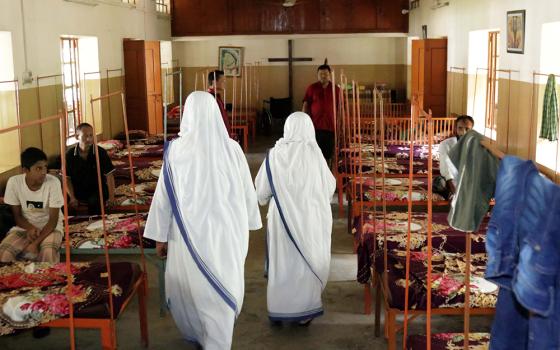
Life inside Bhakti Luhur, known locally as wisma (house), follows a gentle rhythm. Sisters sleep in bunk beds above the children — partly so they can hear if a child needs help at night, and partly to reduce the risk of falls. There are no partitions or private rooms.
Meals are shared at a common table, though the menu and timing vary to accommodate residents' nutritional needs and mobility limitations.
"Children with cerebral palsy or those living near-vegetative lives are fed an hour earlier than regular mealtimes," Sister Mega said. "Rice, vegetables and side dishes are blended to meet their nutritional needs."
Activities begin before dawn with breakfast preparation, followed by prayer and Mass. Afternoons are reserved for therapy.
Sister Risye, who has authored at least four books on children with disabilities, said the smallest milestones carry outsized meaning.
"We are overjoyed to see a child with cerebral palsy finish a meal or an autistic child eat calmly," Sister Risye told GSR.
"These are small things, but we assist them in those activities with great respect for human dignity and for God," she added.
High school students in the affiliated boarding program assist sisters with daily care, such as helping the sick bathe and eat and accompanying sick children overnight.
These arrangements, the sisters said, are designed to serve as a formation for the students as well as support for the staff. They help the students learn empathy and patience alongside practical caregiving skills.
Sr. Cicilia Suratmi told GSR that children with disabilities are often overlooked and rarely prioritized in Indonesia's public policy. She added that the care home was established in 1959 by Fr. Paulus Hendrikus Janssen of the Congregation of the Mission, who founded the care home "to serve the underserved, to reach the unreachable," she said.
Carmelite Bishop Henricus Pidyarto Gunawan of Malang told GSR that the sisters "follow Fr. Janssen's charism" and "shelter and care for many children with physical and psychological disabilities."
The work, however, takes a toll. "Sometimes I feel tired of caring for the children. All my energy is drained," Sister Mega said.
"But my calling as a sister is the driving force that keeps me going," she said.