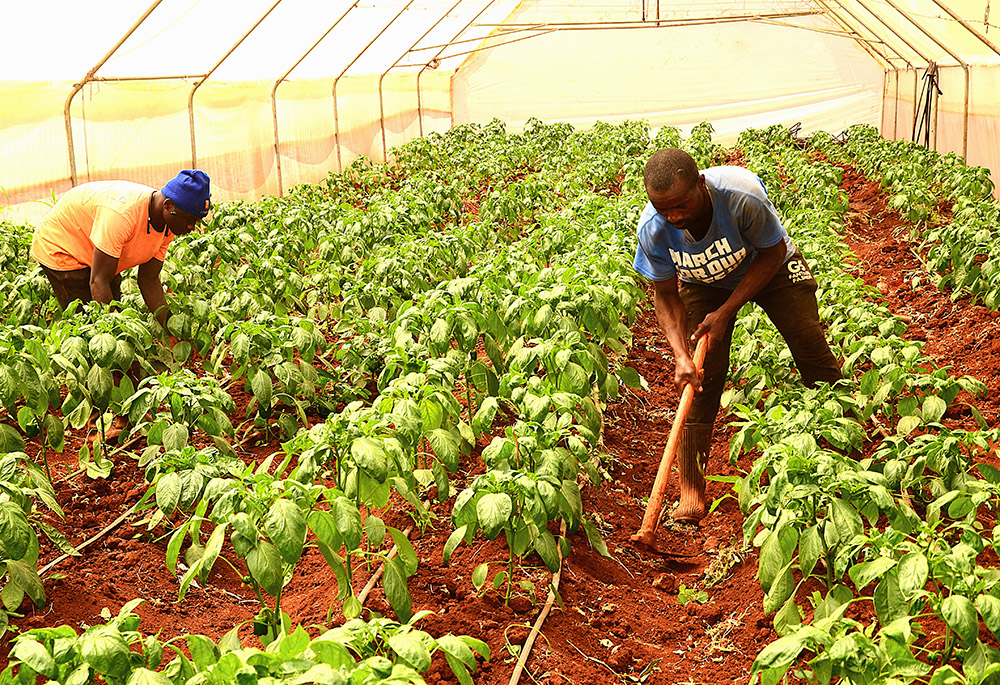
John Selemeni, left, and Stephen Ikuytwa tend to a crop of capsicum in a greenhouse managed by Sr. Christine Kagunye of the Assumption Sisters in Thika, a town on the outskirts of Nairobi. (Charles Onyango)

by Gitonga Njeru
The cold July morning is coupled with mist that carries a sharp scent of rusted iron rooftops and sewage. By dawn, long before the sun begins to rise, long queues of people begin forming outside the convent gates and spread into the parish grounds.
Men and women of all ages, some accompanied by children, wait for a bowl of porridge or tea, and a plate of rice and bean stew. During Easter or Christmas, chicken or beef is added to the menu along with rice.
Kibera is a settlement on the outskirts of Nairobi, where more than 250,000 people live in about 2.5 square kilometers. Even surviving the morning is an uphill task.
Nairobi is currently experiencing a high cost of living associated with many challenges affecting the entire country, including high taxation and rising inflation.
In major settlements like Kibera, Mathare and Mukuru, food is plentiful in the markets, but is simply unaffordable.
"Buying food in Nairobi has become a luxury," said Anne Onyango, 27, a mother of three. "Some Catholic dioceses provide free breakfast and lunch daily. It's often a relief."
Sheila Olang, a development economist in Kenya, told GSR, "The government has had poor priorities and ignored issues to do with food security. They have ended up launching policies to do with industrialization and have ignored the hunger crisis."
Olang praised the sisters for their efforts and recognized that they are filling the gaps left by the government.
"Young mothers come to our gates weeping," said Sr. Susan Wanjiru of the Assumption Sisters of Nairobi. "And many complain their children haven't eaten in days. We don't just pray with them but give them a bag of beans and porridge. Our work is to ensure she can feed her family tomorrow, and forever."
Wanjiru and other sisters have encouraged vertical sack gardening across many of Nairobi's slums. "This has helped improve hunger and is a sustainable long-term solution," she said.
Thanks to the sisters' efforts, many throughout Nairobi's slums now pack sacks filled with topsoil, manure and gravel. They then punch holes in the sides and grow kale (known as sukuma wiki in Swahili) as well as spinach and amaranth.
Advertisement
According to Juma Kondiek, a beneficiary, a single sack occupies less than a square meter but can supply an entire household with fresh vegetables.
"It is very sustainable and prevents many youths from turning to crime. It also moved many youths to sell food affordably to the communities," he said.
This initiative can be traced back to the Lea Toto Project, a community-based care model for vulnerable Nairobi families founded by Fr. Angelo D’Agostino and administered by Sr. Mary Owens. This program formally concluded two years ago when funding made it unsustainable. However, gardening by those trained under this program has continued.
Wanjiru told GSR that the Lea Toto Project influenced other programs in many informal settlements and has spread to the Mathare, Korogocho, Mukuru kwa Reuben and Katina slums.
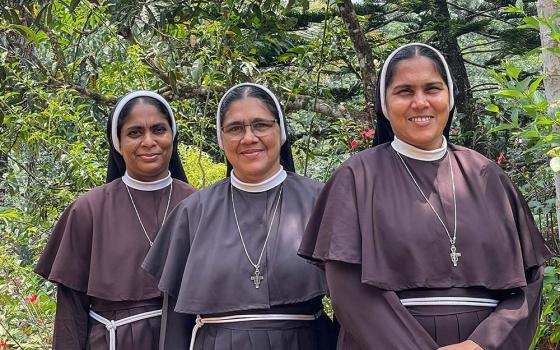
Meanwhile, in Thika, Sr. Christine Kagunye, a member of the Assumption Sisters, oversees plantations where kale, capsicum and tomatoes are grown under drip irrigation.
"We also have weekly feeding programs in some of the dioceses," she said. "This helps reduce not just hunger but brings relief for many families."
She added that the food grown is distributed in Thika and throughout Nairobi.
In the Nairobi area of Karen, an affluent suburb, the Dimesse Sisters have shifted from dairy farming to commercial greenhouse production. Sr. Eva Atieno oversees this program, where bell peppers, tomatoes, broccoli and eggplant are grown. The goal is for these initiatives to be as sustainable as possible.
Despite vocational training and farming initiatives, hunger remains unforgiving.
"Maybe someday, communities can also get bank loans to improve their businesses," Atieno said.