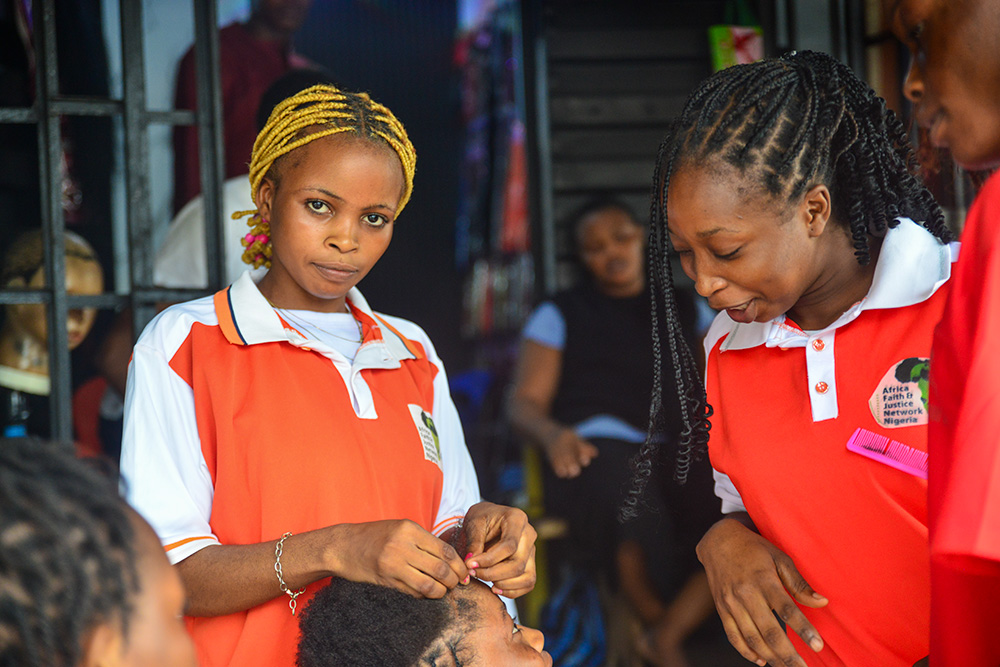
Veronica Boniface (left) says she wants to be a lawyer to help victims of child labor. (Patrick Egwu)

by Patrick Egwu
On a sweltering Thursday afternoon, Veronica Boniface sat in a plastic chair at a hair salon in Ikot Ekpene, a semi-urban town in Nigeria's southern region. About a dozen other girls were milling around, styling hair for clients in the packed salon.
In July, Boniface, 18, moved from her village where she lived with her grandma to enroll in a class that teaches young girls hairdressing at the salon.
"I want to become a boss someday," she told Global Sisters Report. "After my training, I would like to launch my own hair business and have many people working for me."
Boniface was just 8 years old when her parents died. She lived with her aunt for a few months, but then she was taken to a family in Calabar, in Southeast Nigeria, where she entered into domestic servitude. It is a common practice for children aged 5-12 years old from poor families and rural communities in Nigeria to be given away to strangers, relatives or family friends to work as domestic servants with the promise of taking care of them and providing quality education.
Boniface was not enrolled into a school but instead was given the responsibility of hawking refrigerated water at a local market. For the three years she lived with the family, she said, she endured physical abuse and harsh treatment.
Nigeria is facing a severe water crisis, so many people rely on buying clean water from local vendors. Boniface said that whenever sales were down, she would face assault from the woman she was living with.
"I still have scars from that experience," she said. "After that experience, I went back to live with my grandma in the village."
Omodot Nkereuwen, 17, lost her parents before the age of 10. She lived with a middle-aged woman who wanted a domestic servant. Her host never enrolled her into school, but instead made her a banana hawker.
Advertisement
"She told me that I won't eat in her house if I don't make any sales," Nkereuwen said. "I left there after some time because of the poor treatment I faced."
The International Labour Organization says child labor remains a significant challenge in Nigeria, particularly in the cocoa and artisanal small-scale gold mining sectors. Per a 2022 survey by the Nigerian Bureau of Statistics, 39.2% of children aged 5-17, representing about 24.67 million children, are engaged in child labor. In rural areas, 44.8% of children are used in child labor compared to 30% in urban areas.
A familiar story
Sr. Theresa Sunday Mihomi of the Missionary Daughters of the Holy Name of Jesus and Mary was about 8 months old and still breastfeeding when she was given to an aunt as a maid. At the time, her aunt was married and childless.
She said she spent the next 15 years being subjected to assault and poor treatment.
"I was beaten and branded a witch," Mihomi said. "On most days, I didn't eat the same food with her children."
Mihomi said she did not meet her mother until she was 15.
"I never slept on the bed like other children. I normally slept on the floor," she said. "I never discussed it with my mom because I never had a bond with her. I started drawing close to my mum just two years ago."
After an encounter with a visiting priest from another parish in 2016, Mihomi decided to go into the convent and become a nun.
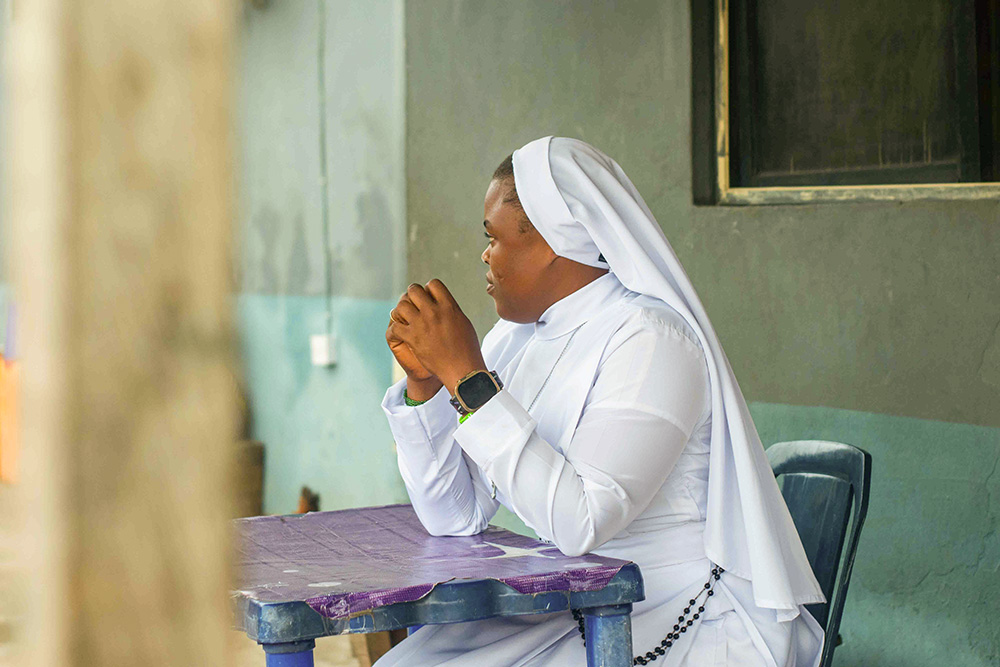
Sr. Theresa Sunday Mihomi, of the Missionary Daughters of the Holy Name of Jesus and Mary, says she doesn't want another girl to experience what she experienced as a child. (Patrick Egwu)
"I told the priest that I would like to become a reverend sister even though I have never seen a sister before then," she said. "The priest liberated me, supported my secondary school education and my dream to go into the convent."
Mihomi now works with the Africa Faith and Justice Network, a Washington-based advocacy group, in the fight against child labor and domestic servitude across Nigeria.
"I still have a scar from living there until I ran away," she said. "I made a promise that whatever I have experienced, I won't live to see another person go through it. I want to support and encourage girls to dream and be determined to succeed."
At every event or outreach, Mihomi uses her experience to "show that what is happening is really true and it comes from those we call our own."
Ray of hope
Through a network of sisters from different congregations across Nigeria, the Africa Faith and Justice Network is tackling child labor and domestic servitude, adopting a comprehensive approach of advocacy, awareness campaigns, economic empowerment and partnership with government and traditional institutions.
The network provides skill training programs and support to young girls like Boniface and Nkereuwen who have been victims of domestic servitude and child labor. The girls are trained in computer literacy, tailoring, hairdressing and sustainable farming to help them become independent and self-reliant.
"One of the problems that young people face is that if they and their families are not socially and economically empowered, they may become victims," said Sr. Eucharia Madueke, the women's empowerment coordinator at Africa Faith and Justice Network. "We are teaching them valuable life and economic skills they need, making them active in the community, and teaching them how to channel their energy positively by giving them the opportunity to play as young people."
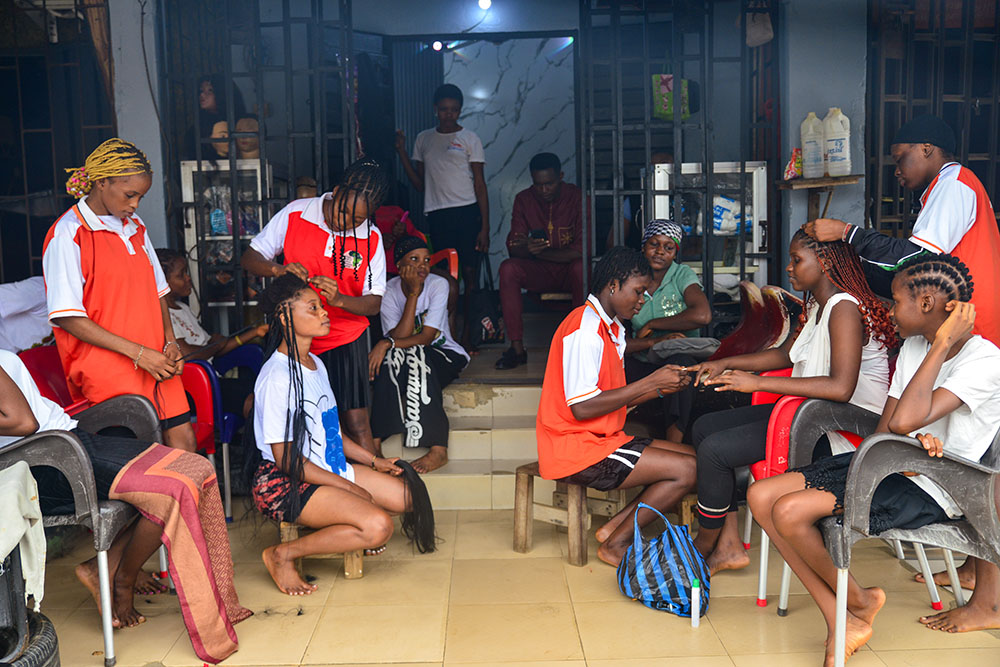
Young girls rescued by the Africa Faith and Justice Network learn hairdressing at a salon in southern Nigeria. (Patrick Egwu)
The sisters in the network travel several kilometers to remote villages across south and southeast Nigeria to educate communities and advocate for policies to protect children, especially girls who are often the victims of these practices.
"We also pick up girls between 10 to 18 years old, after signing a memorandum of understanding with their families and communities who have been victims and potential victims of child labor and domestic servitude," Madueke, of the Sisters of Notre Dame de Namur, said. Boniface and Nkereuwen were selected during one of such visits.
Madueke said after signing the agreement, they bring the girls to partnering skill training institutions to learn an apprenticeship skill of their choice. The Africa Faith and Justice Network also rents an apartment for the girls to live in Ikot Ekpene and Iziogo in Ebonyi State for the duration of the training.
"We provide the girls in rural communities the opportunity to play soccer as a means of helping them learn life skills through game," Madueke said adding that "We take these messages to the people in the rural areas who are mostly affected."
"Rural communities' outreach programs are important and that is where we are most powerful," she said.
Sr. Stella Usen of the Handmaids of the Holy Child Jesus who works with the Africa Faith and Justice Network in the Akwa-Ibom region said she and her team have visited different communities to raise awareness with parents and village chiefs. Over the last few months, Usen said, they have visited about 20 schools in the rural areas to educate the students against child labor.
"The people in the villages lack the education and awareness on the dangers of child labor," she said. "The goal is to empower the girls so they can learn a skill and become independent."
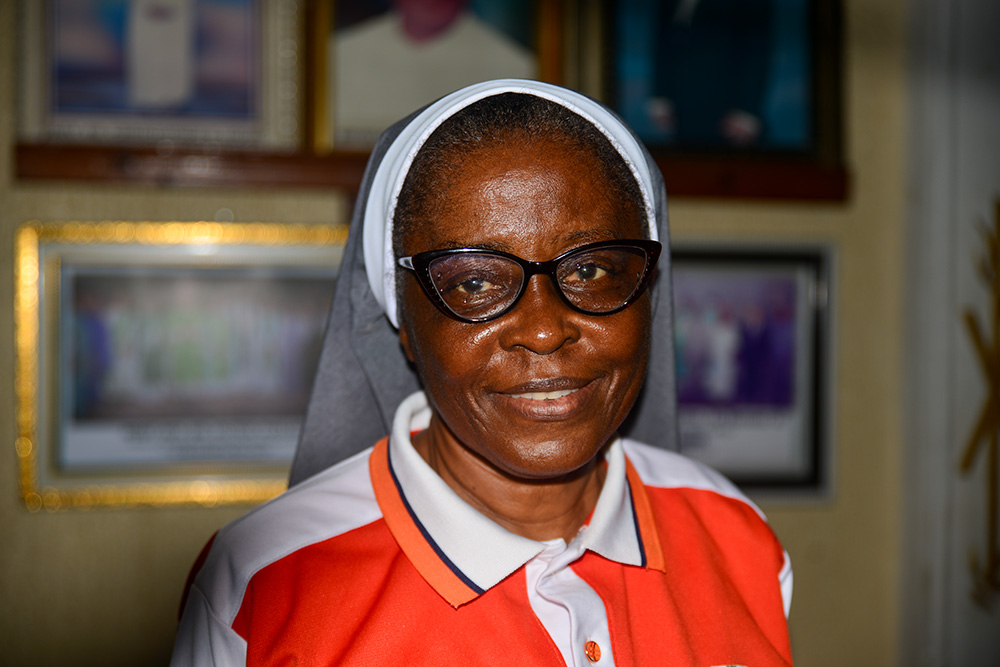
Sr. Stella Usen of the Handmaids of the Holy Child Jesus coordinates the Africa Faith and Justice Network's awareness programs in local communities. (Patrick Egwu)
Usen and her team also host radio talks on the issue to educate the wider community. She said they partner with the National Agency for the Prohibition of Trafficking in Persons and the Ministry of Justice to educate people on the legal implications of child labor.
"Knowledge is power and if these girls are empowered, they will have self-confidence to be better people in future," she said.
Usen said that since they started a massive campaign in 2022 targeting rural residents, parents are now more hesitant to give their girls to strangers or distant relatives.
Training new 66 girls
The Africa Faith and Justice Network is currently training a new batch of 66 girls in Southeast Nigeria in a skills program.
"We want to empower them in various skills and provide them alternatives to improve their economic standards and that of their families," said Madueke. "This will also lift the hopes of their family."
Madueke said another important part of the Africa Faith and Justice Network's work is partnerships with traditional institutions and local chiefs in rural communities to work on tackling domestic servitude and early child marriage.
"We are signing agreements with chiefs and traditional rulers who serve as the custodians of the people in local communities," she said. "We have also trained monitoring groups on how to monitor the activities of people coming to the community to take children and report to the local chiefs to take action."
Madueke said the government is weak in implementing protective measures to safeguard vulnerable children, families and communities, so the Africa Faith and Justice Network works with communities to take necessary actions to protect residents and to hold the government accountable by training community members on safe and responsible reporting.
"It's all about working together for the greater good," said Oliver Eze, a traditional ruler in one of the communities partnering with the Africa Faith and Justice Network. He said they have been utilizing women's meetings to raise awareness on the dangers of child labor and early child marriages in his community.
Eze said that he created a register to help track who is taken in his community.
"I have integrated this as a written document into my community's customary law and those responsible will be held to account," he said.
Peter Ewah, an Africa Faith and Justice Network-trained youth advocate, said that before the nonprofit's intervention, early child marriage and domestic servitude were recognized community concerns, but there was no sufficiently structured, community-owned monitoring and reporting mechanism linking traditional institutions, community leaders, faith actors, government agencies and civil society.
"Community discussions revealed that poverty, unemployment, limited livelihood opportunities, harmful social norms and deeply rooted cultural practices contributed to children's vulnerability," he said. "Although community leaders had made individual efforts to address cases brought to their attention, there was a need for a more coordinated and sustainable system for prevention, identification, reporting, referral and follow-up."
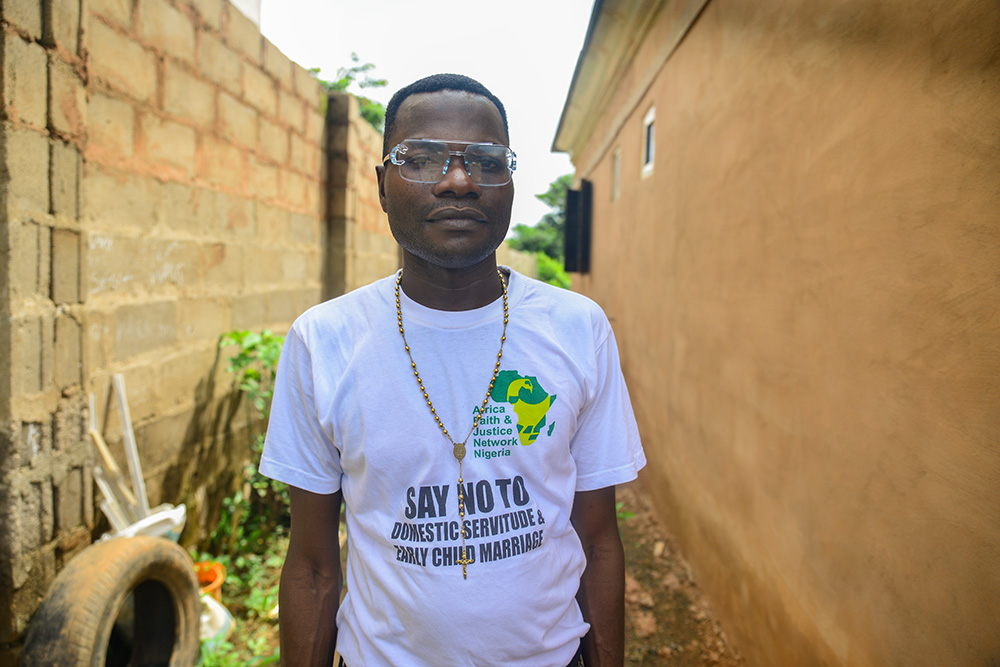
Peter Ewah leads the Africa Faith and Justice Network's advocacy campaigns against child labor and early marriage in local communities across Nigeria. (Patrick Egwu)
Ewah said that with the successful partnership of rural community leaders, the National Agency for the Prohibition of Trafficking in Persons as well as governmental agencies and gender-biased violence task forces, the network is now focused on skills acquisition, economic empowerment, smart farming, financial literacy, and adolescent girls' football activities.
"The intervention has shifted the response from isolated individual efforts toward collective, community-owned action," he said. "Traditional rulers and community leaders are now actively participating in discussions on child protection and have publicly reaffirmed their commitment to ending child early marriage and domestic servitude."
He said communities have also begun taking ownership of monitoring, reporting, referral and awareness activities. He noted that more than 200 cases have been successfully responded to and are currently undergoing investigation with security agencies.
The establishment of community monitoring systems, he said, provides a practical mechanism for identifying vulnerable children and responding to protection concerns.
"The project has created a safe platform where community leaders can acknowledge harmful practices, examine the cultural and economic factors behind them, and identify positive ways of using existing community and faith structures to protect children," Ewah said.
Standing in front of the salon in Ikot Ekpene, Boniface told GSR she has a big ambition: She wants to go back to school and study law and human rights.
"I want to become a lawyer so I can help victims of child labor and fight for those facing abuse," she said.