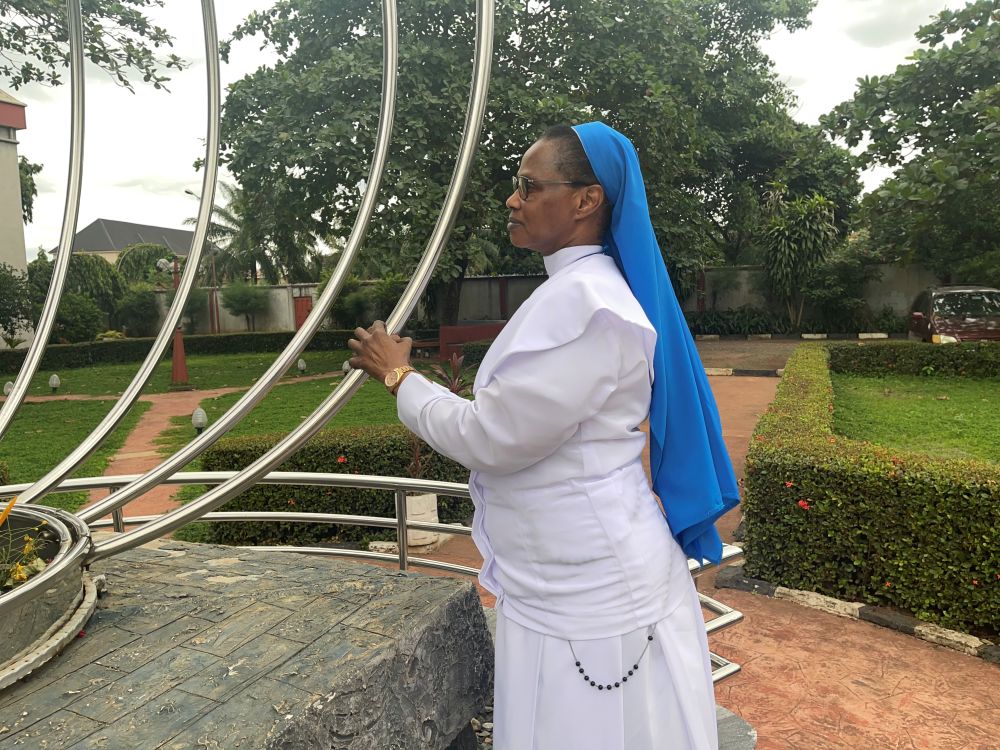
Sr. Lilian Ogbodu, a member of the Daughters of Divine Love Today, serves as a vocation director and works with Nigerian women after their first profession. (John Chukwu)

by John Chukwu
Sr. Lilian Ogbodu believes that forming young women for religious life is not simply about teaching them the rules of a congregation. It is also about helping them discover whether they are truly called to give their lives to God and, if they are, accompanying them through the often difficult process of becoming sisters.
Ogbodu hails from Eke in Enugu State, eastern Nigeria. She said her own vocation began with a childhood fascination with sisters, whom she saw as closer to God. She joined the Daughters of Divine Love in 1990, made her first profession in 1993 and her final profession in 1999.
In 2021, she completed a master's degree in Christian spirituality at Creighton University in Omaha, Nebraska, and became a formator. Today, she serves as vocation director and works with women after their first profession. In her words, she is helping a new generation discern their calling in a world shaped by social media, greater individual freedom, and changing expectations about comfort and authority.
GSR: What does formation ministry involve, and what are your main responsibilities?
Ogbodu: Formation helps young women discern the spirit and answer the question: Is this really what I want, or is something pushing me into this?
As formators, we help in different ways. We have stages of formation, beginning with aspirancy, where the candidate is helped to become familiar with basic Christian doctrines and detach a little bit from the world, while learning the difference between "you are in the world, but you are not of the world."
Formation trains you to be who you are: living the life, living the charism, communicating, loving and becoming an ambassador.
How do you accompany women as they discern whether religious life is truly their vocation?
We help them one-on-one and dialogue with them. Sometimes people's backgrounds affect the way they behave, so we work with trained formators and spiritual directors who help them understand the journey they are taking and whether it is really what they want. Sometimes someone will come and say, "I don't even understand this life. I don't think it's really what I want." And they can go and happily leave. Some will tell you, "This is what I want," and you help that person keep moving.
We always say that the Holy Spirit is the principal formator. We are just instruments trying to understand what the spirit and this person are doing.
What changes have you noticed among those entering formation today compared with your own time?
People are very open and expressive, telling you what they want and how they want it. When we were growing up, we were afraid of our parents and did what they asked.
These days, I keep hearing, "Why, Sister? Why do we do it like that?" They are very expressive and inquisitive. They only want to know why you are doing this and why they should not do that.
They like their freedom and comfort. In religious life, you have time for prayer and have to get up early in the morning, and some are finding it difficult. They want to do things their own way.
For example, we may be using firewood to cook, and they ask, "Why should we use firewood to cook? Why do I have to break firewood with an axe?" Or they might ask, "Why are we in darkness? Why don't you just put in solar?"
But I don't say, "These people are not ready to be nuns." No, this is their generation, and that's what they know. So, you laugh with them, you dance with them, and sometimes, we tell them to teach us their dance style. From then on, you can catch them. When you do that, they are open to you. They come closer, and you can tell them what is possible.
Advertisement
Society and social media influence them a lot, too. A phone is very much a distraction. If they come for a program and you say, "Don't come with your phone," they don't like it. You have to explain that it is a distraction and that it can distract them from the program.
We follow them gradually, making them understand certain things. It's not that they don't obey the law. They obey the law, but we can't be too strict.
Another challenge is silence. During our time, we valued silence. The important thing here is that you can't train them to be afraid of you; you train them to respect you and, at the same time, to be who they are, love God and love the life they have come to embrace. Their lives are a challenge for me, but that challenge helps me to grow too.
What qualities do you hope every young sister develops before their final profession?
Openness is very important. Being open to life, real, and ready to learn and accept help. A forgiving spirit, with the spirit of the congregation in mind. The selflessness to say, "This is my family now, and everything I have is for my family, and I work for my family."
What do you enjoy about serving in formation?
My joy is seeing people living their lives well. They understand and value who they are and the privilege God has given them to become a nun.
Looking back, you see that it is not you who did these things: It is the Holy Spirit, and you were allowed to be used as an instrument to help a candidate. When I remember my own training, I still value my mistress today because she really tried to help me understand my relationship with God.
The privilege that my congregation gave me to become a formator has also helped me deepen my relationship with God and see God in everything I do. That doesn't mean there aren't difficulties, but even in the midst of difficulties, I still see God in them.