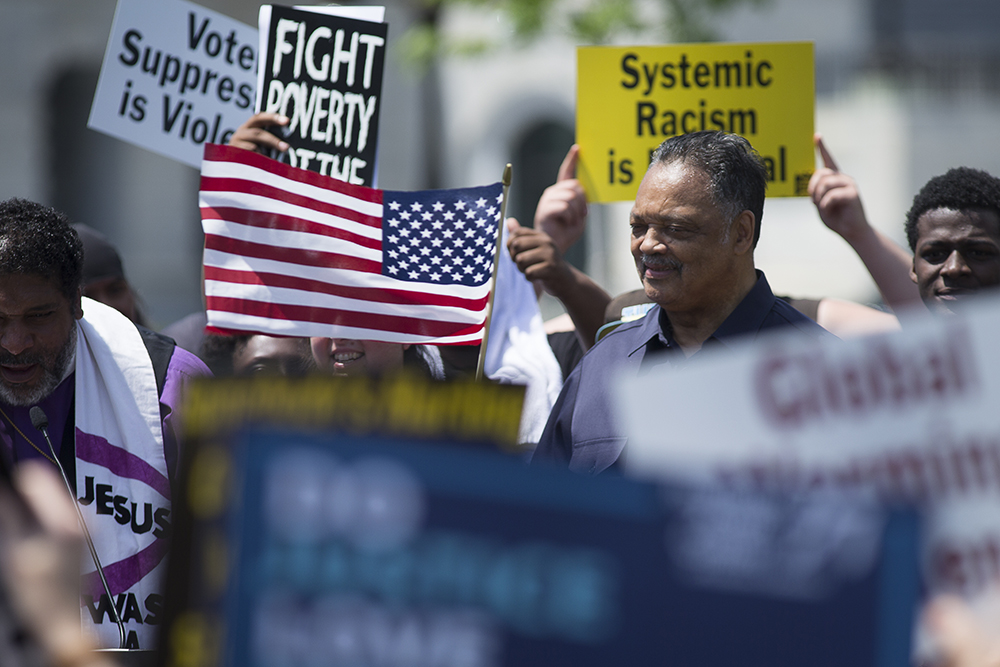
The Rev. Jesse Jackson and a number of religious leaders are seen near Capitol Hill in Washington May 21, 2018, during a protest to demand elected officials take immediate steps to confront systemic racism. Jackson died Feb. 17, 2026. (CNS/Tyler Orsburn)


The Rev. Jesse L. Jackson, a towering civil rights figure whose public life was deeply intertwined with Catholic clergy, institutions and social teaching, died Tuesday (Feb. 17) at 84.
A longtime associate of the Rev. Martin Luther King Jr. and a two-time presidential candidate, Jackson forged enduring alliances with Catholic priests, sisters and lay activists who marched, prayed and strategized alongside him in the struggle for racial and economic justice.
Jackson, who rose from the segregated South to become the nation's most prominent civil rights leader since King, died at home in Chicago, surrounded by family. His daughter, Santita Jackson, confirmed his death, noting that he had lived with a rare neurological disorder.
Over several decades, Jackson's activism repeatedly intersected with Catholic life and outreach — such as Chicago parishes, university campuses and a papal meeting — until his last moments of life when a priest was at his side.
Advertisement
Fr. Michael Pfleger was with Jackson in his final hours, praying with him and his wife Jacqueline late into the night before the civil rights leader died. The veteran Chicago priest and activist, who has spent decades alongside Jackson advocating for racial justice, described that moment as a final, intimate gift from a man who had been both mentor and comrade in battle.
"I will forever thank Mr. Jackson for the gift of calling me to come over and to be there with him," he told the National Catholic Reporter.
Pfleger, a longtime pastor of St. Sabina Catholic Church, a historic Black Catholic community in Chicago, recalled a friendship forged with Jackson in public marches and campaigns, but also in moments of personal crisis.
"When I was suspended by the Catholic church, it was Rev. Jackson who called me up and said, 'Hey, if they put you out, come work with me at PUSH. I'll get you a job at PUSH tomorrow,'" Pfleger said, referring to a dispute he had with former Chicago Archbishop Francis George that led to his temporary suspension. PUSH is a civil rights advocacy organization Jackson founded in 1971.
"He's always been a mentor, and he was one that always supported me, always encouraged me, always stood with me." For Pfleger, Jackson's defining trait was his relentlessness: "There was no fight too small and no fight too big for him. His consistency from a young man till the day he died, he never stopped fighting."
Reflecting on decades of shared activism, Pfleger said Jackson understood something about racial justice that many religious leaders still fail to grasp. "Racial justice does not just happen," he said. "It's got to be built. It's got to be created. It's got to be pushed and shoved and pulled to make it happen."
"There was no fight too small and no fight too big for him."
— Fr. Michael Pfleger
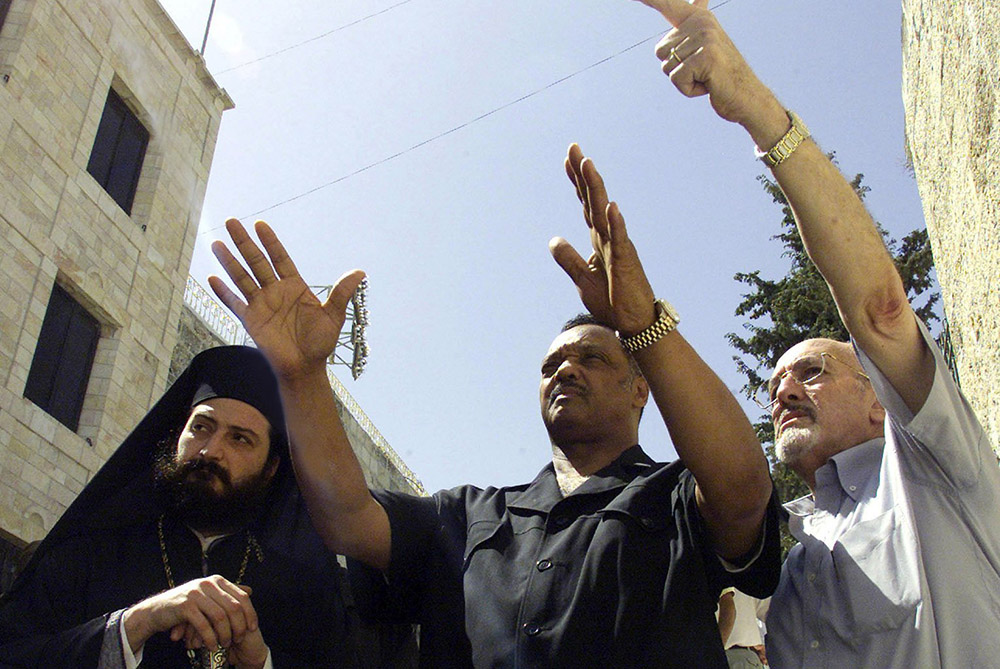
U.S. activist the Rev. Jesse Jackson (center) tours the area surrounding Bethlehem's Church of the Nativity in the West Bank July 30, 2002. Jackson called on then-President George W. Bush to help bring reconciliation between Israelis and Palestinians. (CNS/Reuters)
Central to Jackson's public identity was a declaration he returned to often: "I am Somebody." In a poem he repeatedly recited, Jackson sought to affirm dignity across lines of race and class: "I may be poor, but I am Somebody; I may be young; but I am Somebody; I may be on welfare, but I am Somebody."
In his early days as a civil rights activist, Jackson worked closely with King and others in the Southern Christian Leadership Conference. He was with King on the same balcony in Memphis the day before the civil rights' icon was assassinated on April 4, 1968.
"It would have been completely understandable if he and the others had said, 'We can't do this. I can't do this,' " said Jesuit Fr. Joseph Brown, director of the School of Africana and Multicultural Studies at Southern Illinois University-Carbondale. "But that's not what they said. They took the trauma, wrestled with it, and moved on … and I think that [Jackson's] life is an example of that."
Jackson worked alongside King during the summer 1966 Chicago Freedom marches protesting housing discrimination. Jackson helped organize demonstrations through all-white neighborhoods, where marchers were met with hostility. In a first-hand account later published by NCR, witnesses recalled onlookers — Catholics among them — pelting participants with rocks, cherry bombs and profanities.
Sr. Matthias, a Franciscan sister working on housing issues with the Cabrini Community Center on Chicago's West Side, wrote in NCR that same year that the marches revealed to her "what a community was in a way I have never known at even the most beautiful of Catholic Masses."
Describing a moment when Jackson asked Catholic sisters to lead a march she said she mumbled something about violence and he asked: "Do you believe in Easter Sunday?" When she said yes, she said, he replied: "Well, do you believe Good Friday came first?"
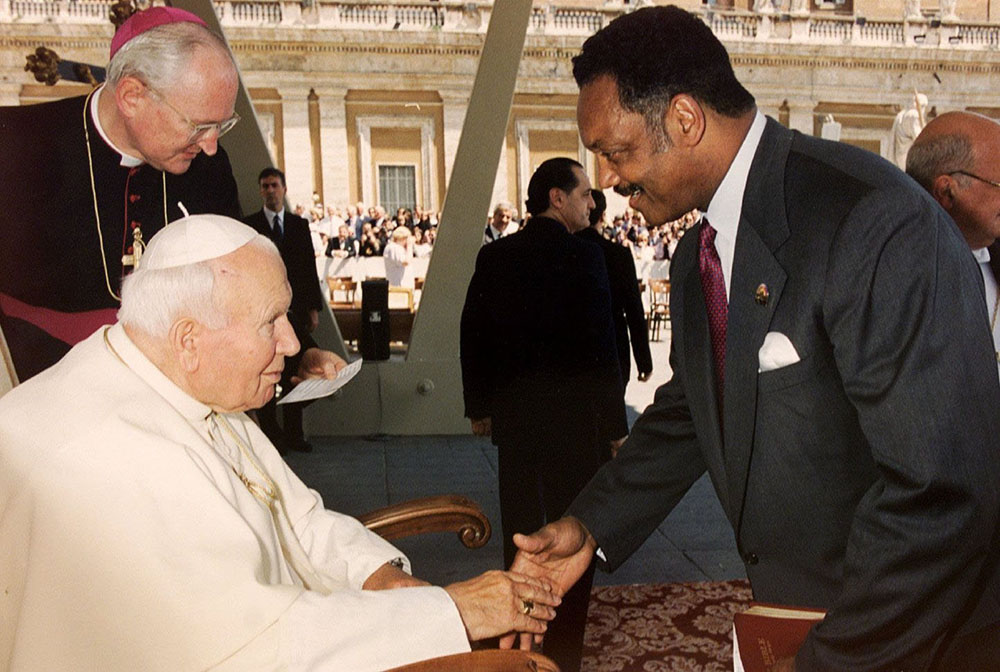
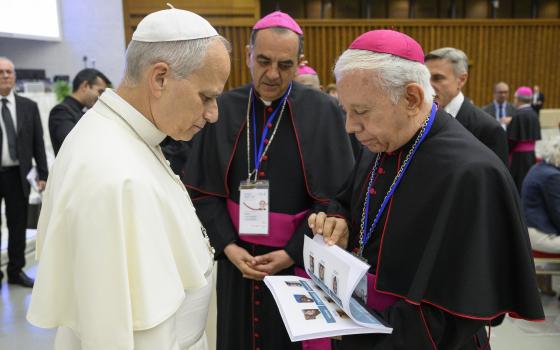
The Rev. Jesse Jackson greets Pope John Paul II at the end of the pope's weekly audience at the Vatican June 23, 1999. Jackson attended the audience during his two-day visit to Italy. Jackson died Feb. 17, 2026. (CNS/Vatican)
In August 1969, Jackson joined Cesar Chavez and other speakers at the National Catholic Conference for Interracial Justice at Loyola University Los Angeles. A year earlier, in Chicago, he publicly supported four Black Catholic priests who were considering leaving the archdiocese amid allegations of unfair treatment by Cardinal John Cody.
"The four black priests are not going to drop out; they're being pushed out," Jackson said. "They cannot grow; they cannot be men."
At the time, Jackson was director of the Chicago chapter of the Southern Christian Leadership Conference's Operation Breadbasket, later becoming its national director. A 1969 NCR article described the Chicago program as the organization's most successful effort, crediting it with securing jobs for more than 4,000 Black workers while also pressuring businesses to contract with Black-owned firms.
After leaving the Southern Christian Leadership Conference, Jackson founded Operation PUSH — People United to Save Humanity — which he later merged with his National Rainbow Coalition.
His political reach often intersected with Catholic leaders. In 1972, Jackson joined clergy including Detroit Auxiliary Bishop Thomas Gumbleton and Sr. Mary Luke Tobin in endorsing Sen. George McGovern for president. In 1982, he held a private audience with St. John Paul II to discuss Haitian refugees detained in Florida. In 1999, he worked with Jesuit Fr. Raymond Helmick to help secure the release of three American prisoners held in Belgrade during the Kosovo conflict and a year later, he received the Presidential Medal of Freedom alongside Msgr. George Higgins, a prominent Catholic labor priest.
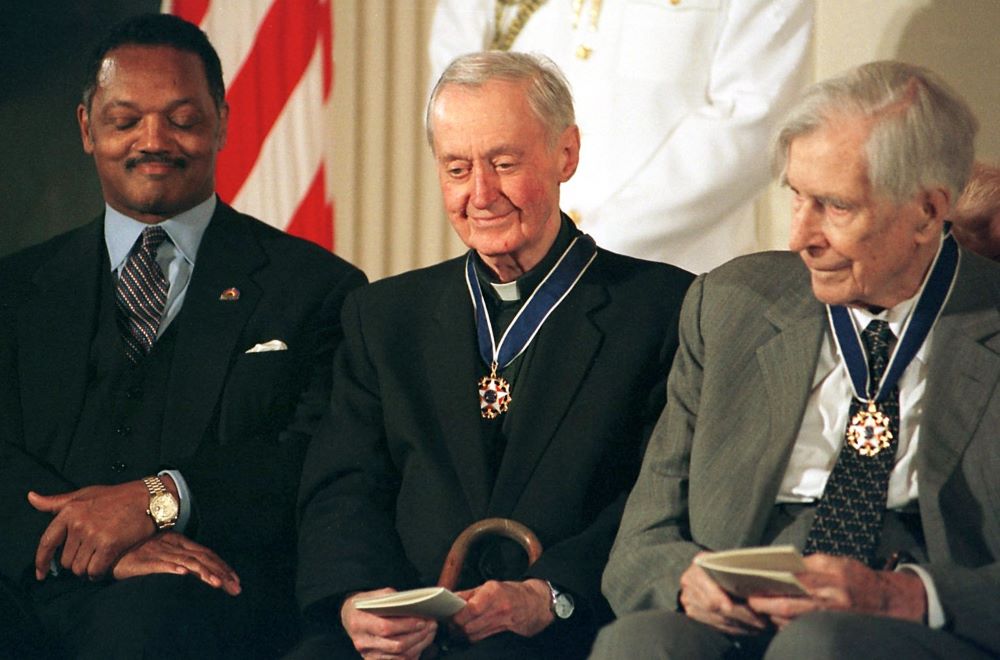
Msgr. George Higgins smiles after receiving the nation's highest civilian honor, the Presidential Medal of Freedom, from President Bill Clinton in 2000. The priest, recognized for his lifelong commitment to workers' rights, is flanked by honorees Rev. Jesse Jackson (left) and economist John Kenneth Galbraith. (CNS/Leslie Kossoff)
"He resisted, he persisted, and now he is joining those who are at rest, but who still guide us and surround us as we go through the same kinds of challenges, day by day by day."
— Jesuit Fr. Joseph Brown
The Jesuit priest Brown first met Jackson in 1988 by arranging him to speak at the University of Virginia, months before the Baptist minister declared he would seek the Democratic nomination for president.
"He just spoke from the heart," said Brown, recalling how Jackson dropped his prepared remarks on the floor. As equally moving as the speech was Jackson beforehand taking time to speak with each of the maintenance workers in the lobby, Brown said, "just hoping to see him."
"And he spent time seeing them, and I really do mean the word seeing," Brown said.
Brown told NCR that Jackson lived foundational principles through civil nonviolent resistance, persistence after King's death and teaching a new generation of activists, and transcendence in overcoming personal trauma and illness in pursuit of peace around the globe.
"He resisted, he persisted, and now he is joining those who are at rest, but who still guide us and surround us as we go through the same kinds of challenges, day by day by day," Brown said.
Rather than sorrow, he said he felt gratitude for the life and example Jackson offered the world, one that is needed all the more amid social and political turmoil he said echoes the time of the civil rights movement.
"He can go to the next place of his existence, which is the cloud of witnesses," Brown said, quoting a passage from St. Paul's letter to the Hebrews. "We're not going to forget Jesse Jackson."