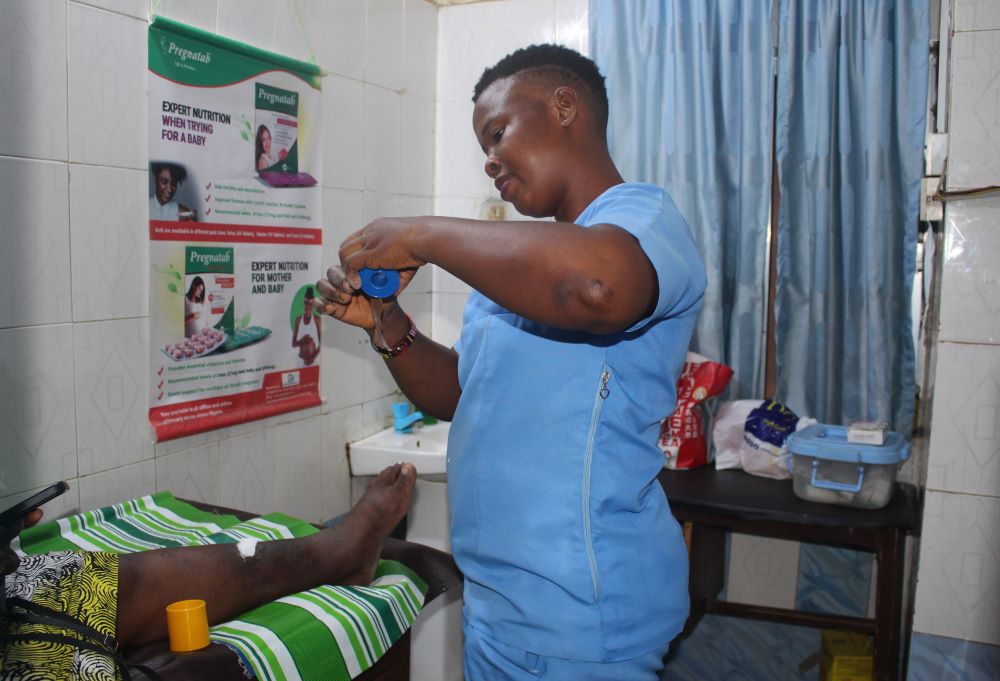
Gladys Madukwe, a nurse-midwife and member of the community advocacy team, dresses a patient's wound in the treatment room at Ancilla Catholic Hospital in Lagos, Nigeria. The hospital is run by the Sisters of the Handmaids of the Holy Child Jesus. (Valentine Benjamin)

by Valentine Benjamin
When a 39-year-old single mother of two came to Ancilla Catholic Hospital, a medical facility run by the Sisters of the Handmaids of the Holy Child Jesus in February 2025, she heard what she described as a "devastating blow."
She had taken two buses from the outskirts of Lagos, Nigeria, where she lives, her clinic card in her pocket. For 13 years, that card had meant a test, a consultation and a small white bottle of antiretroviral medication that sustained her life.
When she arrived at the facility, the sisters announced to her that there was a "stop-work" order on USAID/PEPFAR programs for the antiretroviral therapy that uses a combination of medications to prevent the virus from reproducing in the body. The hospital would have to ration medications.
"That news sounded like a cut to my lifeline. But I never consider giving up on treatment," the woman told GSR.
She knew coping would be difficult, so she searched on her mobile phone to find out how much the medication would cost each month. The prices were, in her words, "prohibitive."
She told GSR that without the medication, "my health will deteriorate, and the more it does, the closer I come to dying."
She tested positive for HIV (human immunodeficiency virus) in late 2012, when the sisters and their team of lab staff, doctors, nurses and the Centre for Integrated Health Programs conducted broad testing near her office on the outskirts of Lagos.
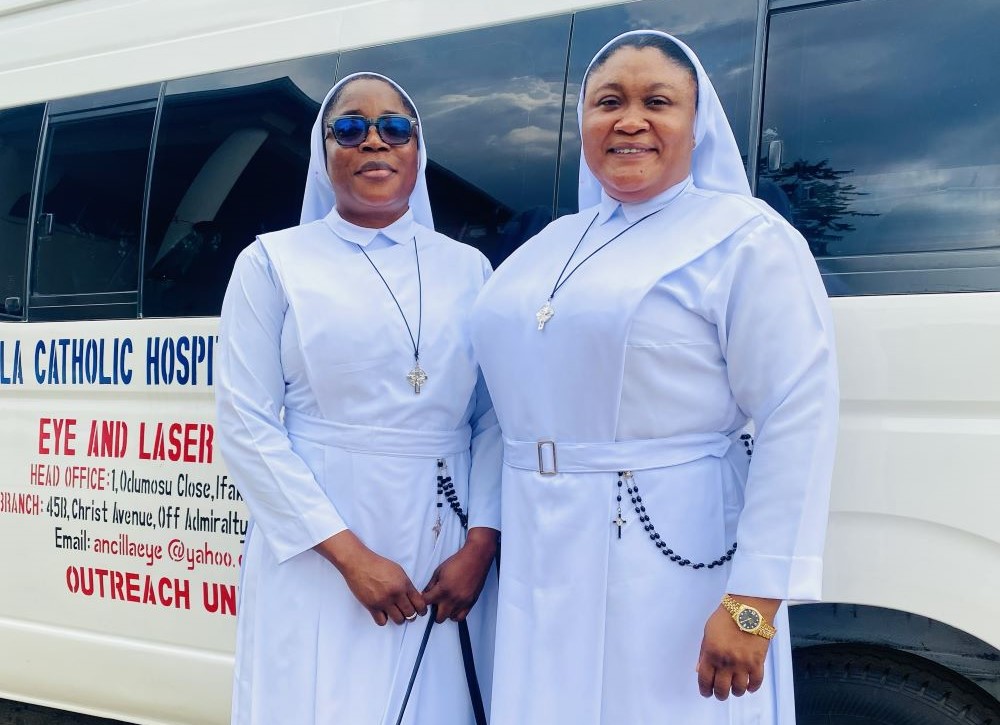
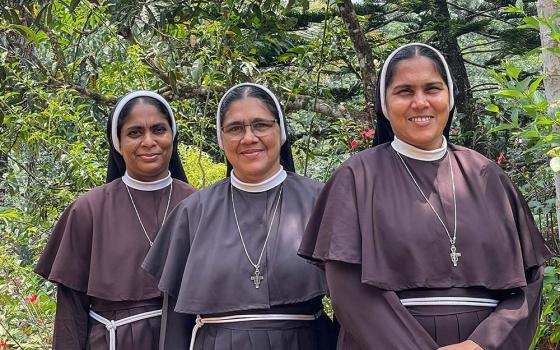
Sr. Maryann Ononiwu, administrator of Ancilla Catholic Hospital in Lagos, Nigeria; and Sr. Mary Elizabeth Adedeji, the hospital's pharmacist and antiretroviral therapy coordinator, pose in front of one of the hospital's buses at their convent west of Lagos. (Valentine Benjamin)
In January 2025 a "stop-work" directive issued suddenly by the U.S. government brought all USAID/PEPFAR-funded HIV programs to a halt in Nigeria. For clients like the 39-year-old single mother who had received care at the Ancilla Catholic Hospital for the last 13 years, the consequences were severe.
HIV care depends on regular quarterly or half-yearly visits, consistent testing, and a reliable supply of medication. At Ancilla Catholic Hospital, these routines have led to a remarkable outcome: More than 97% of the hospital's HIV clients have achieved viral suppression, according to the hospital.
'We're not just doling out pills. We're respecting people's dignity — the right of every individual, be they wealthy or poor, to live without fear of dying from a curable disease.'
—Sr. Mary Elizabeth Adedeji
"For clients living with HIV, unpredictability is dangerous," said Gladys Madukwe, a nurse-midwife and member of the community advocacy team at Ancilla Catholic Hospital. "When health care becomes unpredictable, patients tend to become elusive."
Some borrowed medication from friends. Others simply did not come anymore. The single mother attempted to make her medications last by spacing them a day apart. "You begin to wonder," she said, "what happens if I run out?"
Faith in the gap
At the center of the crisis is Sr. Maryann Ononiwu, a Sister of the Handmaids of the Holy Child Jesus, and hospital administrator and site coordinator for the Centre for Integrated Health Programs. For many years, she has worked to build an integrated HIV care program that combines science, counseling, outreach and trust.
The sisters and medical staff at the hospital offer clinical consultations, antenatal and maternal care, gynecology and fertility services, immunization, prevention of mother-to-child transmission of HIV/AIDS. They also help patients buy HIV test kits. When the sisters received a waiver on supported programs in February 2025, just one month after the original cut, antiretroviral medicines started trickling in and workers personally delivered them to families.
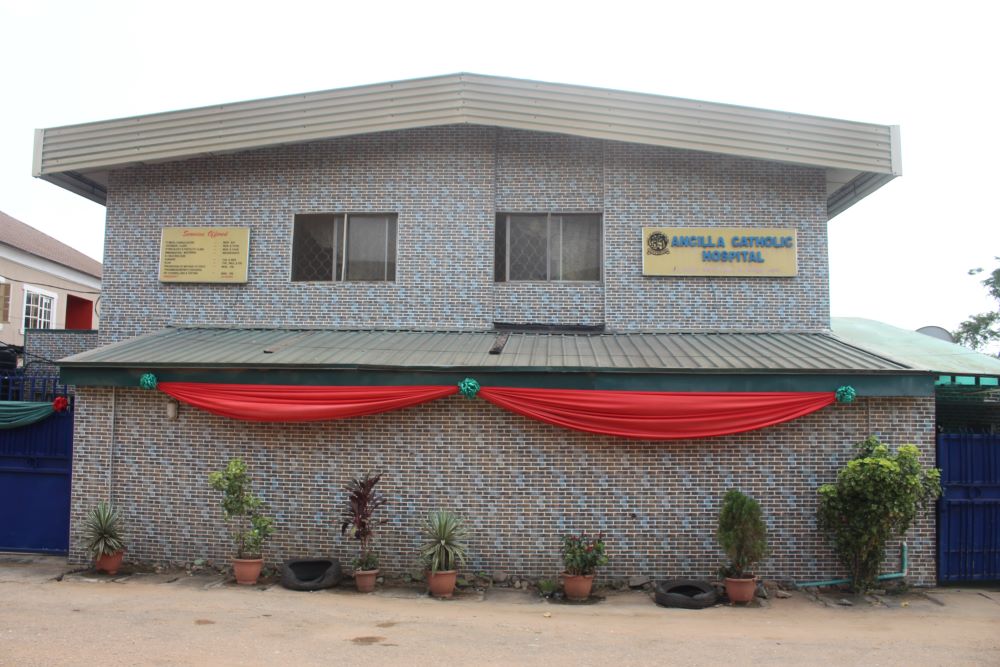
At Ancilla Catholic Hospital Foundation, three Sisters of the Handmaids of the Holy Child Jesus provide clinical consultations; antenatal and maternal care; gynecology and fertility services; immunization; prevention of mother-to-child transmission of HIV/AIDS; and HIV counseling and testing to residents of Lagos and surrounding communities. (Valentine Benjamin)
"We did what we could, not because it was sustainable, but because people were standing in front of us," Ononiwu said. The waiver brought great relief by allowing essential services, including lifesaving HIV treatment, to continue."
Nevertheless, the disruption has taken a toll. Nearly half of Ancilla's community outreach activities have been reduced and mobile testing units abandoned entirely. A 30% reduction in facility-based testers has minimized client services. Employees are burnt out, and volunteers have stopped coming because it was their duty rather than their livelihood.
Two clients died in the weeks following the funding interruption. Although HIV infections are no longer untreatable, the system of which the hospital had been part had failed.
"These were not numbers. They were people we knew," Ononiwu said. "Although the introduction of the new limited waiver arrangement has provided some relief, the program continues to face significant challenges and disruptions in several key areas."
The head of the hospital's medical laboratory department, Sr. Vivien Maduike, a Sister of the Handmaids of the Holy Child Jesus, told GSR that the cupboard where test kits are stored looked empty when supplies ran out.
"We started purchasing testing kits from public markets and charging clients to cover the cost," she said. "Each kit costs approximately N2,000 ($1.40) per kit when we buy them ourselves."
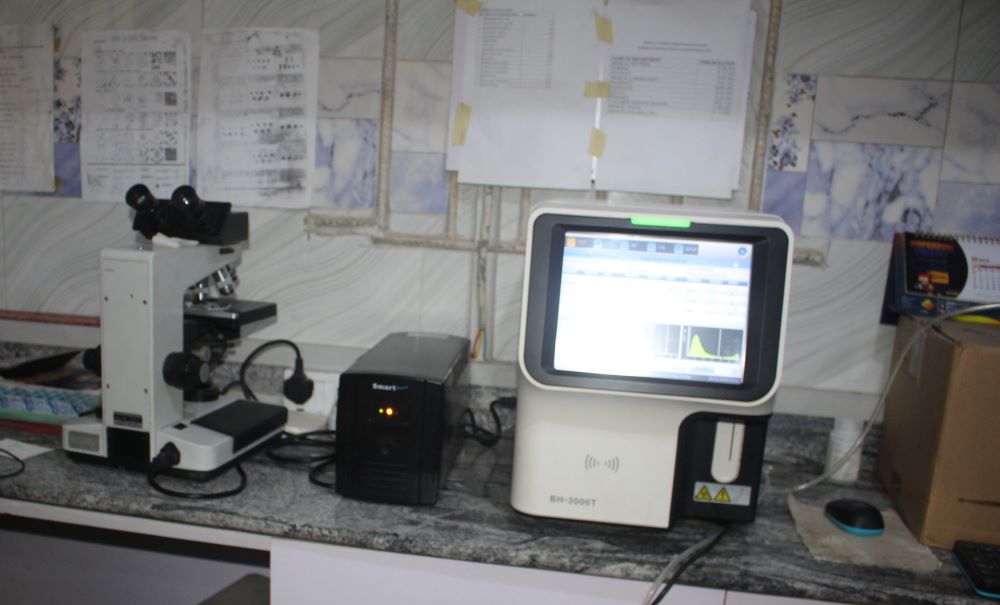
A microscope and a laboratory analyzer are used to perform tests and display the results digitally in the lab at Ancilla Catholic Hospital in Lagos, Nigeria. More than 97% of the hospital's HIV clients have achieved viral suppression, according to the hospital. (Valentine Benjamin)
Prior to the funding cuts, Maduike conducted dozens of tests each week. Today, she maintains a shortlist of clients whom she can assist, focusing on those with the biggest need.
"It's like picking who deserves to know his or her status," she said. "It's a decision no one should have to make."
A country built on donor support
Nigeria has the highest prevalence of HIV in West and Central Africa, and the second highest global burden. Approximately 1.9 million people are living with HIV, with new infections estimated to be at 120,000 annually.
For many years, foreign donors have been supporting the country's HIV response. PEPFAR and other partners contribute to funding over 80% of all HIV services in the country. USAID, in 2023 alone, invested in excess of $600 million in Nigeria's health sector.
When this safety net paused, the weakness of this system became glaring.
"This is what it means to be donor-dependent," said Marycelin Baba, professor of medical virology at the College of Medical Sciences at University of Maiduguri in northeastern Nigeria. "When you cut funding, you cut the service. And viruses don't wait."
The World Health Organization has warned that interruptions in HIV programs could undo 20 years of global progress, leading to a possible additional million cases of infection and deaths by the year 2030 unless funding gaps are closed.
But despite assurances of emergency funds by the Nigerian government, not much has trickled down to institutions like Ancilla. "We are still waiting," said Ononiwu.
Advertisement
For clients, the pain does not only consist of the missing medicine but the fear of being left behind as well.
"It's trust that has kept me coming all these years," said Konoyo, 40, another client and mother of three. "They knew my name. They never judged me."
That trust, Marycelin said, is one of the most powerful and fragile weapons in HIV care.
The sisters at Ancilla understand the implications of this responsibility.
"We're not just doling out pills," said Sr. Mary Elizabeth Adedeji, the hospital's pharmacist and antiretroviral therapy coordinator. "We're respecting people's dignity — the right of every individual, be they wealthy or poor, to live without fear of dying from a curable disease."