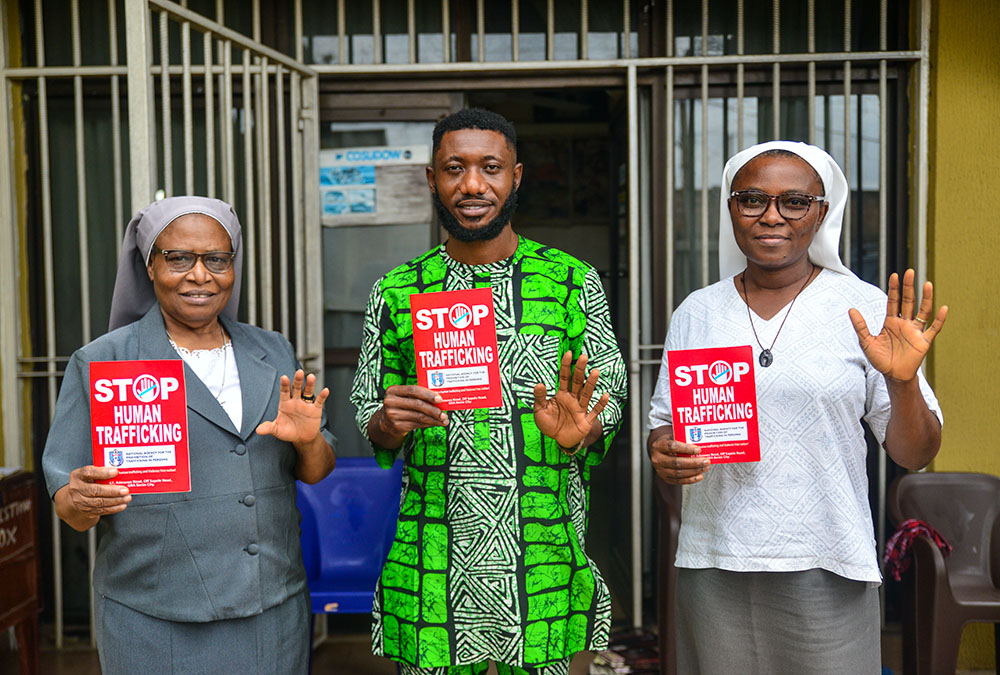
From left, Sr. Justina Odunukwe, staff member Wisdom Ugochukwu Umunakwe and Sr. Helen Omeya display an anti-trafficking poster outside the office of the Committee for the Support of the Dignity of Women in Benin City, Nigeria. (Patrick Egwu)

by Patrick Egwu
Imudia, 37, was running errands for her aunt in May 2016 in Benin, a city in Nigeria's south, when she met Joy, who had just returned from Malaysia.
Over the next few weeks, they became friends, and Joy connected Imudia with her friend, Blessing, a trafficker who brings young girls from Nigeria abroad with the false promise of securing jobs for them.
A few months later, Blessing made travel arrangements for Imudia and paid all her travel-related expenses. Imudia agreed to repay everything once she started working in Malaysia. She trusted her new friends.
"I didn't tell my family about the travel plans because they would disapprove," she told Global Sisters Report.
Upon arrival in Malaysia, Imudia said, she was kept indoors for the first few months.
"After some time, I was given an address, and told that I should call a number when I arrived," she said.
Instead of arriving at a workplace, Imudia met a man at the address.
"That was when I realized I had been pimped for prostitution," she said.
Imudia immediately left, and when she returned home that day, Blessing was angry, seized her passport, and locked her in a dark room, where she was physically tortured until she passed out. When she woke again, the torture continued without food and water. Under duress, she finally agreed to start "servicing the clients."
Imudia continued working for Blessing and paying her the agreed money until December 2019, when she ran away to a police station to report what had happened. With the help of the Malaysian police, she was brought back to Nigeria.
Advertisement
"My mother broke down and started crying when she saw me," she recalled. "I was a shadow of my former self and couldn't sleep most nights. I started drinking to forget everything."
Imudia's experience is not uncommon. Each year, thousands of Nigerian girls move abroad in search of a better life. Most make the move legally, but a large number are trafficked by criminal groups and lured by false job opportunities.
For the past 25 years, the Committee for the Support of the Dignity of Women, a project of the Nigeria Conference of Women Religious, has been helping women like Imudia by fighting human trafficking, protecting victims, encouraging advocacy, prosecuting traffickers, and rehabilitating victims and survivors.
"Trafficking is a crime against humanity, and as religious people, we fight for the dignity of the human person," said Medical Missionaries of Mary Sr. Justina Odunukwe, who serves as a coordinator for the committee.
The committee operates a shelter in Benin City that accepts dozens of young girls and women. Before accepting them, they screen them, conduct background checks and determine their needs.
"We listen to their stories to know how best to support them," Odunukwe said. "We take them to the hospital to examine them and make sure they are healthy."
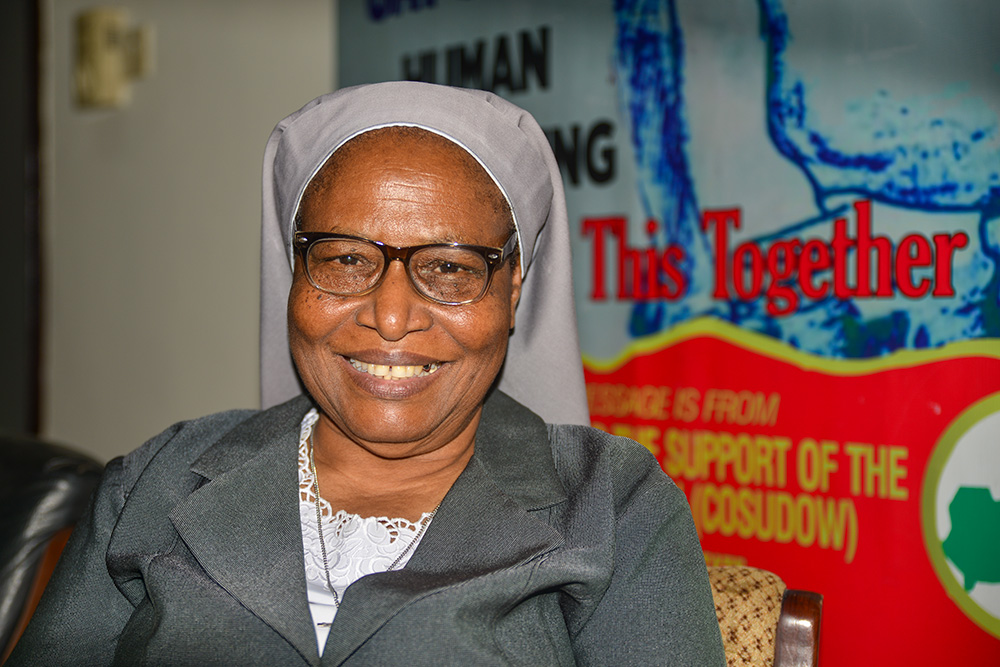
Medical Missionaries of Mary Sr. Justina Odunukwe serves as a coordinator for the Committee for the Support of the Dignity of Women. (Patrick Egwu)
At the shelter, Medical Missionaries of Mary sisters provide food and psychological and social support. In addition to a monthly stipend of 57,000 Nigerian naira (about US$43), they help enroll their guests at a skills center, where they undergo six months of training in fashion design, hairdressing and shoe making, depending on individual interests and preferences.
"We want them to be independent and earn for themselves," Odunukwe added.
Medical Missionaries of Mary Sr. Helen Omeya, a project manager who works with Odunukwe, said the sisters provide their guests with equipment to start their own business. She explained that each "starter package" includes equipment, which costs around 3 million naira ($2,260), as well as one year of rent.
"We regularly visit them to know how they are doing," Omeya said. "Once you agree to be here, you remain under our care and will abide by our rules."
Between April and May each year, the sisters welcome a new group of women and young girls. Each cohort spends about eight months at the shelter and usually leaves around December, which also marks their graduation.
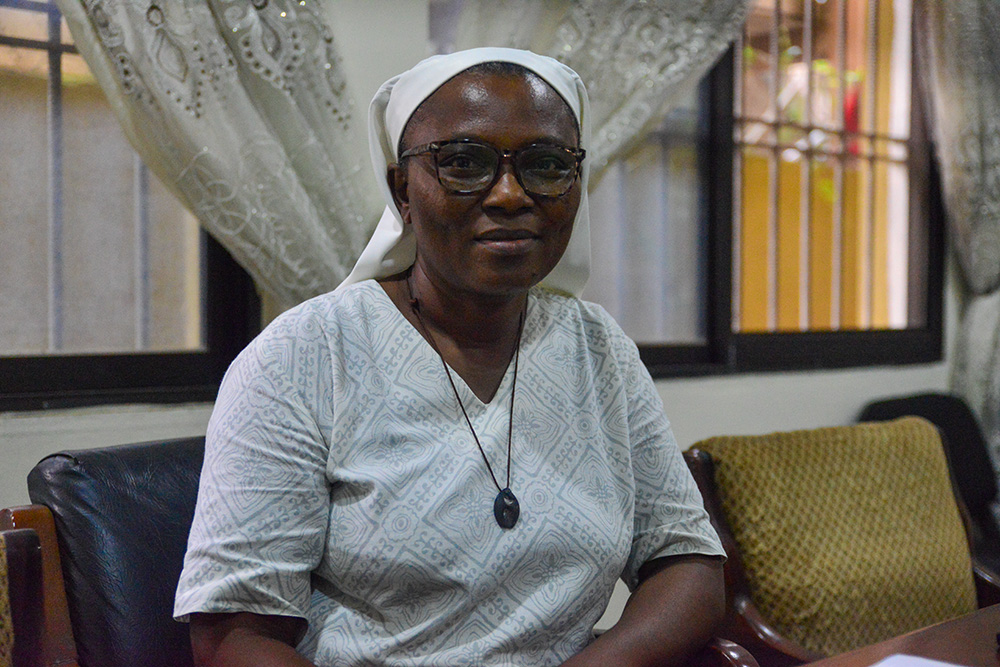
Medical Missionaries of Mary Sr. Helen Omeya is a project manager for the Committee for the Support of the Dignity of Women in Nigeria. (Patrick Egwu)
Imudia is currently making shoes and said she wants to start her own business with the sisters' support immediately after her time at the shelter ends.
In addition to vocational and financial support, each week a trauma and sexuality counselor works with victims of trafficking.
"Most of them have gone through traumatic experiences and need to heal," Odunukwe said, adding that Jesuit priests also come to the shelter weekly to hold Mass and talk to them.
"Every time I talk about these experiences, it messes up my mood and makes me remember things I wanted to forget," Imudia told GSR, noting that the counseling sessions have been helpful in her healing process. "But when I go to therapy, I feel relieved whenever I talk about the things I have gone through."
Imudia said she came to the shelter because she needed a quiet, peaceful place to heal, and the shelter has offered an environment to recover and find a new purpose in her life.
She said the therapy sessions have "built a new mind in her" and changed the way she sees things.
"The sisters here do a kind of self-awareness session to learn how to communicate and deal with certain situations," she said. "We are coming from different backgrounds with different traumas. I needed someone to be my mirror and convince me that I'm not a failure."
Odunukwe and her team also work to organize outreach programs by visiting and sensitizing local villages, marketplaces, churches, local schools and universities to raise awareness about the dangers of human trafficking. She said their anti-trafficking messages have been impactful.
However, challenges remain, and the need is greater than what the sisters can offer. With her face downcast, Imudia told GSR that she is now helping advise young girls against fake promises after her traumatic experience abroad.
"I was naive and young," she said. "I wanted something, but there are other ways than following someone I did not know. If you want something, try to work for it, and you will get it."
When asked if she had forgiven Blessing for trafficking her, Imudia said, "I have forgiven her because if I don't, I won't heal. I tell myself that I can do this despite the challenges."