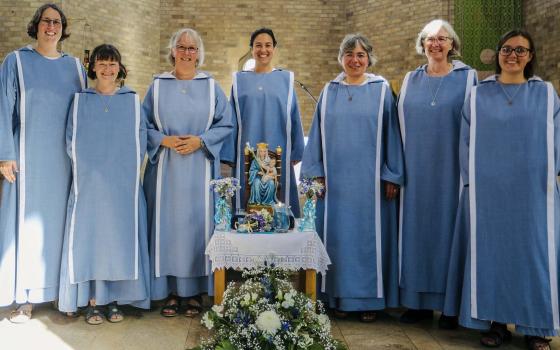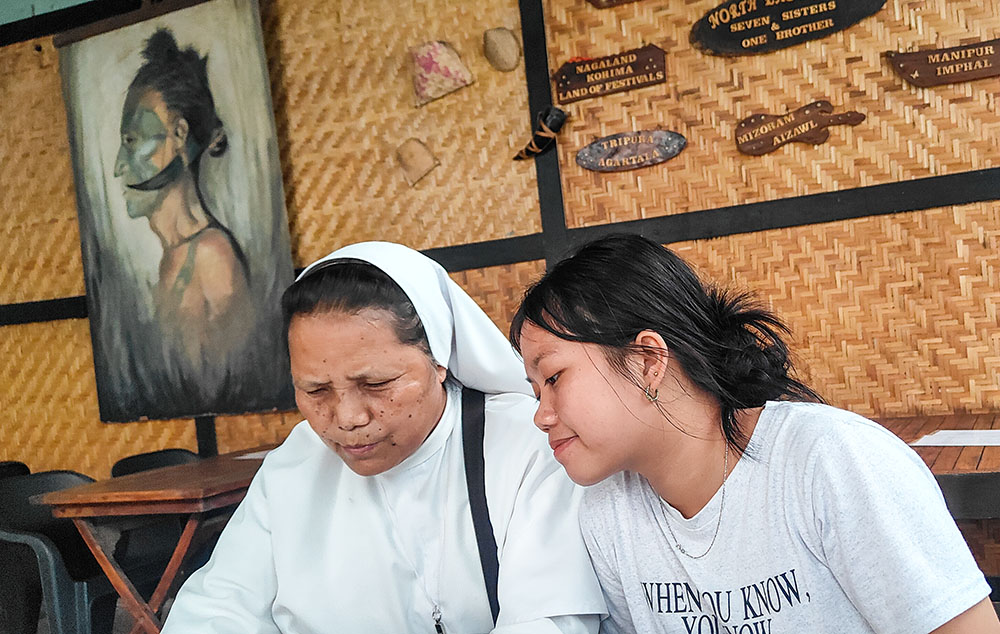
Missionary Sisters of Mary Help of Christians Sr. Bibiana Kamei and Ching Haokip, a migrant from Manipur, look at the menu of Meiphunc, a northeastern restaurant in Calangute, Goa, western India. (Thomas Scaria)

by Thomas Scaria
Ching Haokip left her native state of Manipur in April to escape ethnic clashes that have plagued northeastern India since May 2013. As Sr. Bibiana Kamei sat by her side in the nun's convent in Saligao, a town in the western Indian state of Goa, Haokip told Global Sisters Report of her stressful migration.
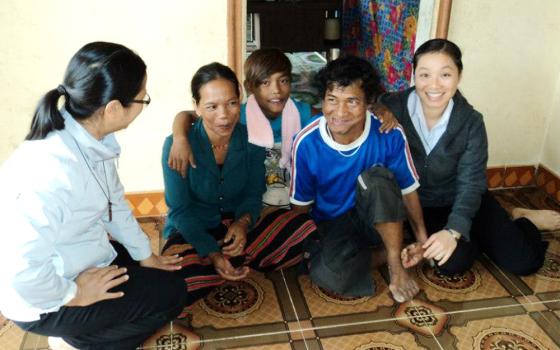
Kamei, a member of the Missionary Sisters of Mary Help of Christians who works among migrants in Goa, found the 21-year-old girl living with a family in Calangute, a beach side village in Goa, where she was temporarily placed as a domestic helper.
"I had no idea about my job, but the family harassed me both mentally and physically. They gave no proper sleeping place, toilet or food," Haokip told GSR on June 27, two days after Kamei and her fellow nuns rescued her.
Haokip said she had to travel some 1,460 miles southwest by train to reach Goa, a top tourist destination in the country. "I did not leave my state just to save my life from violence, but to support my family that had lost everything in the riots," Haokip said while holding hands with Kamei, also a native of Manipur.
The nuns helped enroll her in a nursing course.
Kamei said some 30,000 young people from Manipur and other states in northeastern India now work in Goa's tourism sector, especially in casinos, spas, restaurants, hotels and resorts.
Like many youth from northeastern India, Haokip chose an "unsafe migration channel and landed in a risky situation" in Goa, the 54-year-old nun said.
Sr. Rose Paite, who initiated her congregation's mission among the migrants in Goa two years ago, said they try to provide skills training to girls like Haokip so that they can get decent jobs.
"The ongoing violence in Manipur has led to mass migrations of young people to different parts of the country, where most of them work in vulnerable conditions," Paite told GSR in the Missionary Sisters of Mary Help of Christians' Saligao convent on Sept. 9.
Migrant Initiatives for Northeast, the congregation's new mission in Goa, is being supported by the Missio Institute and helps migrants receive support, vulnerability reduction, advocacy and rights awareness, legal assistance, and resilience building, Paite said.
"Our new ministry in Goa is not against migration, but to ensure safe migration," she said.
The Missionary Sisters of Mary Help of Christians was founded in 1942 as an Indigenous congregation in northeastern India. The congregation works mainly among the region's tribal communities.
It has around 1,500 members from 75 ethnic tribes in the region who not only serve the local tribal communities, but work in different parts of India and in 14 countries.
"We could not ignore the mass exodus of unemployed youth from northeastern states to Goa, and we just followed them," Kamei said.
Most young migrants from northeastern India in Goa are Christians, "but they hardly find a church here that welcomes them," Paite said.
"This was mainly due to a social stigma attached to the migrant youths," said Paite, who has initiated an ecumenical prayer service for migrants in their own languages, in coordination with the Goa Archdiocese.
Once Paite and other sisters started working among migrants, the archdiocese arranged special Masses and other sacramental services in some churches on Thursdays, instead of Sunday.
"Many are not able to attend the Sunday Mass as they are usually busy on weekends with their tourism-related jobs," Kamei said.
Advertisement
Fr. Maverick Fernandes, the director of the archdiocese's social welfare department, told GSR that they were aware of the spiritual needs of the migrants, but could not do anything until the nuns stepped in.
"We do not want to lose our Christian brothers and sisters in the dark realities of the tourism industry," said the priest who said that the work among the migrants was "a much-needed ministry started at the right time."
"Since the sisters are from their own tribal communities, it became even easier," he added.
Monica works at Meiphunc ("Kitchen"), a gathering place for youth from various tribal communities and northeastern states in Calangute. A migrant from Nagaland, she said the prayer services have helped the youth renew their faith.
"We are like lost sheep without a shepherd, and the sisters and some of our leaders united us in prayer and fellowship again," Monica told GSR.
Sisters regularly visit the restaurant. "They not only enjoy their home food, but join prayer and worship programs in an adjacent meeting hall once in a while," Kamei said.
Luna Eimi, a youth leader from Manipur, conducts prayer and worship there, including hymns, songs, Bible services and testimonies.
"Such prayer services bring them together where the nuns can interact with them and help them," Eimi told GSR after one such meeting.
Some 100 youth, including Catholics, Presbyterians and Baptists, took part in the September prayer service, which included Paite as the main speaker.
Moses Khongsai, who coordinates Migrant Initiatives for Northeast for the funding agency Missio, said the church should also provide counseling to migrants in distress and help rehabilitate those abused or cheated by the tourism industry.
He has helped at least 100 young people from Manipur secure safe migration to Bangalore in coordination with the Bangalore Archdiocese.
One such victim, Jeny, from Mizoram, was rescued by the Missionary Sisters after she got pregnant and was thrown out of her job at the casino.
She now lives with the nuns in Saligao and works as a field assistant for Migrant Initiatives for Northeast to reach out to others in risky situations.
"I thought the casino would be the safest place in the tourism industry, but I got cheated by some," said Jeny, whose child was born with some deformities due to meningitis.
Kameni said the nuns were happy to have a baby in their community. "He came at the right time to fix the focus for our project," she said.