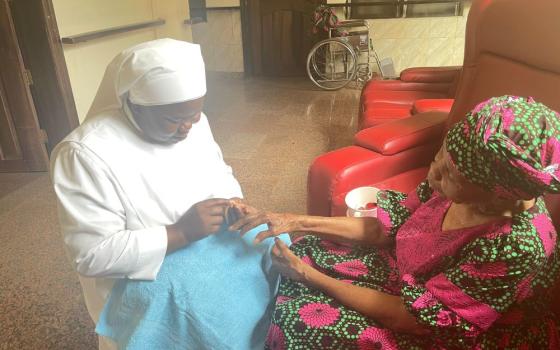
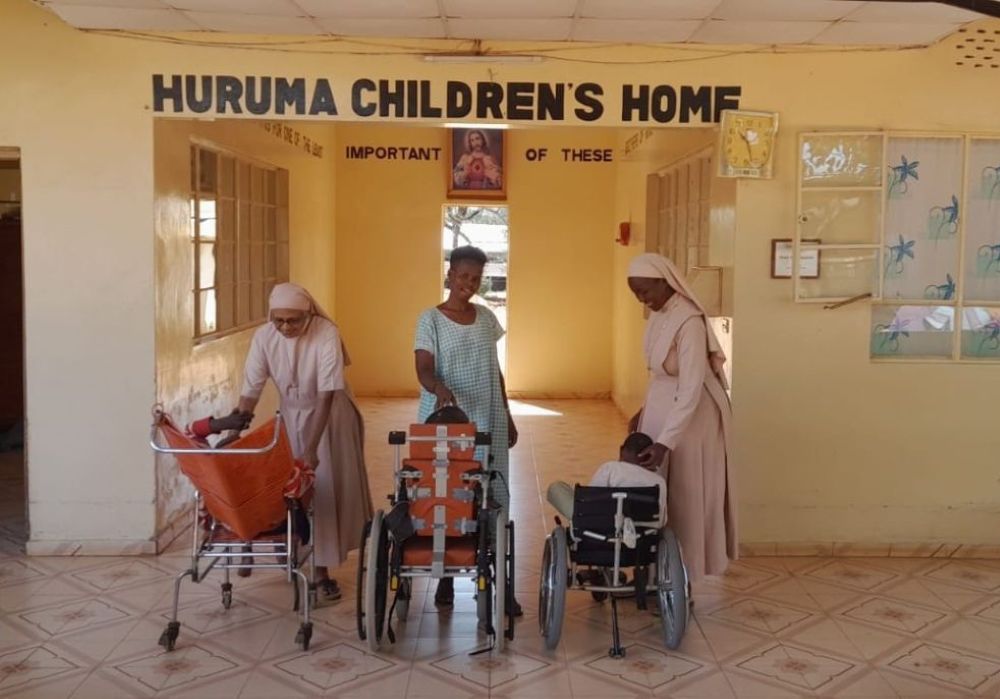
Srs. Rosily Kokkaden, Sr. Anne Hiuhu and staff member Beatrice Lesayeiye interact with children at Huruma Children's Home in Wamba, Kenya. (Lourine Oluoch)

by Lourine Oluoch
As the 2032 deadline approaches for residential charitable children's institutions in Kenya to reintegrate all children under their care back into families, the Huruma Children's Home is facing a peculiar challenge: no one wants the children.
The home, located in Wamba, Samburu County, Kenya, is some 361 kilometers (224 miles) north of Nairobi. It hosts 40 children ages 3 to 41, all of them physically and mentally disabled, and bedridden.
"Their age does not define how developed their bodies are. Because of their conditions, they are still like children. You can say a 30-year-old child," said Sr. Anne Wambui who works at the home as a social worker.
In 2022, the Kenyan government introduced the National Care Reform Strategy 2022-2032, giving childcare residential institutions 10 years to transition all children from institutional care back into families, biological or alternative.
"Some of them have no family, where would they go? Where are we going to send them? I don't know," said Sr. Rosily Kokkaden, the director of the home.
The home, run by the Society of Nirmala Dasi Sisters, was founded in June 1990 to care for disabled children abandoned at Wamba Mission Hospital. It has since become a refuge for disabled children from the region, children who culturally would have faced certain death in the community.
"Here in the Samburu land when you have a child who is in this state, mentally unstable and physically disabled, it's considered an outcast. They either kill the child or they leave the child to be eaten by the hyenas outside there," said Wambui.
Wamboi said that many mothers would leave their disabled children at the hospital because they knew if they brought them home, the children would be killed. Eventually, the hospital was not able to accommodate the children so the Huruma Children's Home was founded to care for them.
Kokkaden has a waiting list of children with similar conditions hoping to get into the home, which can only hold 40 children at a time.
"Many of them are on a waiting list. They ask me to admit the children and if I say there is no space some tell me they are going to kill that child," she said.
According to Wambui, this waiting list is a lifeline as it gives caretakers hope that the children will eventually be taken off their hands.
"We give the parents or guardians hope: Instead of killing them just wait, we will take them. So once a child by God's grace has died a peaceful death, we can pick another one. Their lifespan is also short, so if one child dies we take another. That's how we've been running," she said.
Advertisement
Wambui said that it is difficult for the home to convince families to take the children back home.
"We have tried talking to the parents but they block us completely, they change their numbers and you know they keep migrating, one day they are here the other day so when you trace their homes they are nowhere to be found," she said. Currently only two parents willingly make contact with the home and come to visit their children, she added.
After inspection by the government, the home has had their license renewed to continue caring for the children, even as it grapples with the issue of reuniting families.
"Our intention is that they have good health, good food, good medication, good shelter and clothing and peacefully they stay and die in Huruma home," Kokkaden said.
Huruma Children's Home is managed by four Nirmala Dasi sisters along with 30 support staff. The home is supported by donors to pay the staff, buy food, diapers and other daily essential needs. Because of their conditions, the children need special beds, special wheelchairs, specially made food and a lot of medicine.
In Nairobi, the House of Charity, a rescue home for abandoned children up to 3 years old, is facing a similar challenge. Managed by the Poverelle Sisters of Bergamo, the home is licensed to rescue abandoned children and place them in a home by age 3 but currently has challenges with finding homes for children with disabilities.
For House of Charity, placing children into a family has been part of the program since its founding in 2014. As soon as a child is committed to the home, they work on the child's exit plan either through adoption, foster care, reintegration back into families, or transfer to other charitable children's institutions.
"Our society is still biased on children living with disabilities and so it's very difficult to exit a child that has a disability for adoption. Currently we have five children that are with disabilities," said Becky Bahati, a social worker at the home.
"There is bias with adoptive parents because they are unable to get children on their own for one reason or another, they want a perfect child and you know we do not have perfect children," she added.
Sr. Lilian Ongwae, a Poverelle missionary, said the children come to the home when they are little and sometimes the disability only shows when the child has grown.
"We rescue when it's a baby and it's difficult to know the child has a disability. You come to know that the child has a disability when they have grown to a certain age," she said. It is even more difficult, she added, for the home to find placement for children in other institutions, as those homes also have to abide by the government plan and find exit plans for the children under their care.
"We are hoping that we'll get a place for these five children. For now it's a big challenge for many homes. When we ask they say 'yes we can have the child, but is there the next of kin?' " Ongwae said.
Through the Catholic Care for Children in Kenya program, the Association of Sisterhoods of Kenya is supporting 48 congregations of Catholic sisters that run charitable child institutions through the transition.
"We work closely with sisters or congregations who have children homes or charitable children institutions. We support them to ensure that children are reintegrated or they are unified with their biological families," Sr. Hedwig Muse, a member of the Little Sisters of Mary Immaculate of Gulu in Uganda and the program manager, told GSR.
Catholic Care for Children in Kenya is part of Catholic Care for Children International, a network under the International Union of Superior Generals. The international program is implemented in four African countries: Kenya, Uganda, Malawi and Zambia.