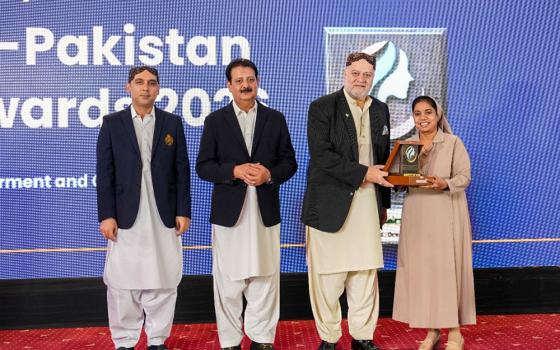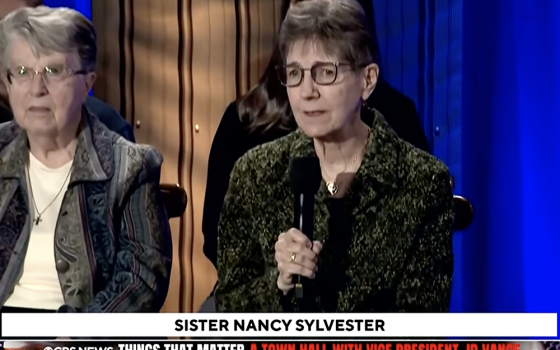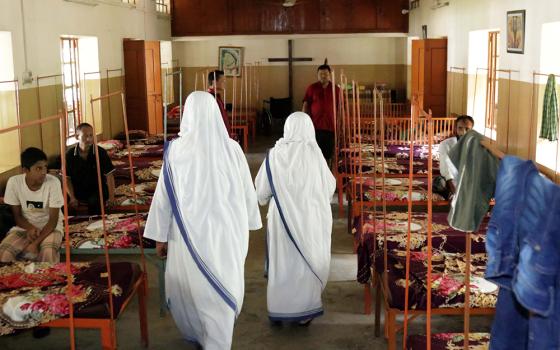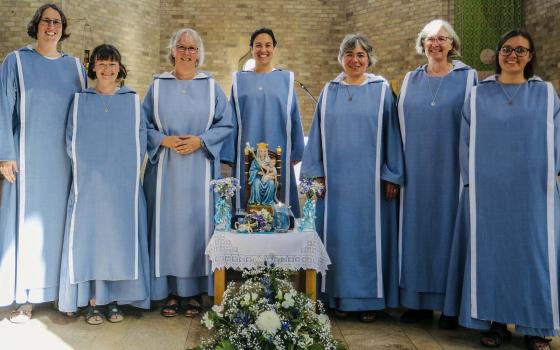
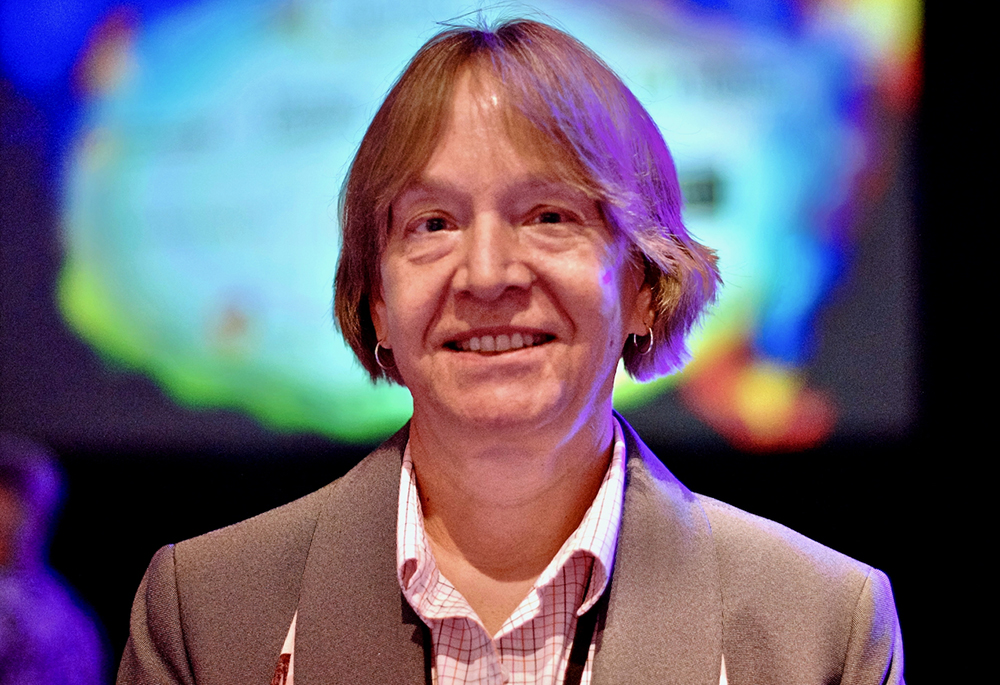
LCWR president-elect Sr. Betsy Pawlicki, a Sinsinawa Dominican, is seen Aug. 14, 2026, at the group’s annual assembly in Orlando. (GSR photo/Dan Stockman)

When Sr. Betsy Pawlicki was growing up in the 1950s and 1960s in Buffalo, New York, being Polish and being Catholic went hand in hand.
And while being Catholic was more cultural than spiritual, she grew up in one of the parishes north of Buffalo that had been pastored by Fr. John Neumann in the 1800s, who in 1977 became St. John Neumann. "Even then, before he was beatified, that was a big deal," Pawlicki said.
Still, it would be a long time before her faith became the biggest part of her life. In between was weak catechesis and a brief tour of other denominations.
"I learned something from each of them, but I eventually found my way back to the Catholic Church," she told Global Sisters Report.
There was also a bachelor's degree in forestry and a master's degree in industrial and labor relations from West Virginia University, and jobs in student affairs administration at her alma mater, North Carolina State University and the University of Notre Dame.
But after six years at Notre Dame, she entered religious life with the Sinsinawa Dominicans, which led to ministries at an adult learning center, a social service community center in New Orleans' Ninth Ward, law school, then five years as a labor attorney in Chicago and nine years as an attorney for the Illinois Education Association, the statewide teachers union until 2016. Then, she was elected to congregational leadership.
Since then, she has had to help lead the process of deciding to tear down several buildings, including the unique, round rotunda building that houses the chapel.
"We're emptying all the buildings built in 1964 in anticipation of huge numbers of sisters, because that was the pattern at the time," she said. "In October, those buildings will be coming down."
Today, Pawlicki, 70, is the president-elect of the Leadership Conference of Women Religious, which represents about two-thirds of the nearly 35,000 Catholic sisters in the United States.
She took office Aug. 14 at LCWR's annual assembly, where then-president-elect Sr. Debra Sciano, of the School Sisters of Notre Dame, became president; Sr. Vicky Larson, of the Presentation Sisters of South Dakota, moved from president to past-president; and past-president Sr. Kathy Brazda, a Sister of St. Joseph, finished her three-year term.
Global Sisters Report: You had a promising career in higher education — what led you to religious life? And why not the Sisters of the Holy Cross, whose motherhouse is across the street from where you were working at the University of Notre Dame?
Pawlicki: It was there that I was kind of reintroduced to the maturity of the Catholic faith post-Vatican II. I wasn't looking to go into religious life there, it was just a good job.
Nobody was seeking to recruit me, but I became friends with a lot of men and women religious ministering there and I came to see that my life and values weren't all that different from theirs.
Traditionally, the director of each residence hall was usually a man or woman in religious life, and they were from all different charism groups, so I got to know a wide variety of charisms and congregations. With the Sinsinawa Dominicans, there was a resonance in how they talked about their life, their preaching, their ministry and prayer. I visited a number of congregations, but ultimately entered the Sinsinawa Dominicans in 1993.
At the time, I had football tickets and an office in the Golden Dome — my family thought I was crazy.
Were you seeking to join leadership? And how do you feel about leadership now?
No, I wasn't. I was happy in the ministry I was doing with the Illinois Education Association and I wasn't looking for a change or anything. But during the nomination period as we were getting ready for a general chapter, I responded to a call from the sisters and after a lot of discernment I said yes.
I had been nominated to the chapter before, but wasn't elected, so I knew what that was like, but I also had something good to go back to so I wasn't worried about it.
I enjoy it. It's fun most days — not every day. But every day you learn something new, you stand in a privileged position within the congregation and the church, and you get to know all the sisters deeply, both their strengths and their vulnerabilities.
It's not a cookie cutter; it's, how do you attend to the needs of each person and the common good and the vows we've made to each other and the church?
There is the administrative side of leadership, which your background clearly has prepared you for, but there is also the pastoral side. How have you adapted to that role?
I have a master's degree in pastoral studies from Aquinas Institute of Theology, so I've learned about it, but it also wasn't brand new because there is a pastoral side of being a lawyer, even though we don't call it that. You have to listen, and you have to listen beyond the words they're saying and get at what they really mean. It's not as much of a disconnect as it might sound.
Advertisement
People might also assume a forestry degree wouldn't be much help when it comes to leadership.
I think forestry is a specific application of management and biology — it's Laudato Si'. One thing we're doing now as a congregation is planning for our land, adapting regenerative agricultural and solid forestry practices. I had an internship at Mt. St. Helens Tree Farm the summer before it was blown off the face of the Earth. We were doing research into how to make trees grow faster with different practices without doing other harm. It's the same skills, just a different application.
There are profound physical changes coming to the Sinsinawa campus in Wisconsin. Has that process helped prepare you for this new leadership role at LCWR?
Absolutely, because all congregations are doing this investigation and study and making gut-wrenching decisions. LCWR is already looking at it — if our members are changing, then what different structures and services are we going to need to engage in? Parishes are doing it.
But navigating that transition has been the single most important and most challenging aspect of my ministry to date. Since 2016, we've been trying to figure out what to do with the rotunda building. I think it has the most beautiful chapel of all the motherhouse chapels. I know everyone thinks that, but it's unique and the art is amazing and it's huge. We've tried and tried to find someone who could use it and we couldn't.
But the future of religious life is bright. That's the other part of leadership — helping us discern the next steps to find the right questions to ask. What's the expression of women's apostolic ministry that the world needs now? The days of building buildings and institutions is gone, but that only happened because it was responding to a need. What is the need now?