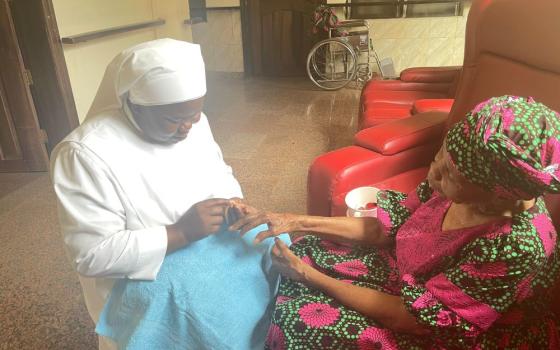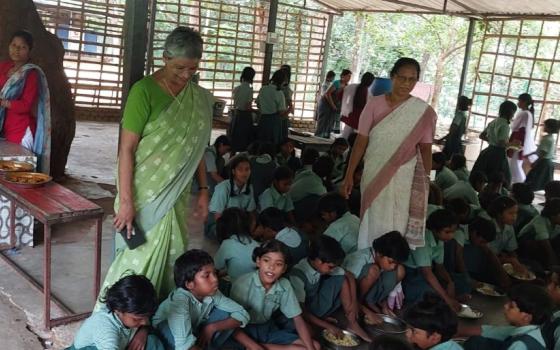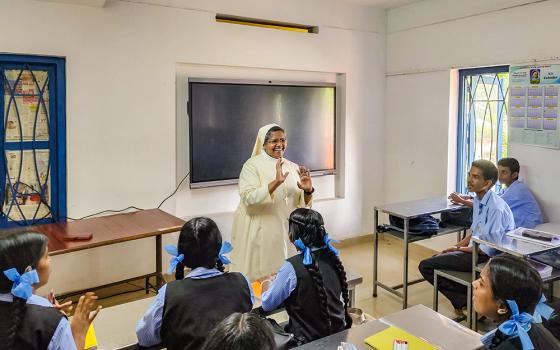
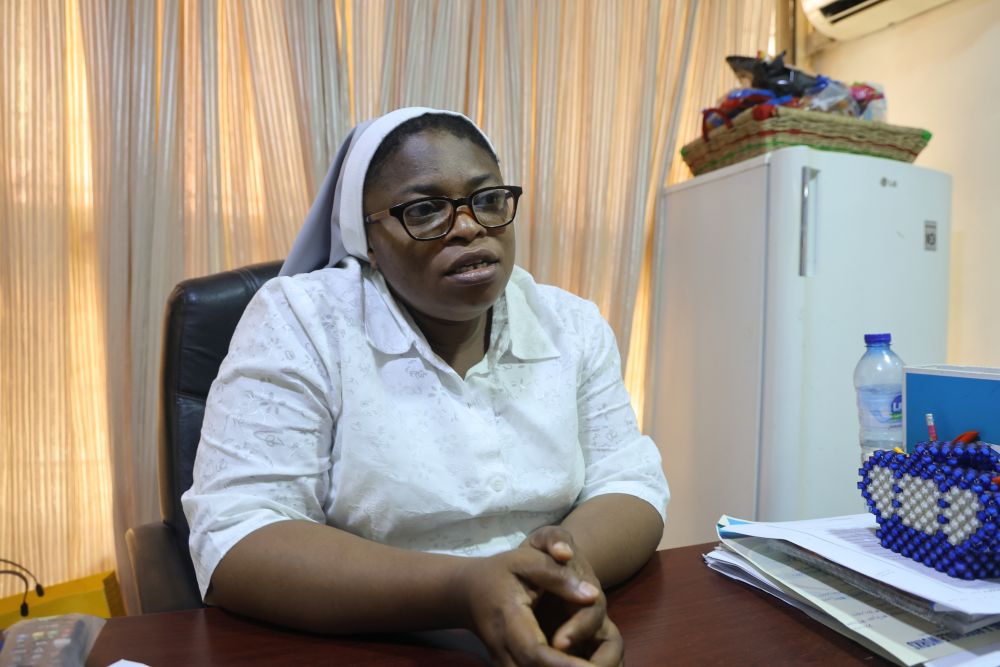
Handmaids of the Holy Child Jesus Sr. Agnes Onwudiwe serves as principal of Pacelli School for the Blind and Partially Sighted Children in Lagos, Nigeria. Established in 1962 by the Archdiocese of Lagos, the school opened at the dawn of Nigeria's independence, when educational opportunities for the visually impaired were virtually nonexistent. (Valentine Benjamin)
by Valentine Benjamin
Sr. Agnes Chinyere Onwudiwe's path to religious life began at a young age. She grew up in Aba, in southeastern Nigeria, and was very close to her elder brother, with whom she attended daily Mass at Christ the King Cathedral.
"When I saw those sisters — their dress, their veil, their white clothes, the way they revered God — that's how I developed an interest," she said. By the age of 4, she was already aware of her calling in life.
Her journey to becoming a sister, however, was not easy. After primary school, she tried to join the juniorate in her village but was rejected because she did not know the catechism. With her brother's help, she gained admission to Loreto Girls' Juniorate in Akwa Ibom in 1993, after passing the entrance exams and interviews. While at the juniorate, she kept her desire to become a sister largely to herself. After passing both her junior and senior secondary exams, she began her postulancy in 2001, followed by her novitiate from 2002-2003 at the Handmaids' Formation House in Kakwagom in Ogoja, Nigeria.
"I chose to join the Handmaids of the Holy Child Jesus congregation because I attended their school," she said.
Onwudiwe was deeply formed by Handmaids of the Holy Child Jesus Sr. Patricia Onah, who was both her novice director and a general councilor of the congregation.
"Whatever you did as a novice, she would somehow know. Any mistake you made, she would call you and correct you. She really prepared us, and we are very grateful," she told GSR.
Today, Onwudiwe lives out her commitment to her faith and her congregation with dedication and quiet strength. She serves as the principal of Pacelli School for the Blind and Partially Sighted Children in Lagos, founded in 1962 by the Archdiocese of Lagos.
GSR: As a principal at Pacelli School for the Blind, did you always feel drawn to teaching and working with children, or did that develop over time?
Onwudiwe: I would not say I had this in mind from the beginning. During my community experience as a novice, I spent about a month working in a special school in Abuja. That was my first and only close contact with persons with disabilities.
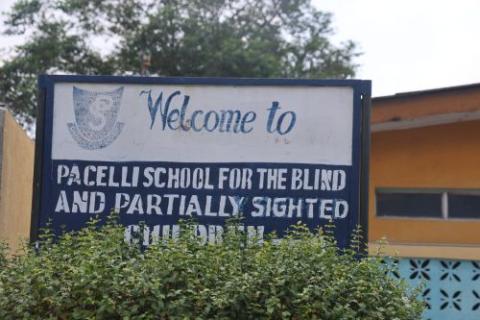
A sign welcomes visitors to Pacelli School for the Blind and Partially Sighted Children in Lagos, Nigeria. (Valentine Benjamin)
Afterward, I went on with my life. I had hoped to become a nurse, but I wasn't a science student because, at that time, my secondary school had no science teachers. That stopped me from taking science subjects. I kept wondering how I'd cope if I chose these science subjects. I worried about how I would pass the external exams. So, I let go of that plan.
Later, when it was time for my group to begin further studies, the counselor in charge of education gathered us and asked what we wanted to study. She explained that the congregation needed more people in special education because there were very few sisters in that field.
She spoke to all of us, then turned to me and said, Sister, you can do it. We want you to go into special education. She told others the same, but her words stayed with me. I went back, reflected on it, and decided to follow that path.
That is how I entered special education. It is worthwhile work, and I find it very rewarding.
What does a typical day here look like for you, and what are some of the greatest challenges and joys you encounter in this role?
In the morning, the boys wake up at 4:30 a.m. because they are greater in number, while the girls wake up at 5 a.m. There are 78 boys and 71 girls, and because of the limited number of bathrooms, the boys start their day earlier. They bathe and then come downstairs. Morning Mass is usually at 6:45 a.m., and on weekends it is at 8 a.m. After Mass, the children go to the dining hall for breakfast.
When they finish breakfast, they gather for assembly and then proceed to their classes.
Break time is at 11:35 a.m., when they have snacks. After break, they return to class until dismissal at 1:30 p.m., except on Fridays when they close at 1 p.m.
After the afternoon assembly, they go to their hostels to change into their day wear. When the bell rings for food, they come down to the dining hall for lunch.
After lunch, they go back to class for extra lessons, which continue until 3:30 p.m. At 3:30 p.m., they return to their hostels for siesta.
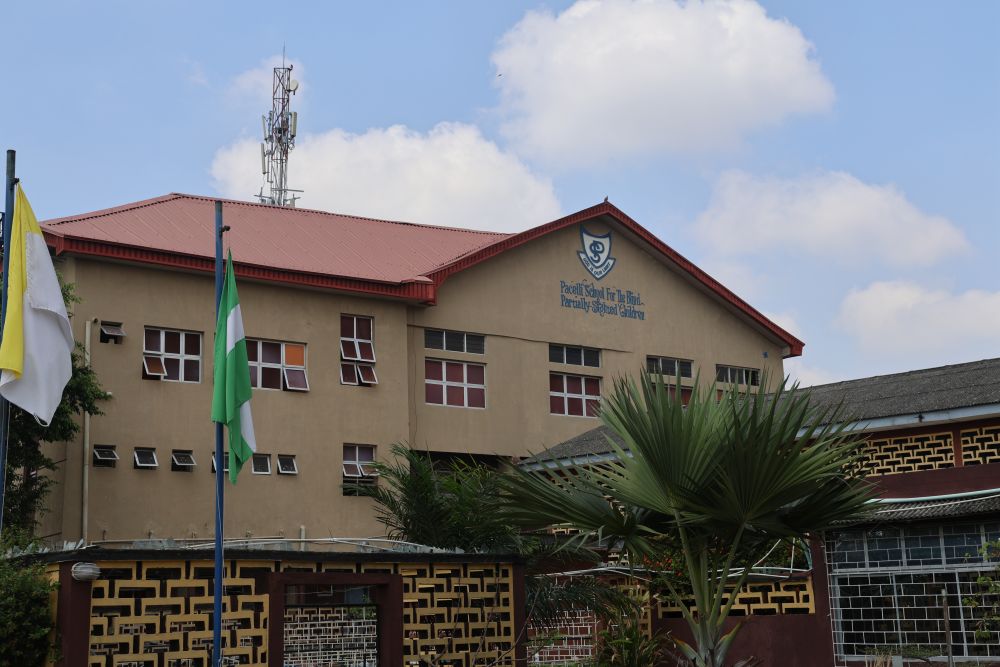
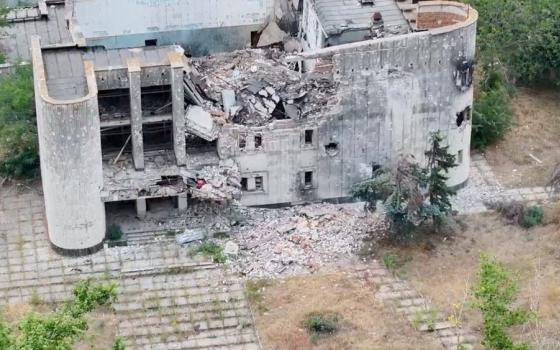
This building serves as a school hall, classroom and girls' hostel at the Pacelli School for the Blind and Partially Sighted Children in Lagos, Nigeria. The school serves about 150 students. (Valentine Benjamin)
At 4:50 p.m., the bell rings for the rosary, as this is a Catholic institution. The day is fully occupied. After the rosary, they have time for recreation.
At 6:30 p.m., they come for supper. After supper, they return to their hostels, shower and change for night prep. Prep runs from 7:30 p.m. to 9 p.m. After 9 p.m., they go back to their hostels, listen to the news until 10 p.m., and then it's lights out and bedtime.
What challenges and joys do you experience in your role as principal of this school, given all the daily activities you oversee?
My greatest joy is seeing our pupils grow until they can live and function like everyone else. One example is Akinola Opeoluwe, an alumnus who is now a university graduate and doing marvelously well. One of his visually impaired colleagues is here with us, teaching computer studies.
Another story is of a lady who is still here. She came last year, convinced she could no longer be productive. She had completed her HND (Higher National Diploma) before losing her sight and could no longer read print. We gave her accommodation and taught her braille, computer use and other skills.
During that period, she learned about Akinola's Accesstech Innovation and Research Center, where he trains visually impaired people in technology. I don't recall exactly how she heard about it, but we enrolled her there as a day student. Now she teaches others. I told her that after her training, she should stay and teach other people, especially adults who come with experiences like hers. We have employed her for that purpose, and she is doing it now.
This, too, is a deep joy for me: seeing them not only manage but excel.
What subjects does the school offer?
It is a primary school, and we follow the same national curriculum as other primary schools. The school is specifically for blind and partially sighted children, but academically, we run the same national curriculum as other schools. That is why we remain in session when most schools in Lagos are also still open.
The main difference is that our children read and write in braille. They use their fingers to feel the dots. Our pupils also do very well in inclusive settings. Some of them go on to regular secondary schools, where they compete successfully with sighted students.
There is one girl named Mercy who left here two years ago. She is now in JSS3 (junior secondary school). In her last result, she placed third out of 125 students. She writes exams and essays just like everyone else. These are the stories that encourage us to continue.
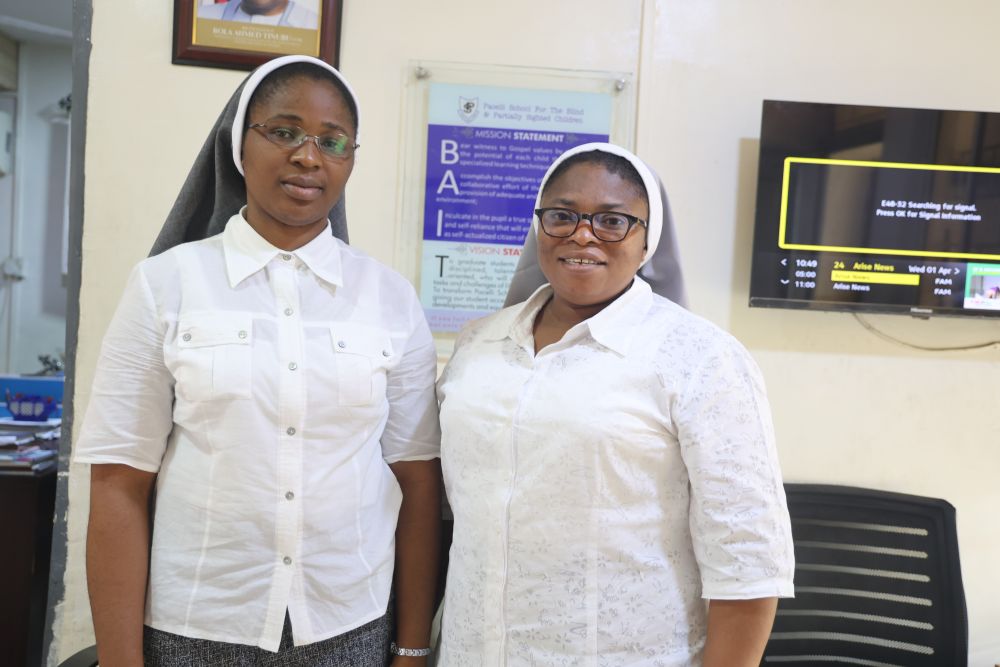
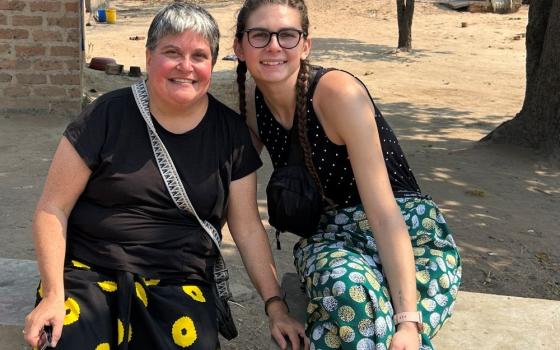
The matron of Pacelli School for the Blind and Partially Sighted Children in Lagos, Nigeria, Handmaids of the Holy Child Jesus Sr. Rosette Lirfe (left), poses for a photo with the principal, Sr. Agnes Onwudiwe. The school was founded in 1962 by the Archdiocese of Lagos. (Valentine Benjamin)
Can you share a particularly memorable or moving experience with a student that affirmed your vocation?
Mercy's story is one of them. We struggled to support her because our school is completely free — the children don't pay any fees.
So, how do you fund the school?
We receive support from a range of people and groups — schools, organizations and individual donors. To reach more supporters, we distribute flyers and direct people to our website, where they can find all the key information about us, including our account details and phone numbers, so they can get in touch.
Funding secondary education for our graduates is one of our biggest challenges because secondary schools charge fees. To manage this, we start planning early. For pupils who will graduate in July, we begin seeking resources and sponsors well in advance.
Advertisement
Looking ahead, what is your hope for Pacelli School and for the broader inclusion of persons with disabilities within the church and society?
I hope that in the near future, there will be proper provisions for persons with disabilities in all schools. Many of them currently struggle to gain admission to secondary schools. If more secondary schools made room for them, for example, by employing special educators, their educational experience would greatly improve.
Instead of everyone competing for a few schools like King's College, Queen's College or federal government colleges, many more schools could admit them. The key requirement is simply to have trained special education teachers. More people should go into special education so there will be enough hands to support these learners.
Also, our society and physical environment need to create many opportunities for children with disabilities. For example, visually impaired pupils in mainstream secondary schools still face significant challenges.