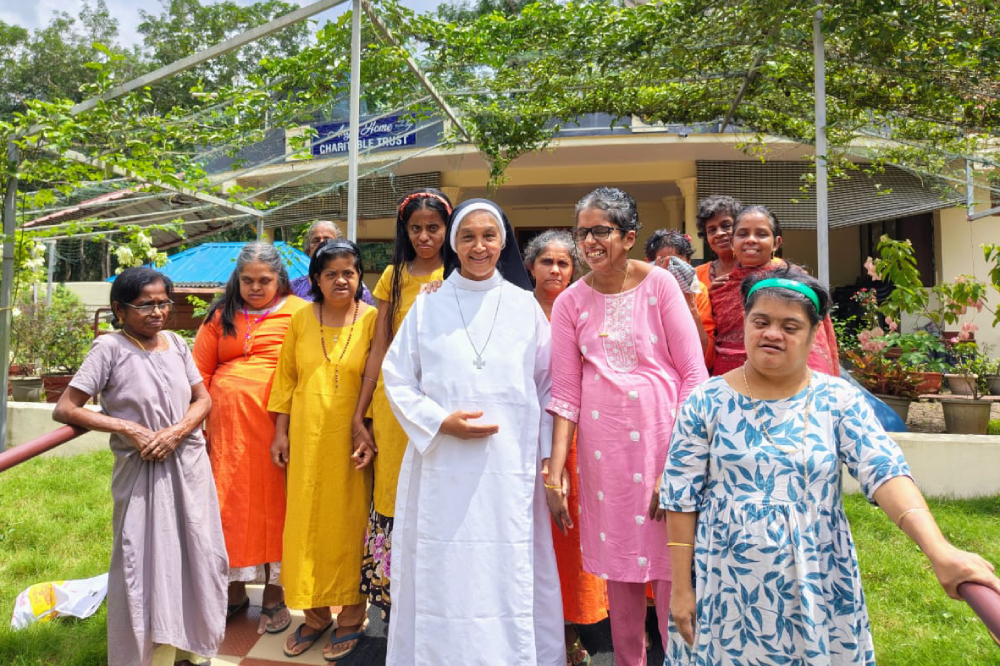
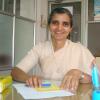
Sr. Elite Mattappillil with the residents of Angel's Home, attached to Asha Bhavan (Abode of Hope) at Changanacherry, a town in the southwestern Indian state of Kerala. (Courtesy of Elite Mattappillil)
by Sr. Lissy Maruthanakuzhy
Congregation of the Mother of Carmel Sr. Elite Mattappillil has completed more than five decades of serving people with intellectual disabilities.
Mattappillil was born in Kerala's Kottayam district. During her school years, she excelled in arts, sports and social activities, and no one expected her to join a convent. However, a Clarist sister shared her vocation story, which touched her. She said to herself, "If she can become a sister, why can't I?"
She joined her congregation as a candidate in 1969 and began her ministry in 1973 when she was 22 in Changanacherry. After receiving special training in India and the U.S., the now 75-year-old nun has set up three schools in the Archdiocese of Changanacherry in the southwestern Indian state of Kerala and three schools in the Diocese of Tzaneen in South Africa.
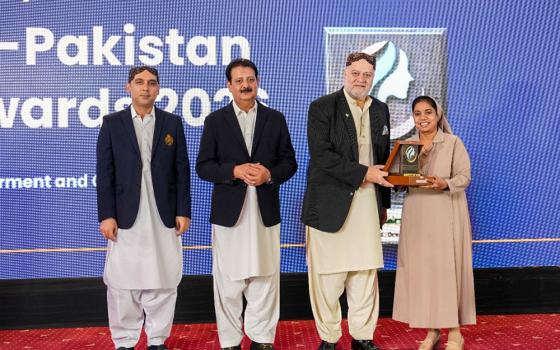
In April this year, she was chosen for the best achievement award given by the Association of Catholic Rehabilitation Centres in India.
Currently, she manages a home for women with intellectual disabilities in Changanacherry.
Mattappillil spoke with Global Sisters Report about her life and mission.
GSR: Why did you take up the mission for the mentally challenged?
Mattappillil: After my first profession in 1972 I was all excited to go to the missions. It was then that the Archdiocese of Changanacherry decided to open a special school for "mentally challenged children," at the request of their parents.
My superiors asked me to take up the new mission but warned me of the sacrifices and challenges involved.
The archdiocese selected one sister from two other different congregations for the school and sent us for a one-year training in Bengaluru, the capital of Karnataka, Kerala's northern neighbor.
Was the school ready when you returned after training?
No. The construction was delayed because of a lack of funds. Seeing the archdiocese's advertisement about the school, many parents came for admission. So, I was asked to start the school with five children in a room in our convent. The other two sisters joined me eventually. We named the school Asha Bhavan (House of Hope). A year later, we had nearly 100 students and moved into the under-construction building. The building was completed in 1985.
For the next 25 years, I served the school as its principal, administrator and secretary.
Were there any memorable events during the initial stages?
Many students were boarders. Once, a child fell ill and I took her to a hospital. I laid her on the doctor's table in the consulting room and pleaded with him to save her. My gesture surprised the doctor, and he told me to bring my sick children directly to him without waiting in the queue.
Could you explain the admission process at the school?
We admit four-year-old children, who have developmental delays. We also check their capacity for self-help. Some parents train their children from an early age to brush their teeth and use the toilet properly. Some do everything for the children, making them totally dependent. When such parents age or fall sick, they bring their children to our school.
Some parents are angry and irritated with their children. We have to train them along with their children. We tell such parents to control their irritation and anger and to not force their children.
We train near-functional students to become productive members of society. We also train them to help other children. We employed some children who turned 18 in our convent. We also send them to shops or factories so that they earn a living.
Does the school have a special syllabus?
Yes, a syllabus is prepared by the government. The classes are categorized as care groups (very deficient in learning), pre-primary and primary. The secondary level has pre-vocational and vocational training. We train them in craft work and how to make disposable glasses and plates. They are also taught to grow organic vegetables and manage poultry and livestock.
So far, more than 1,500 children have gone through our school. We try to discover and nurture their talents and capacities. The younger they are, the easier it is to train them.
Advertisement
Any regrets or causes for joy?
We are happy that the children bring medals from international sports events such as the Special Olympics. Unfortunately, their success is not recognized by the government and society.
We, the educators, do not receive acceptance, encouragement or benefits from society and government like the teachers of a normal school. Our salary is low, and we do not get a pension. We have to fight for our rights.
However, we are thrilled that ten young women who worked as staff at Asha Bhavan have joined our congregation.
Why did you go to South Africa?
The bishop of Tzaneen visited our school when he came to our archdiocese. He then requested our archbishop and my provincial to send sisters to open a similar school in his diocese. I volunteered to go.
My provincial told me that the bishop would arrange everything to start a school.
However, when I reached Tzaneen with two other sisters, the diocese told us to visit villages and discern people's needs. In India, bishops and parish priests arranged everything for us to start a new center.
The parish priest would drive us to a village while he went to another. After a month, the bishop gave us a car and suggested we learn the local language to understand the people. We visited 13 villages in one parish. The people were not familiar with sisters and were not excited to have us. The parish priest, a Belgian, told us to get over our cultural shock.
The people would ask us if we had come to make money and leave. The priest convinced them that we had come to educate them.
After six months, we started a school. We found many children with disabilities during our visits to families. We had to convince the parents to educate them.
We started a school in a house, which the parish priest provided. Soon, people from other villages requested us to open similar schools.
Once, a woman from the municipality requested me to start a school, and I helped her. But I did not see her for a long time, so I went looking for her and found a school with many children. She never bothered to tell us.
It pained me when people did not acknowledge our love for them. However, I opened three schools during the ten years I spent there. I returned to India in 2007.
Why did you open a home for adult women on your return?
Many families in Kerala find it difficult to manage when we send their children after they turn 18. Many parents requested me to open a home for adults who are intellectually disabled. So, I opened the Angel Home for such women. I keep them occupied with cooking, games, prayers and gardening. They call me Amma (mother).
How do you feel about receiving awards for your work?
I have received ten awards so far. My first award was in 2000 when the Archdiocese of Changanacherry recognized my work during the diocesan day celebrations. In April this year, the Association of Catholic Rehabilitation Centres awarded me for extraordinary service during its national convention. I look at the awards as an acknowledgement of my service to the poorest of the poor.
What would you tell younger sisters who want to join this mission?
We have to first love them as special children of God. All they want from us is love. God gives us enough strength and grace to serve these children.