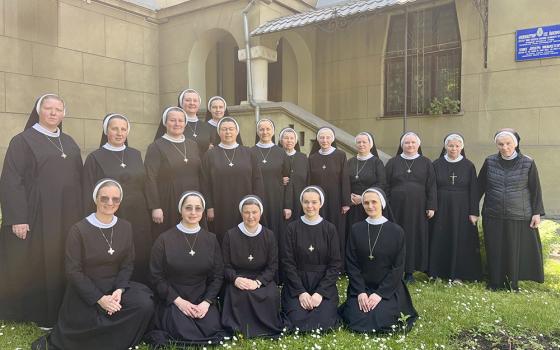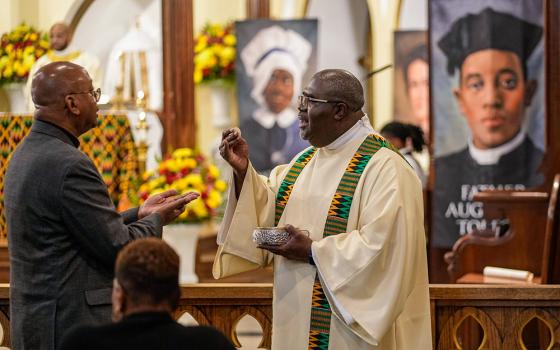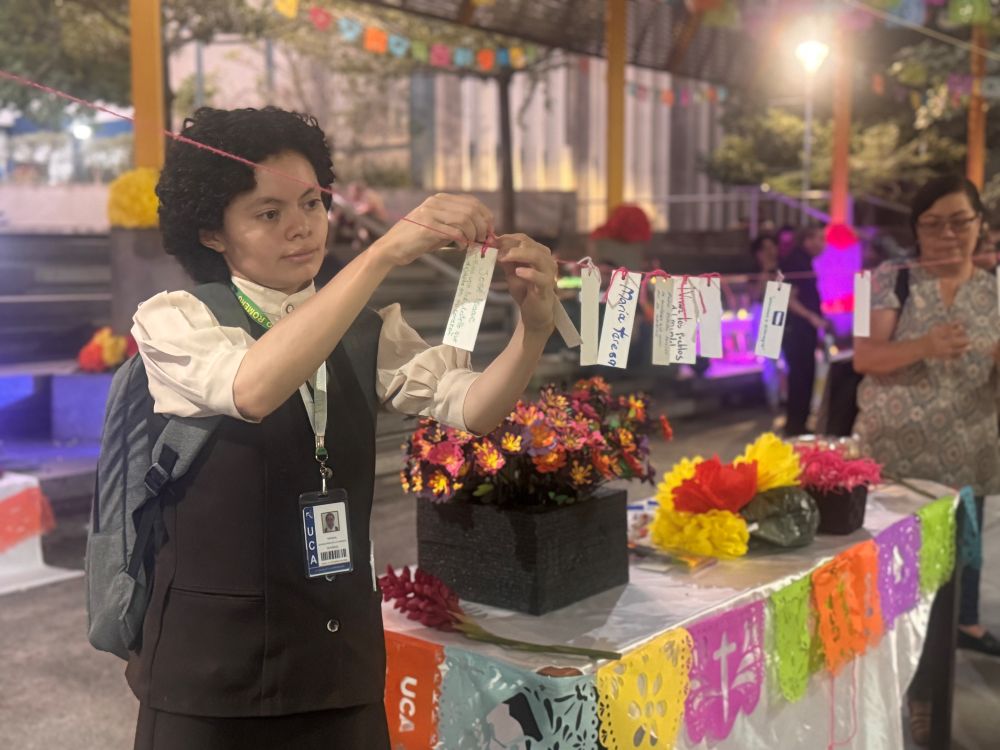
A Carmelite Missionary of St. Teresa sister hangs the name of a loved one at a memorial Nov. 16, 2026, following a Mass to commemorate the 1989 killing of a Salvadoran woman, her teenage daughter and six Jesuits killed on the campus of the José Simeón Cañas University in San Salvador, El Salvador. (GSR photo/Rhina Guidos)
by Rhina Guidos
One of my favorite things to do when I'm home in Washington is to take an autumn stroll through the city's cemeteries. The season, when the cold sets in and the beautiful, vibrant colors of the deciduous trees first appear in the United States, helps us reflect on the cycles of our lives and on our loved ones who are no longer with us. It's a season that coincides with the church's celebration of All Saints' Day and All Souls' Day in early November.
Although I have spent this fall intermittently in El Salvador — where most of the trees are evergreen and retain their leaves, and where the sun still shines fiercely — I have found other reasons for reflection, not in a landscape of trees, but one of martyrdom.
Here, the example left behind by women religious such as Maryknoll Srs. Ita Ford and Maura Clarke, Ursuline Sr. Dorothy Kazel, and lay missionary Jean Donovan — all from the U.S. and all murdered around this time in 1980 — shines as brightly as the red, yellow and orange leaves of autumn in the northern regions of the Americas. On Dec. 2 of that year, all four were raped and then murdered because they followed the Gospel: by offering food, care shelter and transportation to rural victims of a cruel war.
But they weren't the only members of religious life who chose to accept the bold risk of following Jesus and the Gospel.
These days, on the campus of Jesuit-run José Simeón Cañas University, known as the UCA [pronounced ooh-kah], I have observed the great public devotion to the life, martyrdom and the example left by religious life — in particular, a community of six Jesuits who, along with their housekeeper and her teenage daughter, were brutally shot to death in the early morning hours of Nov. 16, 1989.
Each year, the university community honors the "martyrs of the UCA" in the days leading up to the commemoration of their deaths: laywomen Julia Ramos and her daughter Celina, and Jesuit Frs. Ignacio Ellacuría, Ignacio Martín-Baró, Segundo Montes, Juan Ramón Moreno, Amando López and Joaquín López y López. The community remembers them each year with acts of religiosity and love: creating "alfombras," art made from colorful sawdust and strewn on the floor, like a rug, bearing the images of the martyrs; and songs, visual exhibits and a nighttime vigil. But they also host presentations and talks that focus on what the Jesuit brothers and other members of religious life wanted to see prevail in El Salvador and throughout the world: a peace that stems from the truth.
The martyrs of El Salvador — who also include other members of religious life, as well as laypeople and diocesan priests — set a path we can follow, said Jesuit Fr. Leopoldo Galdámez, provincial of Central America for the Society of Jesus, during his homily at the Nov. 16 commemorative Mass at the UCA. Like Jesus of Nazareth and the martyrs, he said, we must live ordinary, daily life guided by values and principles that are neither those of the world nor of society, but rather by the values and principles of the Gospel.
Advertisement
"In the face of national and international realities, we have something to say and testimony to share in a world where lies, manipulation, hatred and polarization prevail — where social problems are resolved through violence, and even where attempts to end violence rely on institutionalized violence that causes pain, death and suffering," said Galdámez.
He added that, like the martyrs, Christians have something to say "where the defense of human rights, the environment, women and the most vulnerable is criminalized, where having one's own critical thoughts is a crime, where the rule of law is trampled upon, and arbitrariness and abuses of all kinds prevail."
Citing Pope Leo XIV during his recent visit to Latin America, Galdámez spoke out against the dehumanization seen in various countries across the region, including El Salvador, whose image of a rehabilitated country has gone viral, painting a picture of a country that has overcome violence by imprisoning 2% of its citizens, a place proud to have the highest incarceration rate in the world and a "mega-prison" for its people.
Under measures the government calls a state of exception, the vast majority of those incarcerated have no right to legal counsel to defend them, and several other personal freedoms, including the right to assemble, are restricted. Likewise, private telecommunications have been suspended in the country with the aim, the government says, of protecting the population. Nearly 70% of the population agrees with the continuation of the restrictions, according to a survey published in June by the UCA's research institute.
"We can give it different names like 'national security,' 'development' or even 'peace,' but in the end, these measures or strategies dehumanize people via demagogic rhetoric and advertising campaigns in a country where reality is not reality but a mirage. We have something to say and a way to position ourselves in the face of it," Galdámez said in his homily.
The Jesuit offered guidance on how to follow the path that the martyrs left for those who pass through El Salvador — and other parts of the world — whether for long or short periods.
"First, we need to keep our eyes open, be aware of what is really happening before us, and not get caught up solely in the facades, appearances and distortions of reality," he said. "Second, seek the truth amid much falsehood, amid so many fallacies and much manipulation. It is important that we always seek the truth in the midst of that reality."
He urged those present to think critically and "not to accept [certain] narratives, much less repeat them" — which is what happens in the wake of a media blitz.
"When many people believe all these lies and narratives, we must — we have to — think deeply and, hopefully, critically," he said.
And that's what this landscape — not of colorful trees, but of holy people who searched for the truth to come out — leaves behind as inspiration in this season of reflection in Latin America.
"From simplicity, from everyday life, from the humility of our daily work, from the ordinary things we always do, that is where we bear witness, and with that witness we are shedding light on this reality," Galdámez said. In the face of the country's and the region's ever-increasing dehumanization, he added, we have a duty to "contemplate our martyrs, to contemplate that army of men and women who generously gave their lives."