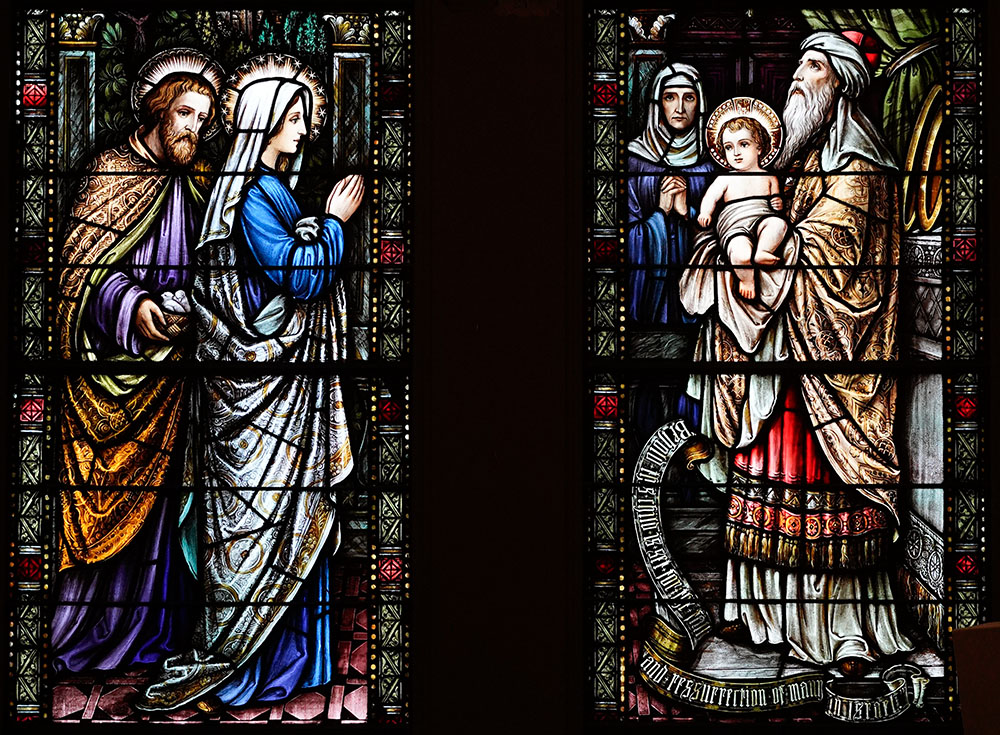
The presentation of Jesus in the Temple 40 days after his birth is depicted in stained-glass windows at Our Holy Redeemer Church in Freeport, N.Y. The feast of the Presentation of the Lord, also known as Candlemas, is celebrated Feb. 2. (OSV News/Gregory A. Shemitz)
by Sr. Joyce Meyer
International Liaison, Global Sisters Report
The World Day for Consecrated Life and the feast of the Presentation of Jesus in the Temple fall on the same day. I'm interested in three stories of the scriptural event: the cleansing ritual of Mary, the presentation of Jesus, and Anna's part in this event.
Mary's need for cleansing was a traditional ritual after a woman had given birth or had been menstruating. During this time, a woman was considered "unclean" because of the loss of life force, or blood. She was no longer spiritually whole.
Leviticus 12 describes how women who had just given birth or were menstruating were excluded from temple worship. To once again participate in temple prayer, she was required to undergo an immersion bath in the local Jewish women's bathhouse and then go to the temple to make certain offerings. She would have stayed away for 40 days after the birth of a male child and 80 days after the birth of a girl.
In reflecting on Mary's cleansing ritual, I understood that the tradition was about recovering and replenishing the life force that seemed to have left in childbirth. She did all that was required to make herself available for receiving life again. Consecrated life is also about being faithful to do all that is needed to be spiritually open to receiving God's fruitful and live-giving Spirit in the way we live and serve others.
Anna, Jesus and Mary were all simple, humble people who followed the daily rituals and commitments, while God worked through them for the good of others.
The second story is about the presentation of Jesus. Mary and Joseph brought their newborn to be dedicated to God. Traditionally, if the child was a firstborn son, they were required to present him to God for ritual redemption — meaning that God received him back as a true son. It can be imagined that in their minds, they were remembering Jesus' unusual conception and this presentation only affirmed for them that he belonged first to God and his life would continue to be guided by God in a special way.
Jesus' presentation and consecration began his spiritual journey, nourished by his parents and their local community and following the Jewish traditions of his time. He became and remained a fully active Jew.
Through Christian baptism, children or adults are similarly presented to God and thus consecrated, made holy, received as daughters and sons as Jesus was. This baptism is the beginning of a lifetime spiritual journey and, for some, God invites that beginning to take the form of a public consecrated life.
This is a kind of second baptism that has its own rituals of commitment. The rituals and forms of consecration for religious life are not all the same. Some promise celibate chastity, poverty and obedience, but they all come to the same purpose — a lifetime choice to be totally open to God for transformation.
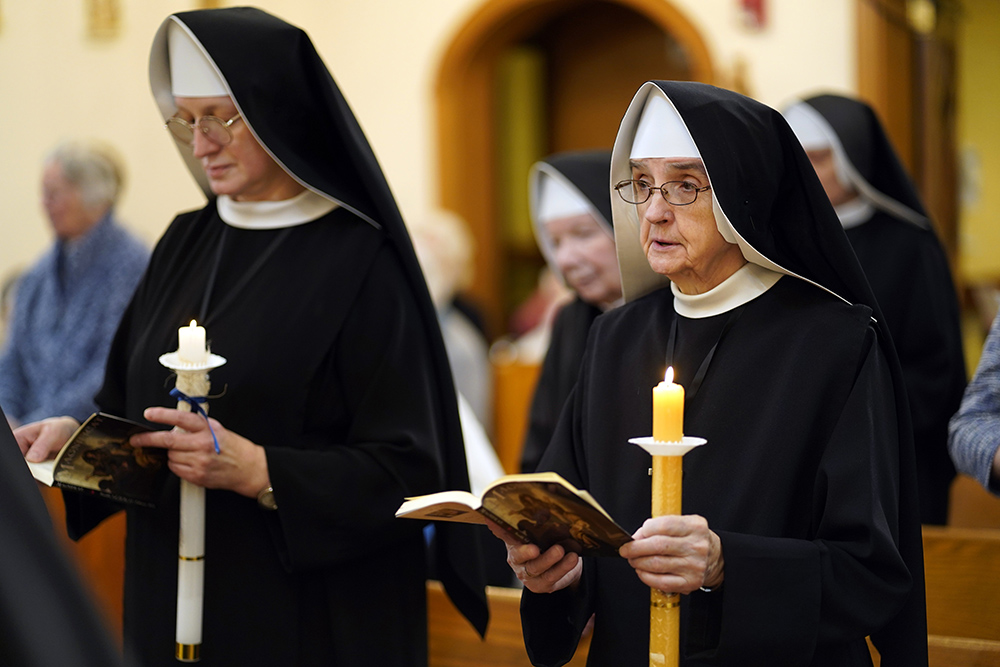
Members of the Missionary Sisters of St. Benedict mark World Day for Consecrated Life at morning Mass at the St. Joseph Home for the Aged in Huntington, N.Y., Feb. 2, 2024. (OSV News/Gregory A. Shemitz)
None of us ever knows exactly where those choices may lead. Anna, the prophetess, is a perfect example.
Her story starts out as a married woman, committing herself to a lifetime as a wife and mother. But life intervened and only seven years later she was widowed. Still a young woman, she felt a call to temple life of fasting from everything that was not of God. She also prayed, opening her up to God, waiting day by day to see where God was leading.
Her life may have seemed useless to her family, since she was childless, but as time went on, by careful listening and responding to Sophia, God's Spirit alive in her, she developed deep, penetrating spiritual insight, a "gaze" into God that Pope Francis once said "did not stop with appearances."
The transformation of her mind and heart became so obvious that she was known as a prophetess, taking her place alongside Old Testament women like Miriam, Moses' sister, and Deborah, a judge of Israel and Huldah, a king's counselor.
She and all of these women in Scripture were called to bear witness to God's active presence in the world, transforming them into public leaders among their people. Their lives and words witnessed the importance of listening and following the guidance of Sophia, Wisdom.
Advertisement
Even at age 84, Anna was still actively engaged in the mission God had called her to. She had been unwittingly preparing all those years for one moment — the coming of God's special revelation. Having been fine-tuned by Sophia, she discerned, proclaimed and praised God that in this tiny baby being held by this young couple was the hope, the redemption that the Jewish people had been awaiting for thousands of years. Her eyes perceived beyond these humble appearances to recognize God's vision.
Those publicly consecrated in religious life are called to follow a similar pattern as Anna, learning skills of deep listening, allowing their hearts and minds to be shaped and transformed into Christ's. And, along with being witnesses of the values of temple life, we are called to be of service in walking with others who are also on this journey of transformation.
Anna, Jesus and Mary were all simple, humble people who followed the daily rituals and commitments, while God worked through them for the good of others. Today, we celebrate many such women and men, many of whom are hidden, but all find joy in being called to daily witness to God's presence and action in the world.