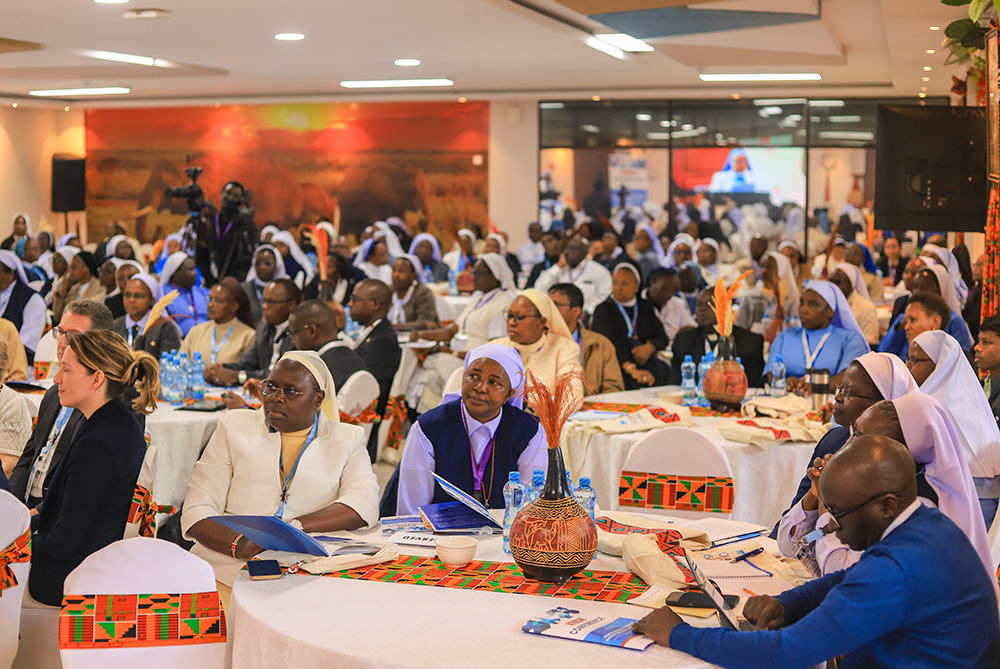
Delegates in canon and civil law from 13 African countries attend the African Conference for Catholic Sisters in Canon and Civil Law held July 30-31 in Nairobi, Kenya. (Wycliff Peter Oundo)

by Mourine Achieng
For decades, safeguarding was perceived as the church's response to address abuse allegations. Over time, safeguarding has shifted to institutional frameworks that enable the church to protect the dignity of those entrusted to its care.
"Safeguarding asks us not only how the church should respond when abuse has occurred but how authority should be exercised so that abuse becomes less likely in the first place," Francesco Pappalardo, legal consultant for the Pontifical Commission for the Protection of Minors, said at the African Conference for Catholic Sisters in Canon and Civil Law held July 30-31 in Nairobi, Kenya.
Effective safeguarding, he said during his presentation, needs streamlined reporting procedures, clear delegation of responsibility, reliable accompaniment processes, foolproof evaluation systems, and collaborative leadership that integrates safety in every aspect of ecclesial governance.
Claudia Giampietro, of the Pontifical Commission for Protection of Minors, noted that beyond the safety of those entrusted to the care of religious through the ministries, projects and initiatives they run, effective protection measures must also include the safety of religious — an area that rarely gets attention, as religious often shelve their own abuse experiences.
Conference participants acknowledged that for safeguarding to be inherent in their everyday life, it must be woven at the onset of formation and nurtured throughout their vocation. Sr. Dr. Mary Lembo pointed out that during the recruitment process, institutes must assess candidates' life experiences to understand what makes them feel safe.
It would help to incorporate the individual candidate's experiences into the formation process rather than simply offering formation as a checklist of step by step process to be ticked to become a sister, said Lembo, a psychotherapist and a member of the Congregation of St. Catherine of Alexandria.
Similarly, incorporating code of conduct and safety guidelines into the formation curricula would help the religious discern when they feel safe, with whom they feel safe, and whether others feel safe in their presence, community or church. This would create a fertile ground where protection buds and grows in religious life, Lembo said.
Advertisement
Participants regarded the conference as a timely first step, as the sponsoring organization Catholic Sisters in the Legal Profession could further strengthen and nurture robust safeguarding within religious life through training superiors and religious congregations. This would fill gaps in formation, participants said. Over time, it would create an environment where religious understand safety, feel safe, raise concerns and get support.
Such an initiative has been implemented in India through the Conference of Religious Women in India. The Grievance Redressal Cell, established in 2023, creates awareness and trains religious women on the different forms of abuse and protection acts and laws. The initiative also provides a platform where religious women can report their grievances and are sure to find support and accompaniment throughout the process.
Referencing the victim-centered approach, Johanna Streit, head of safeguarding at Missio Aachen, explained that survivors' dignity, security and needs take precedence. "Those receiving allegations must listen without judgment and maintain confidentiality, as most survivors fear reporting because of what others might say about them. 'I understand' or 'I hear you' is a simple yet adequate response," she said.
Equally important is understanding the extent of support available and connecting survivors with the right professional help, whether medical, legal, psychological or spiritual.
When healed, survivors can become "wounded healers," said Sr. Jane Wakahiu, assistant vice president of the Catholic Sisters Initiative at the Conrad N. Hilton Foundation. "Personal pain, when transformed through grace, can deepen empathy and become a source of healing for others," Wakahiu, a member of the Institute of the Little Sisters of St. Francis, said in her keynote speech. (The Hilton Foundation is a major funder of Global Sisters Report.)
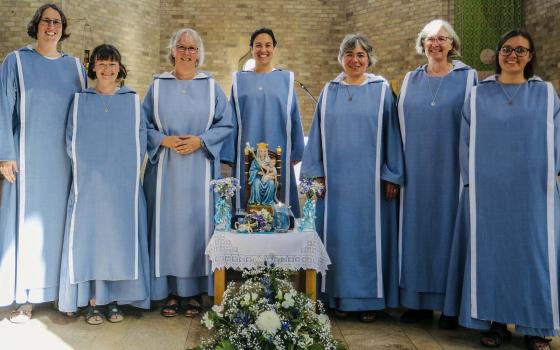
A testament that brokenness, when healed, can create an environment that nurtures healthy religious life is the initiative of Srs. Theresa Aletheia and Danielle Lussier. Drawing from their own personal experience of abuse in the church, the two sisters are working to establish the Sisters of the Little Way of Beauty, Truth and Goodness in Lexington, Kentucky, to support other sisters who have experienced abuse.
The well-being of the religious also extends to when institutes face challenging circumstances like canonical separation of members. Safeguarding here calls for respect for a person's dignity and rights while exercising authority with responsibility, transparency and accountability.
"We help congregations to follow the right canonical procedures in cases of separation from their institutes," said Sr. Eutropia Chao Mwakamba, director of Catholic Sisters in the Legal Profession. The organization also provides accompaniment, referring sisters for counseling where needed and following up on their progress after they leave their institute.
Holistic safeguarding measures care for the religious from their formation through religious life, preventing and mitigating harm, according to conference discussions. In cases of harm, regulations that support and accompany allow for healing without shame, while canonical separation procedures and accompaniment allow for a dignified transition.
Participants characterized safeguarding as a synodal journey, where everyone must share the responsibility for creating an environment in which "each person knows that his or her dignity will be recognized and protected," Pappalardo said.