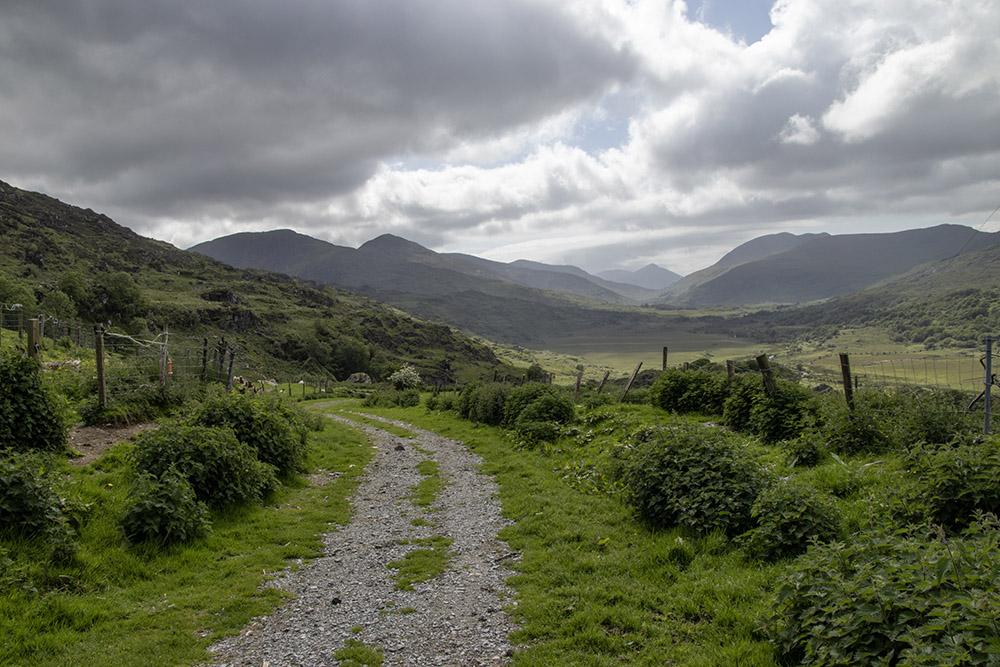
A gravel road travels into Killarney National Park in Ireland. One of the sister panelists for The Life has resolved to relearn the Irish language in 2026, after many years living as a missionary outside of her native land. (Teresa Malcolm)

by The Life Panelists

(GSR logo/Toni-Ann Ortiz)
Starting a new year often comes with resolutions, wishes and promises that attempt to set the course for what lies ahead. Some resolutions become habits, others get lost amid fatigue and routine, and others transform along the way.
This month, the panelists for The Life answer the questions: What has been your resolution for this new year? How are you doing with it? Are you keeping it or laughing at it?
Sr. Abhita D'Silva belongs to the congregation of Franciscan Missionaries of Christ the King from India. She trained professionally as a teacher and has worked as a school principal. She also specialized in counseling for people living with HIV/AIDS. D'Silva currently serves as secretary to the superior general and will complete her term in 2028. Her hobbies include reading, cooking, dancing, singing and caring for the sick with abundant mercy.
Every Christmas, I would eat sweets to my heart's content, resolving that in the coming year I will not eat sweets, in order to reduce weight. But as I write these reflections, I am having belly laughter, realizing the New Year is breathing at the corner and I have gloriously forgotten my resolution.
While trying to improve my health, I resolved to give up meat to reduce my weight. And yet at the end of three months, I had gained more weight than before. How ridiculous is that?
New resolutions aren't necessarily hard resets, but gentle, intentional shifts — and gifts born from failed resolutions.
As I reflect now, I see the deeper connections between the Catholic Church's World Day of Peace and the Solemnity of Mary, Mother of God. Mary, the "Queen of Peace," shows us that total surrender follows an algorithm.
My resolution to eat less and lose weight only created stress, headaches and restlessness, not peace in my being. Mary's outstanding virtue of welcoming the Prince of Peace in the world proved contrary to my resolution.
The essential inner disposition needed to sustain any resolution is peace. Mary found that peace through her total surrender in the words, "Let thy will be done."
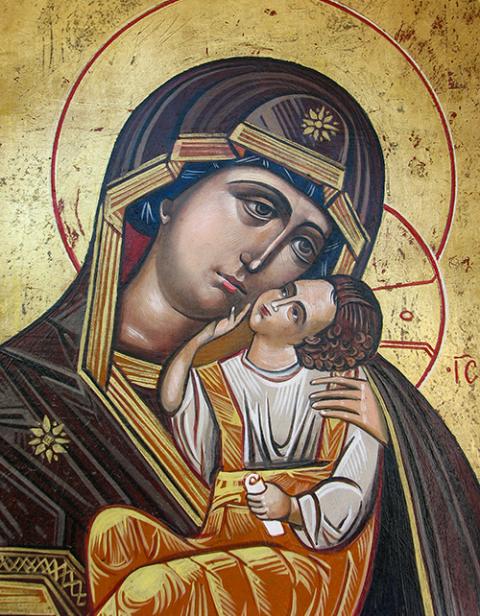
A Hungarian icon of Theotokos, the Virgin Mary as "God bearer" (Wikimedia Commons/Jojojoe)
Faithfulness to God in all things, at all times, is what creates peace. I realize now I was worried only about my peace and well-being, without considering surrendering to a higher power and embracing the gift of each new morning as a new beginning.
Will I bring lasting peace to the world by obsessing over beautifying myself, or by becoming an ambassador of peace for the poor and hungry?
Having failed to keep my resolution, I felt hurt and embarrassed, but it also helped me grow mindful of the chaos everywhere.
My resolution of self-serving love began to expand outward, leading me to see the greater need of feeding the hungry, which ultimately helped me gain control over my eating habits.
Mary is called Theotokos — "God-bearer." Will my efforts to care for beauty become efforts to bear God through acts of kindness?
After focusing on the power of right intention, everything in my life began to fall into place — God's place (Romans 8:28). The Solemnity of Mary, Mother of God, reveals that in this chaotic world, a woman of integrity can bring peace, which is the need of the hour.
New resolutions aren't necessarily hard resets, but gentle, intentional shifts — and gifts born from failed resolutions.
The goal may seem absurd, but the journey of letting go might just lead me to the heartfelt new beginning I was truly seeking: peace within.
Sr. Jacintha Rantšo is currently the provincial leader of the Servants of the Immaculate Heart of Mary, also known as the Good Shepherd Sisters of Quebec. She lives in Lesotho, southern Africa. She joined the congregation in 1983 as a postulant. First, she taught in high school and later on trained as a social worker. She holds a degree from the University of Namibia. After graduation, Rantšo worked with those affected by HIV and AIDS from 2004 to 2011 then became an assistant of the provincial leader. She was appointed as provincial in 2017.
My resolution this year is to enjoy time off after nine years in administration, to renew and restore my spiritual life. I hope this time will bring me more joy and inner peace.
As the angels said at the birth of Jesus, "Peace on earth to those who are favored by God" (Luke 2:14).
I believe that inner peace must be sought — it does not come easily or quickly. It requires surrender to God's will, like Mary's response, "Let it be done to me according to your word."
I am content that I made this resolution and am working on it. In our world today, with its lack of peace and stability, my resolution is an ongoing journey.
Advertisement
Writing for The Life in Global Sisters Report is part of this resolution. In reflecting and sharing, I hope to enter into the peace and reconciliation the world seeks, learning from the columns and articles shared by other sisters.
Pope Francis left us a spiritual legacy of "hope that does not disappoint," and I believe that it is important for religious women to be prophetic witnesses of this peace. Our world lacks peace and stability, but I continue to pray with St Francis of Assisi: "Lord, make me an instrument of your peace." Amen.
Sr. Jean Flannelly, a Sister of Charity of New York, holds a doctorate in clinical psychology from Fordham University, a master of theological studies from Weston Jesuit School of Theology, and a certificate in spiritual direction from Hesychia School of Spiritual Direction. She has devoted much of her ministry to preparing both lay and ordained individuals for church service. Previously a pastoral associate for faith formation, she managed liturgy, spirituality and faith formation in a large urban parish. Now based in rural New York, she continues her outreach to underserved communities, bringing spiritual guidance and support to those in need.
If report cards were given for participation in New Year's traditions, mine from my formative years might look like:
- Eating pickled herring: A+
- Banging pots and pans: A+
- Singing "Auld Lang Syne": A
- Making New Year's resolutions: F
It's clear that I excelled in activities that have a symbolic meaning. Eating herring, pickled or otherwise, is a sign that the new year will be blessed with prosperity, abundance and luck. Making a racket by banging pots and pans or other noisemakers was done to chase away any negative or evil spirits that could darken the new year. Joining in the communal singing of "Auld Lang Syne" affirmed the gift of friendships and the commitment to continue to nurture them.
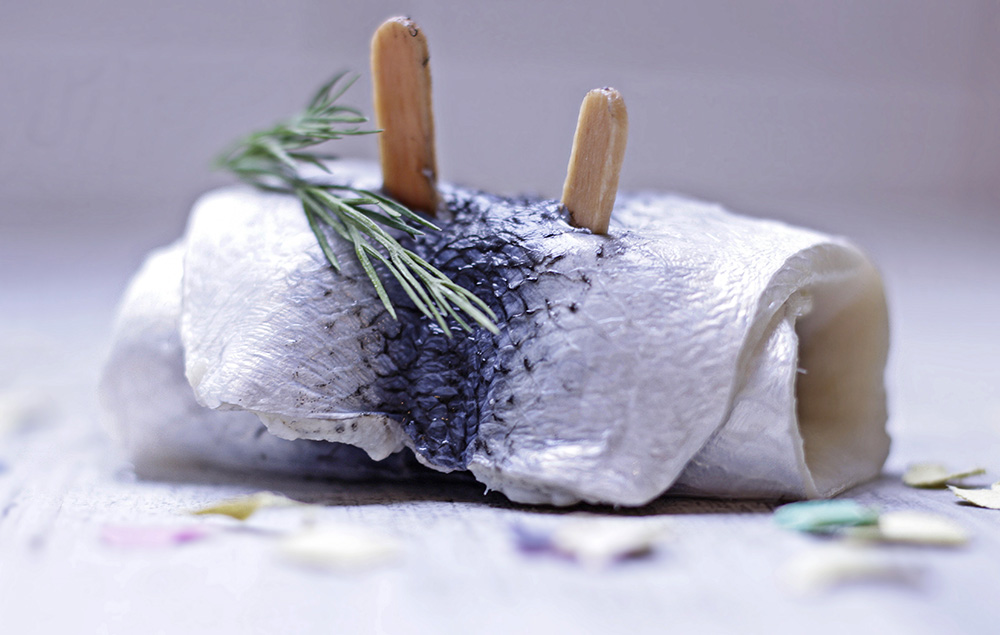
Eating herring, pickled or otherwise, is a sign that the new year will be blessed with prosperity, abundance and luck. (Pixabay/NoName_13)
The failing mark in resolution-making pulled down my GPA by a full grade. It ignored a tradition traceable to the Babylonian empire some 4,000 years ago. The question is why? I desired to grow and become a better person. Maybe it was an intuitive sense that these kinds of promises most often fail before January ends.
But here I am now, more than a half century removed from that fantasy report card and still resisting making New Year's promises. To understand the "now," a couple of clips from my past can shed some light.
Snippet 1: It is 6:30 a.m. in the motherhouse chapel. I am there with all the other novices.
More than 200 sisters sit in silence. It's broken only when a voice loud enough for all to hear speaks the word "resolution." On cue, all move to their knees, silently offering to God the resolution prompted by the day's meditation. Usually some practice or action.
Snippet 2: Same time, same place, same people, the next day. The one difference is that silence is now broken by the priest chaplain. Walking down the side aisle to the sacristy, in a clear loud voice he says, "Revolution." All 200-plus sisters fall to their knees.
God is the one who takes the lead and invites us in numerous ways to become the person God calls us to be.
As a novice in the community and in the spiritual journey, my focus was on my efforts to become a better person, a kind of muscular spirituality. As I have lived, ministered and related to different people on various levels of intimacy and mutuality, I have learned that the impish priest chaplain was right. There must be a revolution in how we see ourselves and God.
God is the one who takes the lead and invites us in numerous ways to become the person God calls us to be. My strategy now is to listen carefully to my experience and for an invitation as to where to walk into the future.
Sr. Prisca Chuzu is a dedicated member of the Handmaids of the Blessed Virgin Mary of Lusaka, a diocesan congregation. Growing up in a Catholic family, she actively served as a youth secretary at parish level. With a strong passion for health care, she began her ministry as an enrolled nurse and later advanced to become a registered midwife. Currently, she serves as the hospital administrator at Mpunde Mission Hospital in Kapiri Mposhi District, Central Province of Zambia. Under her leadership, the hospital received an award from the Churches Health Association of Zambia for outstanding performance in income-generating activities.
Every year, I make resolutions that keep me spiritually grounded and, at times, a little amused at myself. For the past three years, my goal has been to faithfully say the Divine Mercy Rosary at exactly 3 p.m. and 3 a.m.
The 3 o'clock hour, known as the Hour of Mercy, holds deep significance for me. It is a time to remember the Lord's mercy and to seek his grace for the world. For peace in the world, our country, families and hearts.
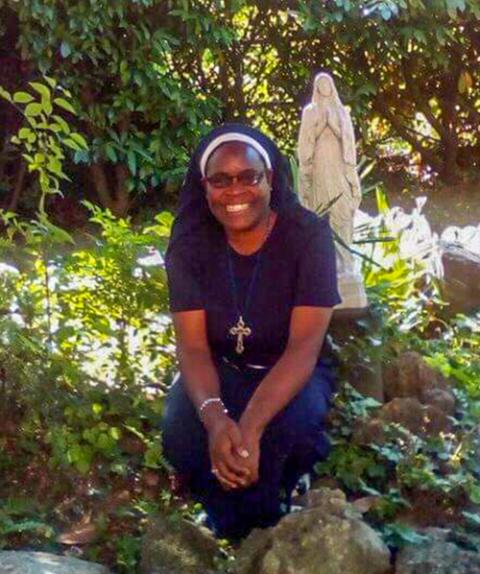
Sr. Prisca Chozu of the Handmaids of the Blessed Virgin Mary pauses for prayer at the 3 p.m. Hour of Mercy at the convent of the Sisters of Charity of Milan in Lovere, Italy. (Courtesy of Prisca Chozu)
Now, here's the curious part: No matter how fast asleep I am, when the sacred hour of 3:00 a.m. arrives, I somehow wake up almost instinctively. I reach under my pillow, and there lies my rosary waiting like a quiet companion in the dark. It's as if heaven itself nudges me awake, whispering, "It's time." Half asleep or not, I find myself mumbling the familiar words, and before I know it, the chaplet is done.
But the 3 p.m prayer? That's another story entirely! During the day, life seems to whirl around me — community duties, meetings, phone calls, conversations and a hundred little distractions. More often than I would like to admit, I look at the clock only to realize it's already 3:30, and I've missed my moment of mercy.
So, for 2026, I made a rather silly but serious resolution: to set an alarm for 2:55 p.m. every day, no matter where I am or what I'm doing. Imagine sneaking out of a meeting, tiptoeing to a quiet corner and whispering the chaplet like a secret agent of Divine Mercy!
What inspired me most is the example of my Muslim brothers and sisters. I have always admired their prayer times — no matter the setting, no matter who is watching. When it's time, they pray, and the world can wait. That level of devotion humbles me. Why should I hesitate to pray when I know the value of that moment?
So far, my alarm has startled more than one unsuspecting sister, and we have shared a good laugh about it. But I am keeping this resolution with joy. Whether in the silence of dawn or the bustle of the afternoon, sometimes inconvenient, it is always beautiful.
In 2026, my goal is simple: to pray, to smile and to stay awake — both spiritually and, at 3 a.m., quite literally.
Sr. Kathleen Geaney is a member of the Missionary Sisters of St. Columban, an international congregation with missionary presence in China, Pakistan, Myanmar, the Philippines, Korea, Ireland, Britain and the United States. Geaney was missioned in the Philippines, England and Myanmar. Her ministry centered on interfaith dialogue and working with women from different faith communities. She was enriched by 18 years of presence in Myanmar and returned to Ireland in 2024. Having had sabbatical time, she continues to have an attentive ear and open heart as she strives to respond to the next stage of her missionary journey.
I have resolved that in 2026 I will relearn and speak my own language. I have spent a large part of my life learning different languages — mainly in the Philippines and Myanmar — with limited success. Now I find myself back in Ireland, my native country, where there is a revival of our own language, Irish (Gaeilge).
We all learned Irish in school, but it is not widely spoken among us. Now everywhere I hear a call and encouragement to speak whatever words we can of our native tongue. Why? Because they say a country without a language is a country without a soul. So, as we move into a new year, I hope to join a face-to-face class and begin to speak Irish again.
Recent books by Manchán Magan write of how Irish has 99 words for rain and one for sun and 32 words for field. This indicates how language is sensitive to the nuances of weather, climate and the uniqueness of each piece of land. In a world of fake news, attention to language can bring us to the heart of life.
As I prepare to move forward with my resolution, I reflect on the various experiences I have had of language learning. In Myanmar, two of us Columban sisters went to live in a Buddhist monastery. We had a monk as our official language teacher, but the whole monastic community and the people in the local village became our teachers.
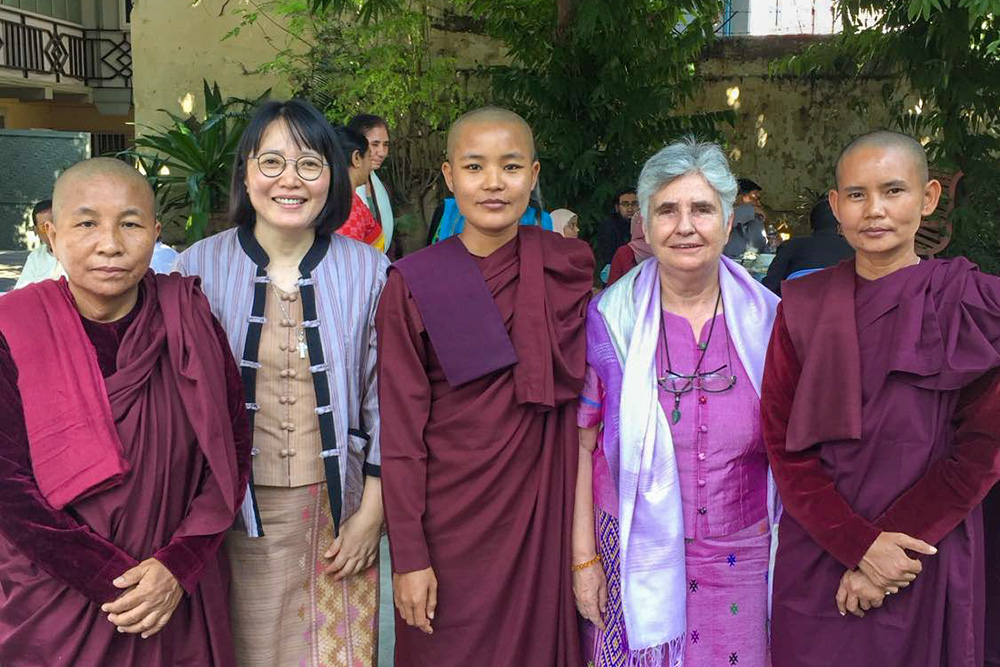
Columban Srs. Theresa Kim, second from left, and Kathleen Geaney, second from right, with Buddhist nuns in Mandalay, Myanmar, in December 2023 (Courtesy of Kathleen Geaney)
We learned the words and patterns of the language, but there we also learned the language of silence. We became sensitized to the importance of what remains unsaid, the poignancy and tenderness of the pause between words and the deep connectedness of the place beyond words. We joined the Buddhist monks and the wider village community in their meditation practice and we found depth, a sense of being at home and a bond of unity that remains to this day.
Language learning was a privileged time when we were welcomed into the very soul and heart of Myanmar. Learning the language was also fun. Our mistakes provided amusement for the whole community when our misuse of words communicated a reality very different from the one we intended.
As I move forward with my New Year's resolution, I hope that, after many years living as a missionary outside of Ireland, through relearning the language I can enter more deeply into my own Irish culture and the best of its values and traditions. I hope I can be at home again in its silence and its depth. I pray that whatever language I speak, my words may be words of peace and love.