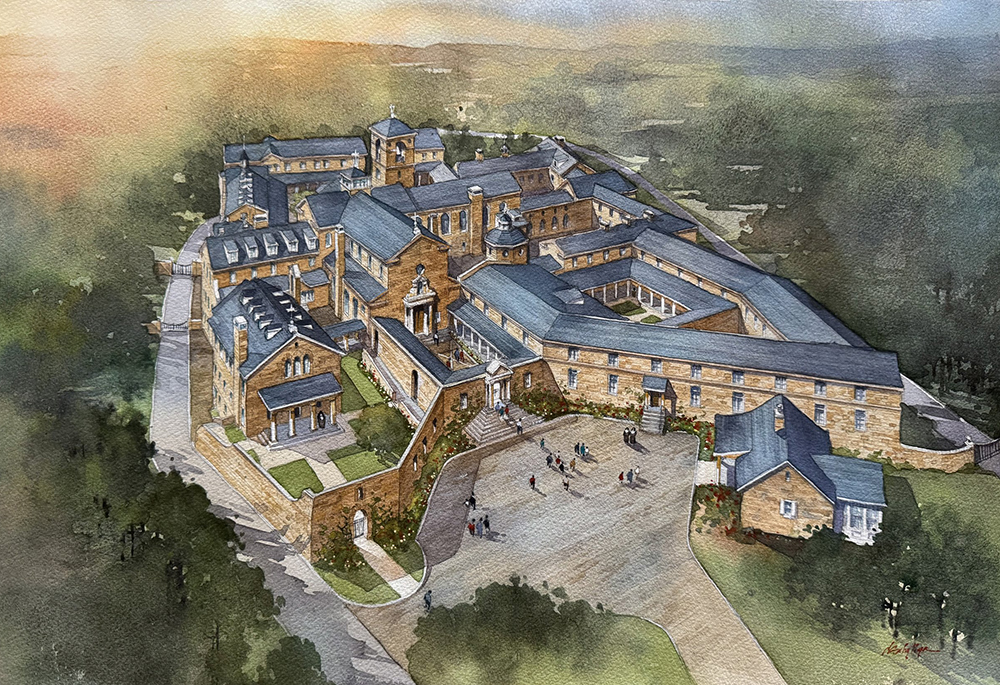
An artist rendering of the Monastery of Jesus, Mary and Joseph the Fairfield Carmelites are constructing in Fairfield, Pennsylvania. (Courtesy of the Fairfield Carmelites)

A small band of cloistered nuns in rural Pennsylvania are constructing a monastery built to stand for 1,000 years.
The Discalced Carmelites of Jesus, Mary and Joseph began planning the project in 2013, but it was five years before construction would start. The biggest holdup was finding a contractor who could build a true stone building.
Most modern buildings that appear to be made of stone are actually built of steel with a stone façade. The Carmelites wanted the monastery, located on 45 acres in Fairfield, just west of Gettysburg, to be built like a monastery would have been built in Europe a thousand years ago.
"When the design process started, of course, they were looking at going the conventional route," said Catherine Bauer, the order's director of development and spokesperson for the nuns living within the papal enclosure. "Then they decided, if we're spending the money, let's do it the right way."
But finding a stonemason was not easy, she told Global Sisters Report. The prioress began going through the Yellow Pages, calling any contractor with the word "stone" in the name.
Meanwhile, Joe Bonifate was praying in Pittsburgh's St. Paul's Cathedral and mourning that he would never get to build something similar to the limestone and slate edifice built in 1900. A week later the Carmelites called his company, Arch Masonry.
"It kind of, like, made the hair on the back of my neck stand up a little bit," Bonifate said in a video about the undertaking. "I instantly fell in love with the project."
It would not be quick or easy: The monastery will resemble a village, with a complex of buildings so the community can be self-sustaining as the sisters raise animals, tend their fields and gardens, spin wool and sew. Some work cannot be done in the winter because the mortar will freeze. In total, construction is expected to take about 15 years.
"They want it to last a long time, they want it to be here for a thousand years, and steel rusts. And I can't take you to a thousand-year-old steel building and show it to you," Bonifate said in the video, titled "To Last A Thousand Years," which is how the sisters describe the monastery project on their website.
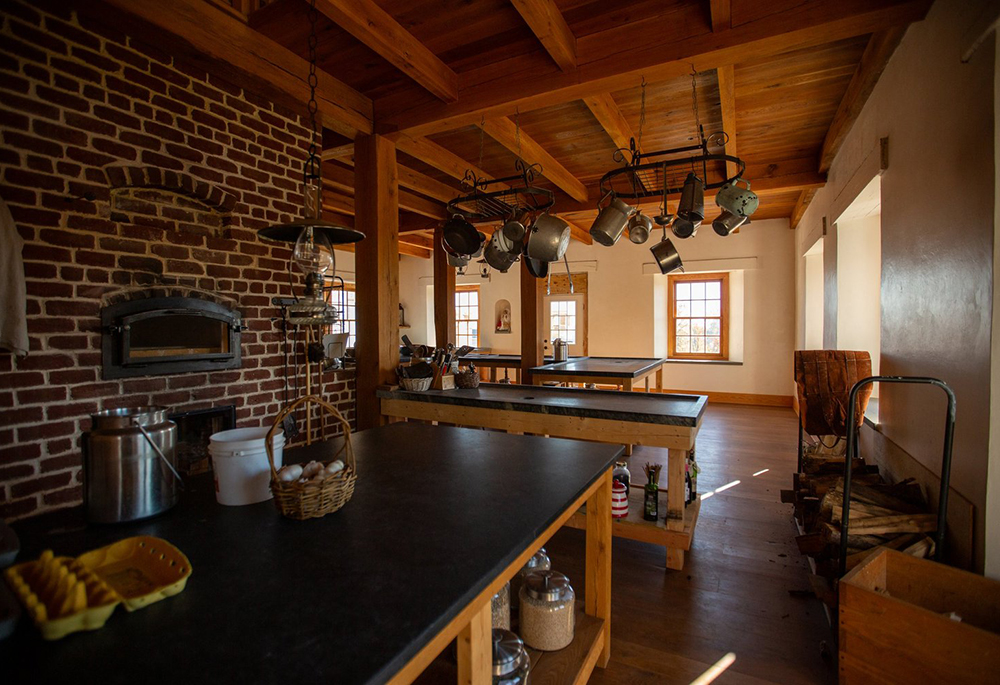
The completed refectory – where food is prepared and eaten – at the monastery the Fairfield Carmelites are constructing in rural Pennsylvania (Courtesy of the Fairfield Carmelites)
Currently the workrooms and refectory — where food is prepared and eaten — are complete, as is the oratory. Construction continues on the main chapel; the nuns are living in the workrooms — a step up from when they first moved to the property and lived in the barn.
Where materials other than stone are used, they are natural and locally sourced or even reused. Timber framing and things such as wood framed windows are joined without nails or glue. In addition to Bonifate, stonemasons from Ireland and Scotland have visited, bringing with them techniques long forgotten here.
"The perception of permanence from the stone structures communicates a sense of eternity," architect Riccardo Vicenzino said in the project video. "The sisters have their eyes set on eternity, and so what more expresses the idea of eternity than structures that are permanent, and enduring and stand the test of time?"
The construction is projected to cost about $100 million; the sisters have raised about $22 million so far. There are currently 12 sisters in the community, with four or five aspirants entering this year. That number is down after 18 were sent to other missions.
Advertisement
When completed, the monastery will be able to house about 40 nuns, but Bauer said Carmels are generally much smaller and any number near that large would be only temporary.
Bauer told GSR that while the nuns are cloistered, the monastery is open to the public and is being built for the entire community.
"It's for the people, for the faithful," Bauer said. "They purposely included a baptistry. It will be open for weddings and funerals. In the Old World, [monasteries] were in the center of the town and part of the town."
Now, Bauer said, other monasteries are interested in similar projects and have asked how to get started.
"A lot of monasteries have approached us saying, 'We want to do this,' " she said.