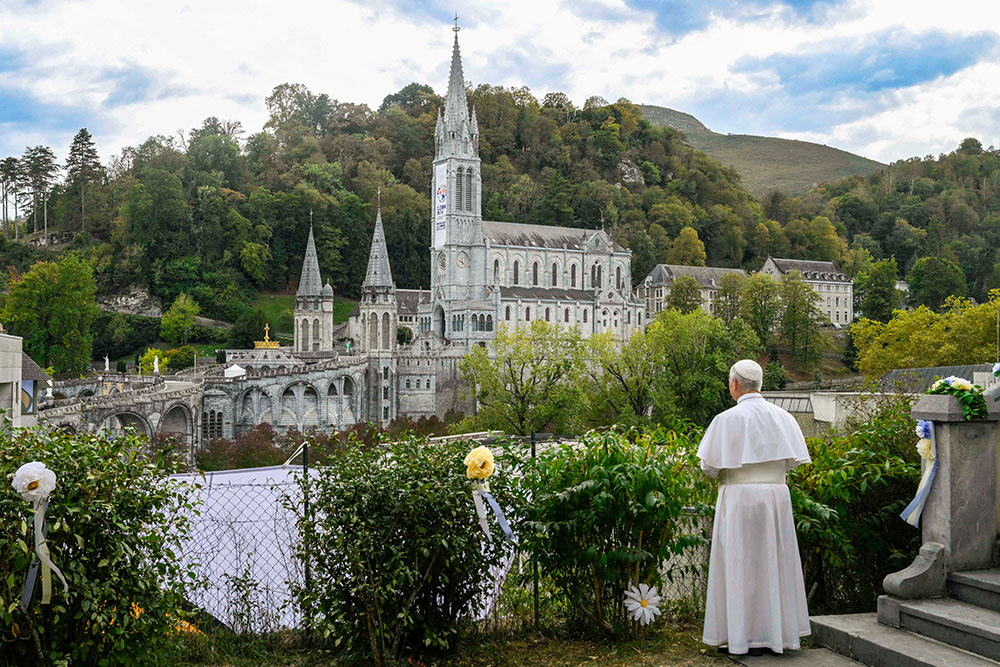
Pope Leo XIV looks at the Sanctuary of Our Lady of Lourdes from the hill of the Carmelite Monastery of Lourdes in France, Sept. 27, 2026, after a private meeting with contemplative religious sisters. Three days later, Leo met with a group of Dominican contemplatives at the Vatican. (CNS/Vatican Media)

Contemplative orders — nuns who have largely withdrawn from the world — are at the heart of the church's mission, Pope Leo XIV told a group of Dominican contemplatives Sept. 30.
The International Commission of Nuns, a group made up of representatives from federations of contemplative Dominican orders around the world, met with Leo at the Vatican, where he told them that silence, prayer and study are not an afterthought in God's plan.
"The contemplative vocation, in the Dominican spirit and in the church as a whole, does not lie on the margins of the mission, but is its very heart," Leo told them, citing the documents of the 1962-65 Second Vatican Council and that St. Thomas Aquinas' work "echoes St. Dominic's insight that every word of proclamation, in order to be true, must spring from silence, from listening, from prayer and from a profound relationship with God."
Contemplation, Leo said, is "a silent pause in which to receive the Word and allow ourselves to be transformed by it, which enables us to know things and people ever more fully in him, so that we may then share with others what we have experienced and understood."
Though the commission Leo met with traces its roots to 1989, only about half of the roughly 8,000 contemplative orders in the world were members of federations until Pope Francis' directive resulted in 2018's Cor Orans ("Praying Heart") required membership in a federation, association, conference or congregation. The rule was controversial at the time, with some critics alleging it was a plot by Francis to make conservative orders more liberal.
Leo cited Cor Orans and its requirement for visitations by the federation's president, saying they are responsible for ensuring orders are living their charism.
Advertisement
"Here, in particular, there is a call addressed to you, federal presidents," Leo said. "Your presence during visits to monasteries and in the leadership of the federation, in fact, beyond the necessary administrative aspects, demands that you be above all guardians of these values." The visits "should always be, first and foremost, occasions for a shared encounter with the Lord, through prayer, mutual listening, fraternal correction and reconciliation."
Silence is more important than ever, he told the group.
"If faithfully cultivated, [silence] will be precious to you, not only for safeguarding the entire observance and favoring tranquility within the monastery, but also for looking within yourselves, and for being attentive to your sisters in the community and to others outside," Leo said. "Keeping silence is an act of the will that engages the whole person and helps to cultivate solid relationships, because they are animated by the Word of God."
Though contemplatives are cloistered or rarely interact with the outside world, that doesn't mean that they are not an integral part of it or that they ignore the needs of the many.
Keeping silence "means creating spaces of freedom and truth, in which to preserve one's attentiveness, becoming sensitive to the voice of those who 'do not count,' and developing wisdom and generosity," Leo said.
"This is particularly important in a world characterized by speed, where everything must be immediately visible and every void must be filled in a hurry. ... It is essential that your communities offer oases of true and profound peace, where the chaotic turmoil linked to external matters falls silent and one can listen to the voice of God."
Many contemplative orders are experiencing the same issues as apostolic communities, with declining numbers and a lack of new vocations, but Leo said leaders should not be focused on continuing the monastery but on what God is calling us to.
"The temptation of a 'spirit of survival' starts to creep in, leading to isolation and a scaling back of commitments, under the illusion that the few remaining resources will suffice, so as not to depend on others or have to close monasteries," he said.
"In the face of this, I invite you not to ask yourselves so much how to maintain structures that are becoming empty. Rather, listen to what the Spirit is asking of the Dominican contemplative life today, mindful that, before the works to be managed, there is a call to which we must respond, a fire that burns and which must not be allowed to die out, as St. Catherine of Siena said."