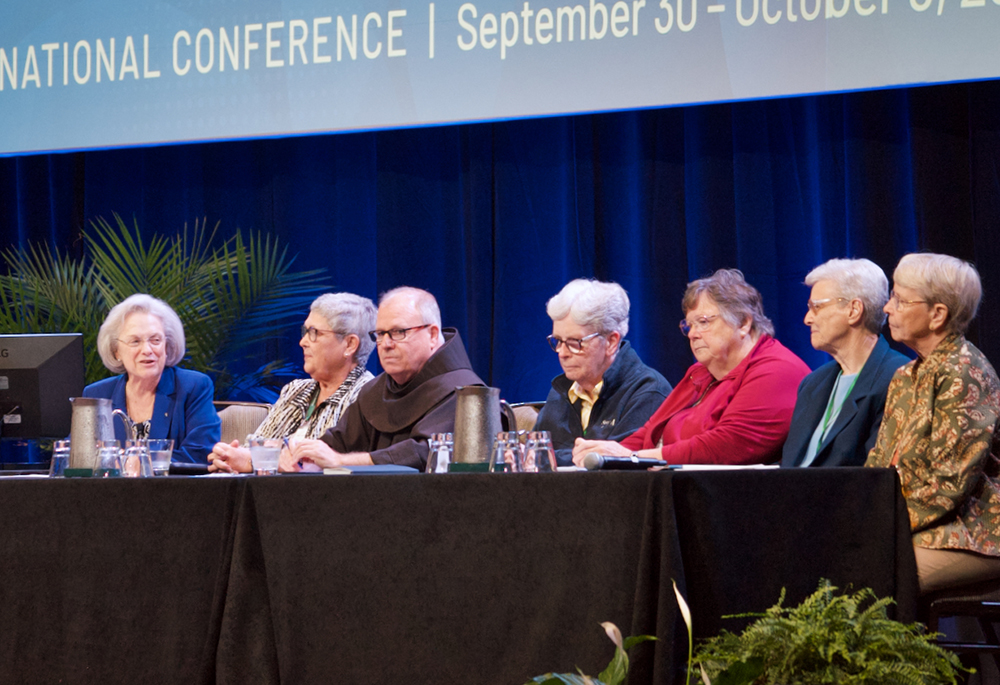
Members of a panel on pontifical commissaries speak Oct. 2, 2025, at the Resource Center for Religious Institutes annual conference in Dallas. (GSR photo/Dan Stockman)

"Evolving Religious Life," a continuing series from Global Sisters Report, explores how Catholic sisters are adapting to the realities of congregations in transition and new forms of religious life. While we write often about these trends, this particular series will focus more closely on sisters' hopes for the future.

A growing number of congregations of Catholic sisters in the United States no longer have enough members able to elect or serve as their own leaders, forcing them to turn to the Vatican or their bishop for help.
In January 2015, there was exactly one congregation of Catholic sisters in the United States where the Vatican had appointed a sister from a different congregation as its superior.
Today, there are at least 20 congregations with an appointed, rather than elected, superior, and likely many more.
Known as a "commissary," these sisters are appointed superior when a congregation either has no member able to serve as leader or has a qualified leader but cannot hold the chapter required to elect her.
That latter circumstance has become increasingly common as congregations shrink. Some communities have or plan to ask the Vatican to appoint a potential leader from their own ranks because too few members are physically or mentally able to participate in the chapter needed to elect her.
Being a commissary is "an individual ministry, because each situation is different, but the essence of what they're doing is caring for these sisters," Sr. Sharon Euart told Global Sisters Report. Euart is executive director of the Resource Center for Religious Institutes, or RCRI, which provides guidance and resources to congregations. "The need is great."
How great?
According to statistics Leadership Conference of Women Religious officials shared at their 2022 assembly, one-third of all congregations in the United States have fewer than 50 members, and the number of communities with enough members to hold a chapter and elect leaders is expected to drop dramatically after 2025.
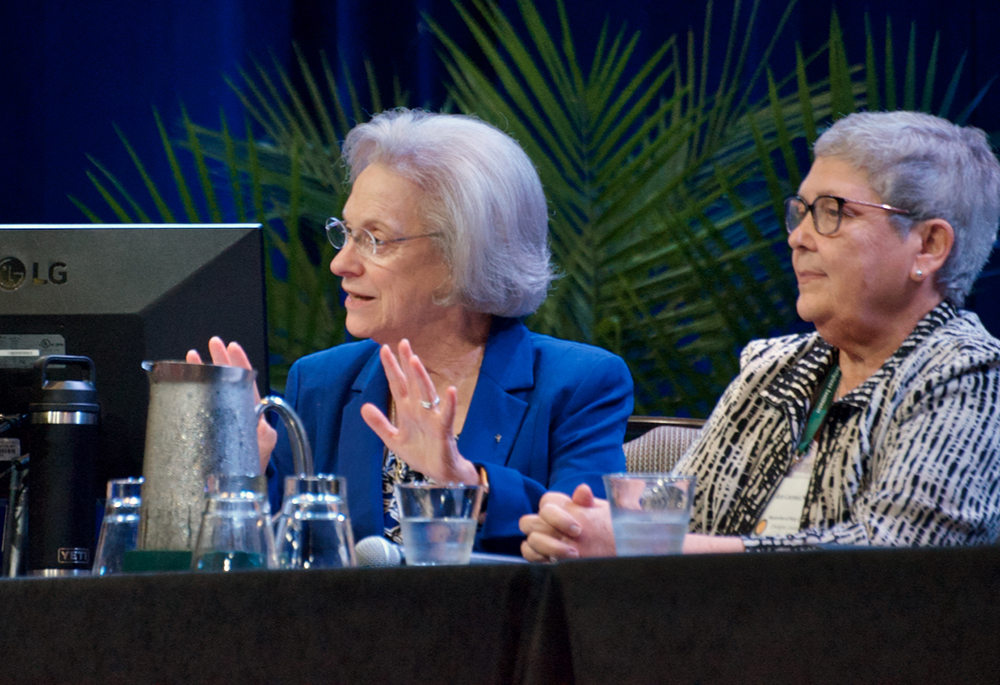
Sr. Sharon Euart, left, speaks during a panel on pontifical commissaries Oct. 2, 2025, at the Resource Center for Religious Institutes annual conference in Dallas. Euart is the organization’s executive director; at right is Sr. Ann Lacour of the Marianites of Holy Cross, the first sister appointed commissary in the U.S. (GSR photo/Dan Stockman)
Euart said her agency is working with about 15 congregations, but just identified five more that are in the process of finding a commissary. The Leadership Conference of Women Religious has a group of about 12 commissaries in the virtual meetings it holds, but there are several more who will be joining soon.
In response, LCWR began compiling a list of former leaders willing to serve as commissaries after the Vatican asked it to help identify candidates.
In March, LCWR held sessions for former leaders who are becoming commissaries, another session for congregations that have been asked to provide a commissary, and a session for congregations on how to navigate the process of asking for a commissary.
"We realized there are issues around the future capacity for leadership," said Immaculate Heart of Mary Sr. Anne Munley, who, along with Our Lady of Victory Missionary Sr. Mary Jo Nelson, is heading up LCWR's efforts. "The rate of change is accelerating."
The need for commissaries will continue to grow, Munley said.
"We're in the first wave of this right now," she said. "The learnings of this time are going to be helpful to the second and third wave."
Diocesan communities also in need
Euart said diocesan congregations — created by and under the authority of a bishop, versus those of pontifical rite under the authority of the Vatican — are increasingly facing the same challenge, though their bishops can often appoint commissaries more quickly than Rome.
"The beauty of it is they're known by the bishop. He knows them and cares about them and is quick to help," she said. The Vatican's bureaucracy is legendary; a diocesan process can be much simpler.
Euart warned that many congregations may need a commissary much sooner than they ever imagined: They may have a large number of sisters, but their demographics are the same as other congregations, and their members are aging.
When her fellow Mercy sisters meet later this year, she said, "It's going to be an eye-opener for some to see where we are.
"We're certainly not coming to completion, but we need to look at the future."
Putting out the call
But finding a commissary can be difficult, and is often made harder by the Vatican asking congregations to name two or three potential commissaries; Euart said she counsels communities that if they have one person they prefer, they need to make their case for that person's appointment. Officials also consider geography, she said, but "I think Rome is going to have to change on this. Out West, there are no communities nearby."
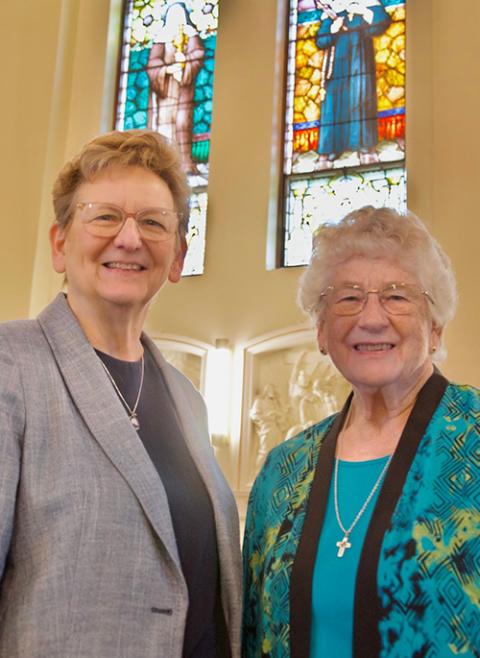
Sr. Dawn Tomaszewski, left, and Sr. Jenny Howard, in the Our Lady of Victory Missionary Sisters motherhouse, May 22, 2026 (GSR photo/Dan Stockman)
For the Our Lady of Victory Missionary Sisters in Huntington, Indiana — better known as the Victory Nolls — their commissary is the superior of the Sisters of Providence of St. Mary-of-the-Woods, currently Sr. Dawn Tomaszewski. But since being appointed in 2022, she has delegated the role to Sr. Jenny Howard, who "has been here full-time practically from the beginning," Tomazewski said.
She said one of the great joys of the commissary process is that the receiving congregation gets to retain its identity until the last member dies. This avoids the pain of being subsumed in a merger or the complexities of a covenant relationship.
"The mission of the Victory Nolls hasn't changed. The charism of the Victory Nolls hasn't changed. Only how we do things has changed," she said. "One of the great joys for both communities is that we, the Sisters of Providence, are enabling them to be Victory Nolls. That is a gift, that's why we agreed to do it."
While that is true, the commissary or her delegate often feels that she has become one of the sisters of the community she is serving. Euart said that at one virtual meeting of commissaries that RCRI hosted, one participant started crying because the congregation had suffered several deaths in just a month.
"They were her sisters," Euart said. "They do become part of the pastoral care for the sisters and they care for the dying."
Many on the RCRI panels at its annual conference have talked about the relationships formed between the commissary and the receiving congregation, and the joy they have found in this new ministry. But Munley said the relationships are even bigger than that.
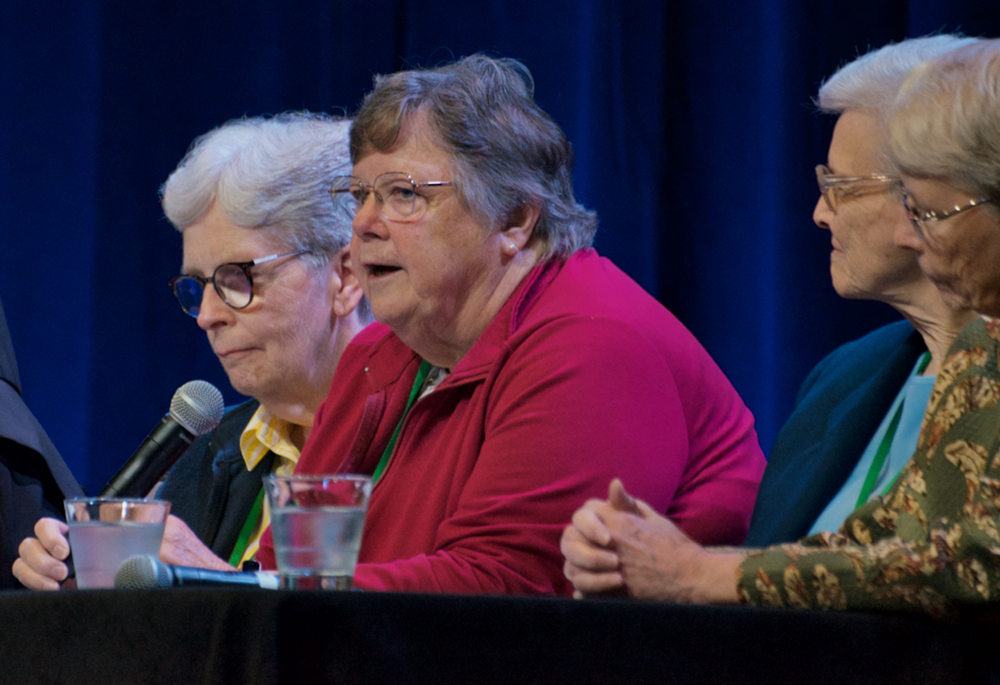
Sr. Elizabeth Langmead, of the Mission Helpers of the Sacred Heart, talks about her congregation’s experiences searching for a pontifical commissary during a panel Oct. 2, 2025, at the Resource Center for Religious Institutes annual conference in Dallas. (GSR photo/Dan Stockman)
The commissary process allows sisters to see that "we share a broader charism of religious life. We share a ministry of community and synodality," Munley said. "Part of the sisterhood now is to assist one another through the governance form of commissary."
The virtual sessions LCWR has been holding show that, she said.
"The discussions are often very practical, but underneath it all, I think there is this profound sense that all of us are in it together and it is a time for sistering."
Leaning on each other
Some congregations already have close relationships, and now more than a dozen Dominican and Franciscan communities are banding together to make the process simpler and faster.
In 2019, when Caldwell Dominican Sr. Patrice Werner was superior of her congregation, she invited five other Dominican congregations in the Northeast United States to discuss how to keep their mission alive amid declining numbers. By 2022, five of the six had formed an association and asked the Vatican to make it official. In July 2025, the approval finally came, and the Dominican Sisters Association was made a public association of the faithful of pontifical rite.
The association will help find leaders for any member congregations that need them, whether it is an open spot on the leadership team or the superior. The association's focus statement says it is to "provide shared canonical governance," and "will support member congregations in planning for a future in which they may no longer have the capacity to exercise canonical governance independently."
Advertisement
"I think most of us in our five congregations all feel we have another chapter" they can hold, said Blauvelt Dominican Sr. Theresa Rickard, a member of the Dominican Sisters Association's executive committee. "But probably by 2030 and after, I think we're all going to start needing help with this."
Tiffin Franciscan Sr. Edna Michel heard about the Dominican organization at a 2022 LCWR meeting.
"It sparked a thought in me: 'That sounds like that could work for us,' " Michel said. "The inability to provide leadership for ourselves is looming on the horizon for many of us."
The Franciscan Association was recognized by the Vatican in January and now has nine members. They'll hold their first assembly in October and elect leaders.
"I don't know if many communities are doing this," Michel said. "But among the nine of us, we think holding a chapter and electing a regular leadership team is possible four years from now, and maybe 8 years from now. But after 8 years it gets a little shaky."
Now, with the association, member congregations know other members will be helping to provide leadership, and the relationship between them all will grow even stronger.
Howard said that sisters in leadership ministry to other congregations through the commissary process is a beautiful gift.
"What a blessing to be part of something that is the future of religious life," she said. "There's a sense of joy and deep happiness."