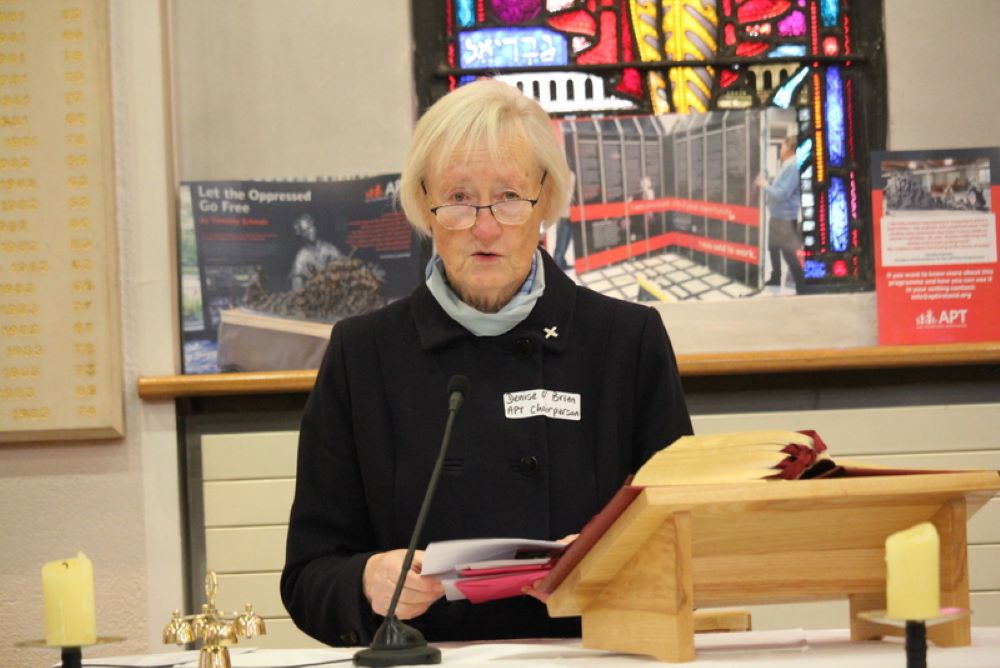
Sr. Denise O'Brien, the chairperson of Act to Prevent Trafficking, speaks at a Mass in Kimmage Manor, Dublin. The organization recently marked its 20th anniversary. (Courtesy of Rowena Galvin)

by Sarah Mac Donald
Twenty years ago, a group of sisters in Ireland was addressed by Sr. Helene Hayes about the worldwide problem of human trafficking. The American Good Shepherd sister showed the sisters a video about child sex slavery — "Fields of Mudan" — focused on the experiences of a 5-year-old girl and left them stunned.
"We said to one another, 'We cannot leave here without doing something.' A month later we met again and have met monthly ever since," Sr. Isabelle Smyth recalled in a December interview with Global Sisters Report at a Mass in Kimmage Manor, Dublin, to mark the December 2005 foundation of Act to Prevent Trafficking Ireland.
Smyth credits the renowned missionary doctor and public health campaigner Sr. Dr. Maura O'Donohue for putting trafficking on Irish horizons. O'Donohue, a Medical Missionary of Mary like Smyth, undertook groundbreaking research in the 1990s on the rape of women religious by priests in several countries, the findings of which were presented to the Vatican in February 1994.
According to Smyth, O'Donohue returned to Ireland in 2003 and said she "wanted to dedicate the rest of her life to raising awareness about the then little-known crime of human trafficking." O'Donohue first encountered human trafficking during her work in the 1980s and 1990s as the head of the AIDS desk at CAFOD, the Catholic Agency for Overseas Development. In 2003, she was given funding from U.S. donors to get this anti-trafficking work going, Smyth told GSR.
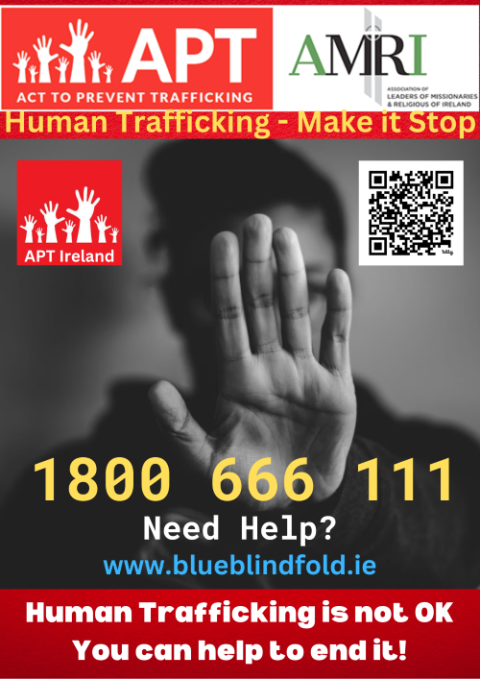
An Act to Prevent Trafficking poster provides a phone number for help about human trafficking. (APT)
At that time there was little acceptance that Ireland could be a destination as well as a transit country for trafficked people. According to Smyth, an important goal of Act to Prevent Trafficking was bringing the problem of human trafficking to the attention of Irish politicians and getting them to introduce legislation to facilitate the Palermo Protocol, the international treaty to "Prevent, Suppress and Punish Trafficking in Persons, Especially Women and Children," and the 2005 Council of Europe's Convention on Action Against Trafficking in Human Beings.
Good Shepherd Sr. Noreen O'Shea, another founding member of Act to Prevent Trafficking, spoke at the anniversary Mass in Dublin. "The past 20 years have been an amazing learning curve for all of us in understanding the implications of accepting Jesus' mission in a world where up to an estimated 50 million people are trapped by the evil of human trafficking," she said.
Act to Prevent Trafficking believes more than 1,000 people are trapped in this modern-day form of slavery in Ireland. "A few are fortunate enough to escape, or to be discovered and helped by our Gardaí [police] and detectives," O'Shea said.
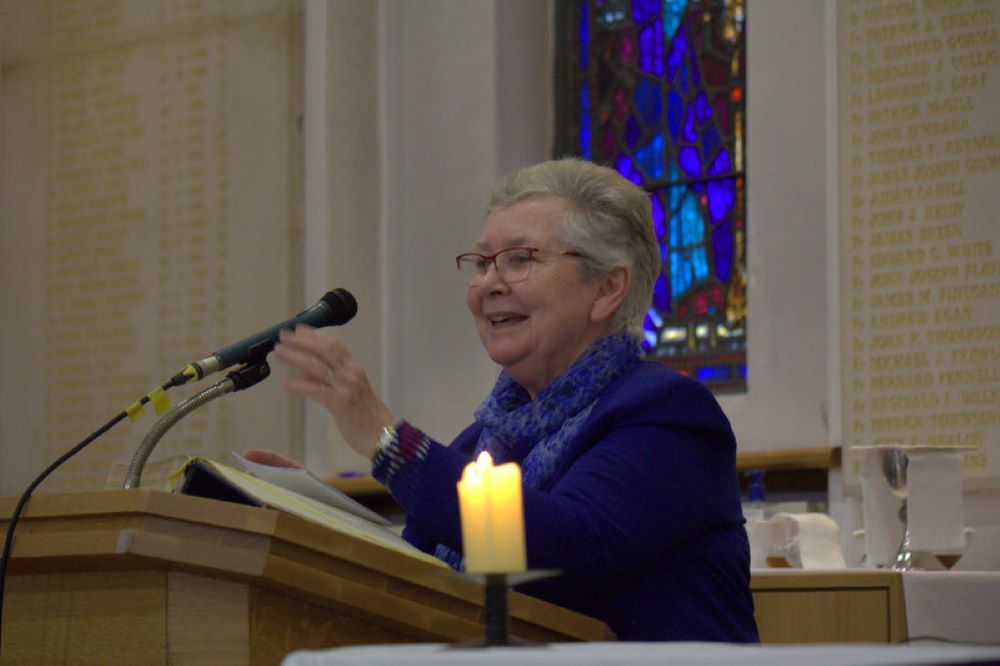
Good Shepherd Sr. Noreen O'Shea was a founding member of Act to Prevent Trafficking. (Courtesy of Rowena Galvin)
But many are not so lucky. For the sisters, meeting survivors of trafficking and hearing their stories "is heartbreaking and overwhelming," O'Shea said. They have been shocked to learn of the way traffickers groom girls and women, tricking them into believing that they are coming to Ireland to get a job in a hotel or a salon, while telling young men they are going to work in the motor business.
"Imagine the trauma of arriving here, having your passport taken, being whisked away by strangers. You don't know the country. You barely speak the language. Young women are beaten into prostitution," O'Shea said. She knows of one man who was found begging near the quays in the town of Drogheda (County Louth). "He thought he was in Liverpool (Britain). He had never heard of a country called Ireland."
Over the past two decades, Act to Prevent Trafficking members have also seen an Anti-Trafficking Unit established within the Department of Justice and Equality while several female detectives have received specialist training in dealing with this crime. Act to Prevent Trafficking Ireland has also been involved in awareness-raising in schools with students, parents and boards of management through their cAPTives program.
'The whole of society needs to be challenged to work for the elimination of this heinous crime.'
—Sr. Isabelle Smyth
"Trafficking is not a national crime, it is an international crime," said Brian O'Toole, a member of the steering committee of Act to Prevent Trafficking. "It crosses borders in ways that crime is not supposed to."
That is why O'Toole strongly advocates that anti-trafficking groups embrace international networking in their work. Act to Prevent Trafficking members were involved in establishing RENATE, the European network of religious sisters fighting human trafficking across 31 countries through 139 anti-trafficking groups, and Talitha Kum, a global network of over 6,000 sisters founded in 2009 by the International Union of Superiors General to combat human trafficking.
O'Toole is director of the justice desk for the Presentation Sisters in Ireland and one of the founding members of Act to Prevent Trafficking, representing the congregation at meetings. He is convinced that the organization has a role to play in what he stresses is the "worst crime because a person will be used again and again and again until they are dead."
O'Shea concurs. "Criminals involved in drugs sell their product once," she said. "But victims of human traffickers can be sold several times from one group to another, depending on their worth. A woman in the sex trade is viewed as a commodity."
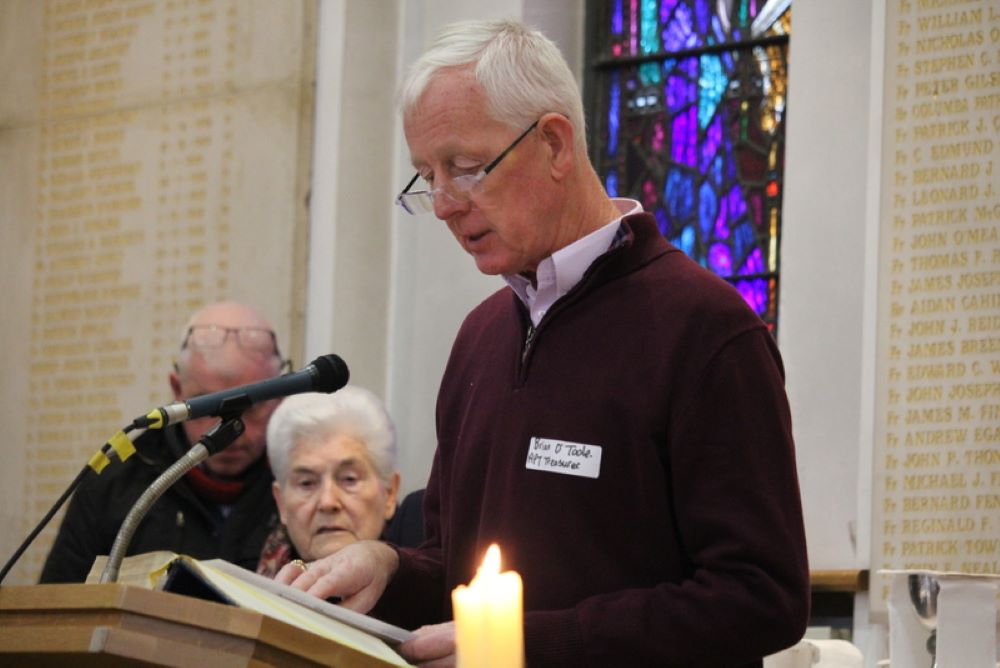
Brian O'Toole, a member of the steering committee of Act to Prevent Trafficking, speaks at a Mass in Kimmage Manor, Dublin, to mark the 20th anniversary of the organization. (Courtesy of Rowena Galvin)
While Ireland is primarily a country of destination, it is also a country of transit.
"People are moved around in Ireland and primarily it's for trafficking in the sex industry. The Gardaí have told us that human trafficking is in every single town in Ireland. If trafficking thrives on silence, then APT refuses to stay silent while this crime continues," O'Toole said.
In his opinion, part of Ireland's problem is that "we are under-identifying victims of trafficking, and we are under-protecting them; we don't have enough training for people to be able to identify victims properly. We need to be more about preventing than reacting to trafficking." To achieve this requires confronting grooming online, strengthening labor inspections and training frontline workers.
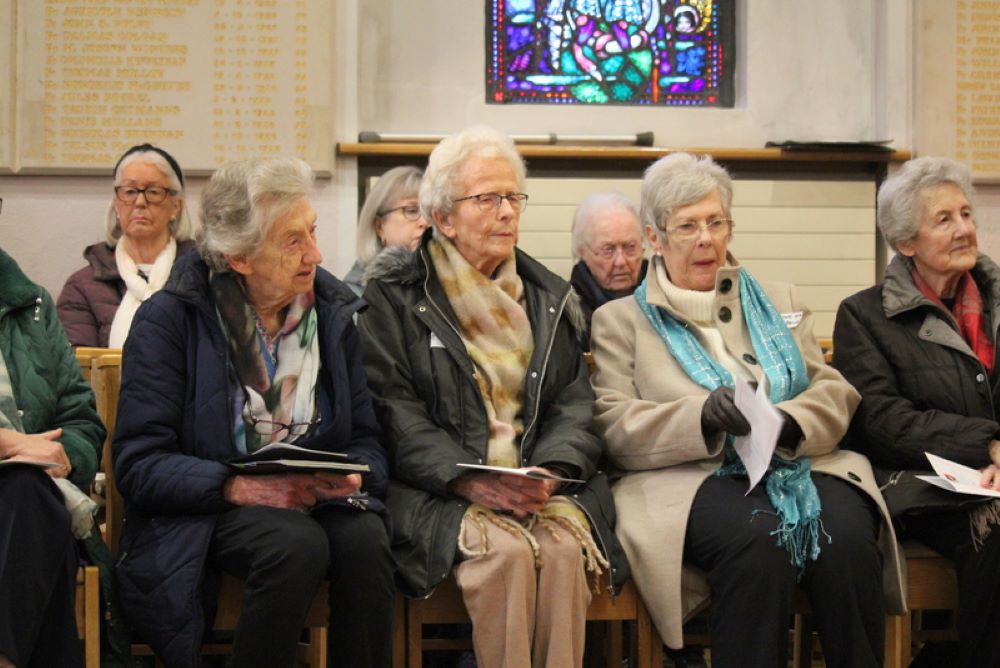
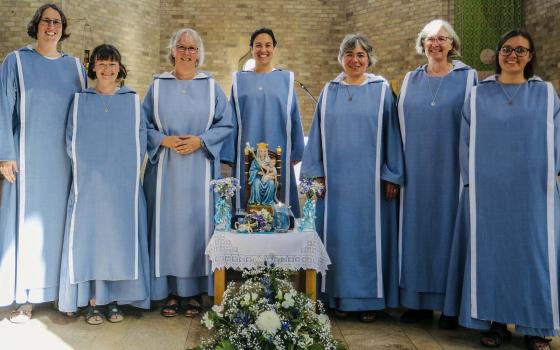
Women religious attend a Mass in Kimmage Manor, Dublin, to mark the 20th anniversary of Act to Prevent Trafficking. (Courtesy of Rowena Galvin)
Both Smyth and O'Toole highlight Act to Prevent Trafficking's collaboration with health care professionals as a possible channel for identifying victims.
"Many people who are trapped as victims of trafficking need to attend a health clinic during the first year of their capture," Smyth said. "Usually, their English is very limited. We are part of a group working to introduce into the undergraduate curriculum of various health care professions ways of identifying — in the course of their clinical work — a person who may have been trafficked and who is attending a clinic."
According to O'Toole, "over 80% of victims of human trafficking will approach a health care setting in their first year of being trafficked. Those who are exploited labor-wise are working long hours and are often untrained and this in turn may lead to injury. We have created posters for locations like pharmacies, physiotherapists and dentists as well as A&Es [accident and emergency departments] and parishes. The posters have QR codes linked to the blue blindfold campaign."
The members of Act to Prevent Trafficking tend to be older women religious. Some are in their 70s and 80s, and one member is 92. O'Toole feels members' experience and skills more than compensate for their age.
"We have up to 25 regular attenders and up to 50 congregations involved. Many of them are women and men of huge experience who have looked after NGOs as executive directors, have been principals of very large schools, taken care of the furthest behind in many countries without any resources, put themselves and their own safety on the line," O'Toole said "These are not people who are afraid to speak out. They would be more aware than anybody else that Ireland's detection and conviction rates for trafficking are very low."
According to O'Shea, "criminals capitalize on new technologies, so we too need to use modern communication systems to further our mission of bringing good news to the poor and liberty to captives."
Advertisement
Artificial intelligence and the use of digital technology are a major challenge. But members of Act to Prevent Trafficking and RENATE, O'Toole said, have undertaken training to learn more about the potentially damaging effects of AI on the issue of trafficking.
"They are aware that the sex trade and trafficking have become increasingly digital," he said. "The reality is that pornography is now much more accessible, and then there is the dark web. … Somebody can live in one country, build a website and have it housed in another country, recruit in a third country, and then sell that person, move them around. The profits they get can be turned into a crypto."
Trafficking, O'Toole said, is now the second most profitable industry in the world. "Ending trafficking is not optional. It's a measure of how we look after the most in need."
Religious sisters, Smyth stressed, are playing a special role in assisting survivors of trafficking, although she added that trafficking is not only a women's issue.
"The whole of society needs to be challenged to work for the elimination of this heinous crime."