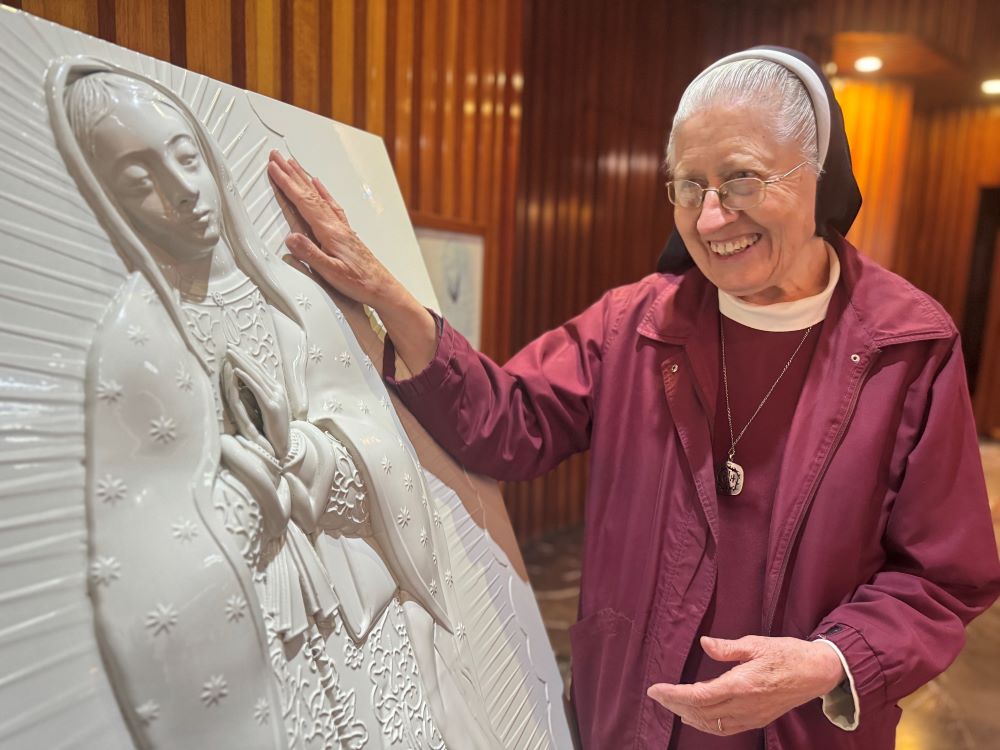
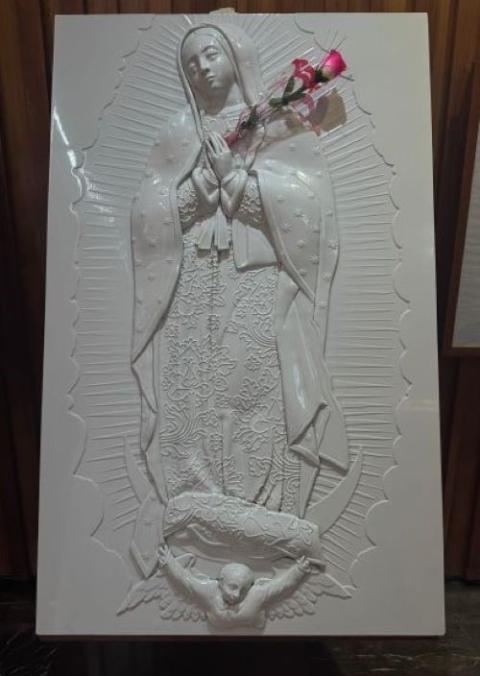
Sr. María Celina Mota Campos moves toward a sculpture for the blind at the Basilica of Our Lady of Guadalupe in Mexico City Nov. 6. Mota, of the Order of the Incarnate Word and Blessed Sacrament, lost her sight to macular degeneration about 11 years ago, but said she's learned to see Our Lady of Guadalupe with her heart instead of her eyes. (GSR photo/Rhina Guidos)

by Rhina Guidos
Most places don't want visitors to touch the art. But Mexico City's Basilica of Our Lady of Guadalupe encourages it for one specific religious sculpture. In the back of the cathedral, near the entrance doors, the white sculpture with a protruding face and hands clasped in prayer, goes almost unnoticed. It's there for anyone, but in particular for those who can't see, like Sr. María Celina Mota Campos. It's a treat to touch it, she says.
She lights up when she runs her hands over Our Lady of Guadalupe's face, sliding them down the sides as her fingers outline her mantle. Mota, who lost her sight 11 years ago to macular degeneration, said it allows her to experience what others feel when they see depictions of Our Lady of Guadalupe inside the basilica that carries her name.
"I'm so happy that someone had this idea of making this [sculpture] of Our Mother, the Lady of Guadalupe so that those of us who can't see with our eyes can still experience the joy of seeing her," said Mota, of the Order of the Incarnate Word and Blessed Sacrament in Mexico City.
A sign next to the sculpture says that the Italian Cultural Institute of Mexico donated the work of art, made in Italy in 2008 by artist Franco Faranda. In 2009, it was sent to Mexico after being blessed by Pope Benedict XVI and installed inside the basilica days before Our Lady of Guadalupe's Dec. 12 feast day that year. A sign in braille to the left explains some of the symbols on the sculpture.
"I see her with my heart and I see her through touch," Mota said. "The Lord gives those of us who can't see with our eyes, the ability to see in other ways. I can see her clearly in my heart and to have a sculpture of her that sticks out, that I can touch, it highlights, for me, her face, her beloved image, which I carry in my heart. It helps to touch her because it's a way of seeing that God still provides."
Though Mota is legally blind, she once could see. Long ago, she had lost the ability to see out of her right eye after a complication following surgery. She didn't allow the lack of sight in one eye affect her ministry or carrying out the missionary work in southern Mexico, Guatemala and El Salvador. She proceeded to work "with one eye as if it were two," and did that for about 40 years, she said. But in 2014, the light around her healthy eye started dimming.
"It happened quickly," said Mota, describing how macular degeneration took what was left of her sight. By then, however, she had been to the basilica too many times to count and had absorbed a lot of what there is to know about the building and its surroundings.
"Tell me what you see," she asks of those guiding her and then can quickly sketch out a mental map of places visitors should take note of inside and around the basilica. A little bit to the left, near the entrance, there's a bent crucifix, she narrates, damaged in 1921 after a bomb went off near the cloak that bears the image of Our Lady of Guadalupe. Outside the basilica, she points out how part of the belltower, via animation, retells the story each hour on the hour of how, in 1531, Our Lady of Guadalupe is said to have appeared to St. Juan Diego on a nearby hill, later producing her image on his cloak.
Advertisement
Just as Mota said she learned to see Our Lady of Guadalupe through touch, she said losing her eyesight has helped her to see people and other things "with my heart." It's difficult to learn to rely on others, to physically bump into things now and then, and to have one's mobility and independence reduced, she said. But she has chosen to embrace that as part of the poverty she opted for in choosing consecrated life. Her visual poverty, she said, has been a blessing because it has drawn her even closer to prayer, to more time with God.
"Throughout my life, the Lord has given me joy in my heart, which is a gift of the spirit. And so, I believe that it is his Spirit, with its strength, its fire, its energy, that has kept me like this, with great peace in my heart," Mota said. "My sadness at losing my sight didn't last very long. It didn't last long because the Lord made me see things differently."
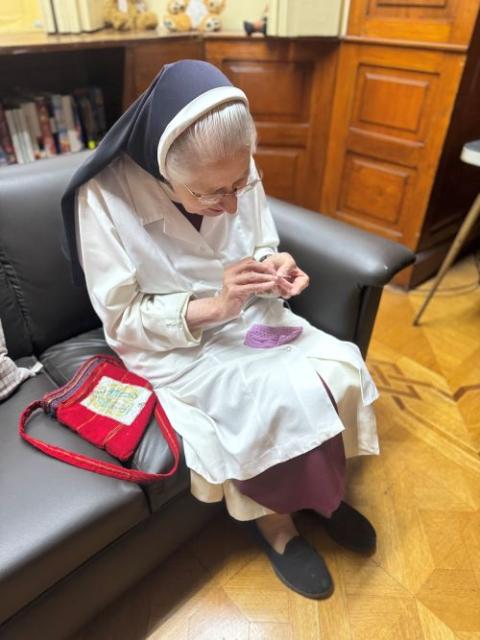
Sr. María Celina Mota Campos, of the Order of the Incarnate Word and Blessed Sacrament, crochets a tissue holder Nov. 1 in Mexico City. Mota said she looks for ways to contribute even though she lost her sight to macular degeneration about 11 years ago. (GSR photo/Rhina Guidos)
She continued: "You can live happily without sight. Sometimes I say to him: 'Lord, it's good that I cannot see. You are giving me the gift of, so to speak, of turning to my inner vision to discover you.' All this is pure grace."
She hasn't, though, been able to let go of her missionary zeal. She still takes part in Holy Week mission trips to Oaxaca, in southern Mexico, where she once served, visiting Indigenous families and farmers and accompanying catechists in the countryside. She also crochets small tissue paper holders to which she pins a medal of Our Lady of Guadalupe. Any donations she receives for them goes to her order's missions.
"When I could see, I would crochet all the time. Today, the Lord gives me the gift of being able to continue. I can no longer see the thread, or the color, or anything, but I do what little I can, which is to make little [holders] for tissues. I tell Jesus that, 'Since love is the only thing that matters, accept all these little things with all my love,' " she said. "The only thing that's absolute is the Lord and it's him who fills us with life. Whether you see or don't, it doesn't matter."