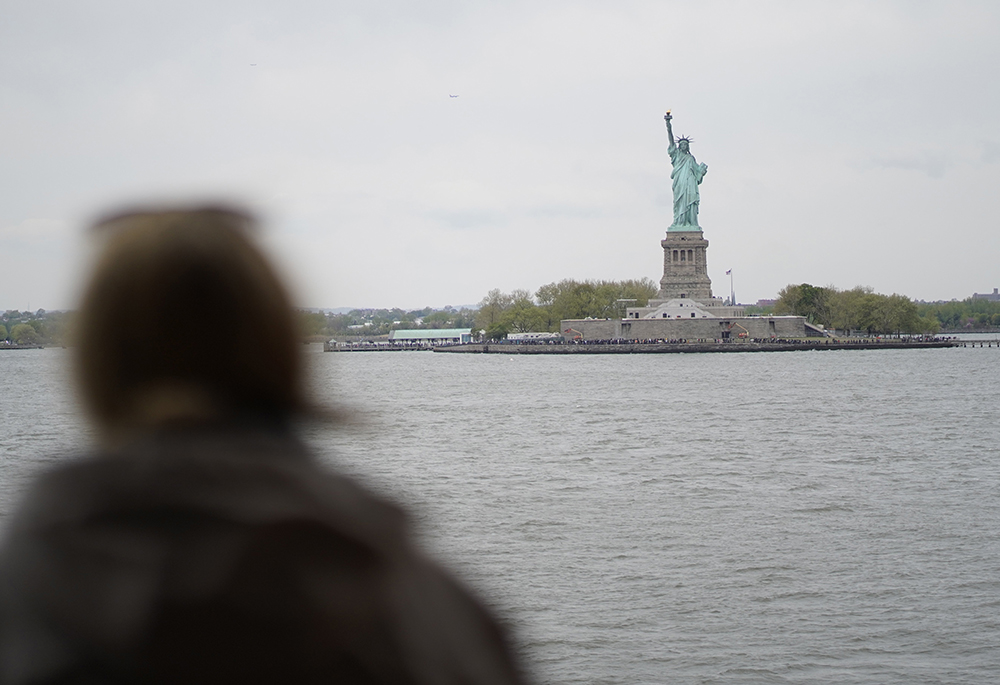
The Statue of Liberty is seen from the deck of the Dorothy Day ferry boat during its maiden voyage from Staten Island, New York, to the Manhattan borough of New York City April 28, 2023. The vessel in the Staten Island Ferry fleet is named for the co-founder of the Catholic Worker Movement. (OSV News/Gregory A. Shemitz)

by Sr. Helga Leija
On Nov. 2, 1883, Emma Lazarus wrote the poem that adorns the pedestal of the Statue of Liberty in Eilis Island, New York:
Give me your tired, your poor,
Your huddled masses yearning to breathe free,
The wretched refuse of your teeming shore.
Send these, the homeless, tempest-tost to me,
I lift my lamp beside the golden door!
However, since 1886, the day Lady Liberty — the "Mother of Exiles" — was dedicated, the United States has had conflicting feelings about migrants. On the one hand we have received them; on the other, we have placed "No Irish Need Apply" signs, interned Japanese Americans and discriminated against German immigrants. Time and again, exclusion has been justified by fear, economic concerns or national security.
That same ambivalence persists today. Immigrants — who have shaped and strengthened this nation — are too often seen as threats rather than neighbors. The current political climate, with its debates over hospitality, generosity and human dignity, makes me sick to my stomach. Are we still the mighty woman with the torch, welcoming the tired and poor?
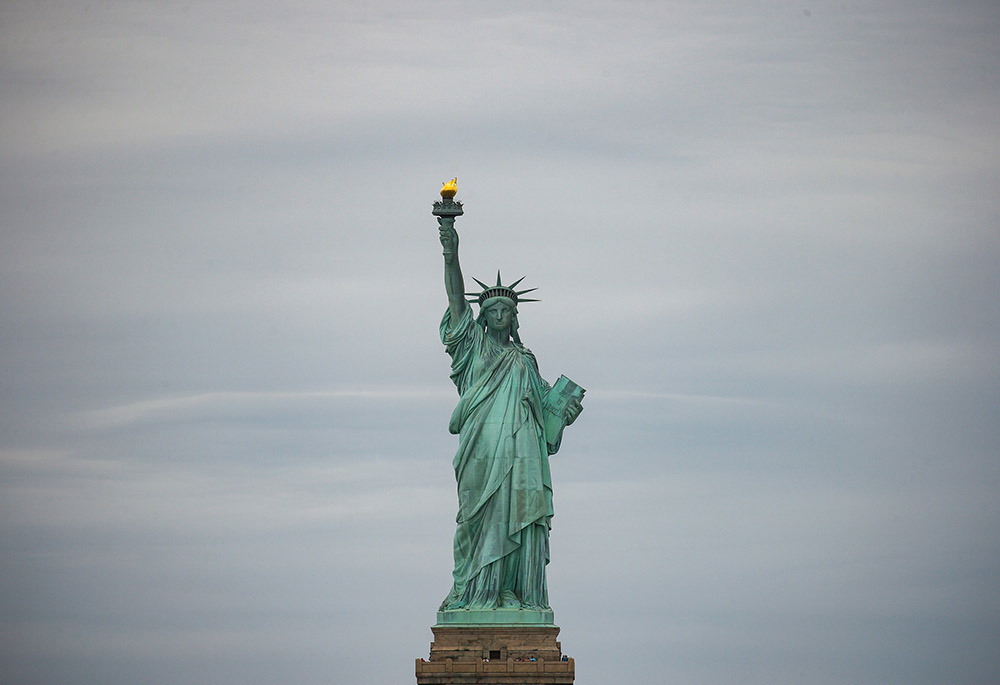
The Statue of Liberty is seen in New York City June 27, 2018. (CNS/Reuters/Brendan McDermid)
As I pray and try to make sense of what is happening in the United States, two stories from the desert fathers offer wisdom on what true hospitality looks like:
Some of the hermits once came to Joseph in Panephysis, to ask him if they should break their fast when they received brothers as guests, to celebrate their coming. Before they asked their question, Joseph said to them, 'Think about what I am going to do today.' He put two seats made of reeds tied in bundles, one on his left and the other on his right, and said, 'Sit down.' Then he went into his cell and put on rags; he came out, and walked past them, and then went in again and put on his ordinary clothes. The visitors were astonished, and asked him what it meant. He said to them, 'Did you see what I did?' They said, 'Yes.' He said, 'Did the rags change me for the better?' They said, 'No.' He said, 'Did good clothes change me for the worse?' They said, 'No.' He said, 'So I am myself whether I wear good clothes or rags. I was not changed for better or worse because I changed my clothes. That is how we ought to be when we receive guests. It is written in the Holy Gospel, "Render unto Caesar the things that are Caesar's, and unto God the things that are God's" (Matt. 22:21). When visitors come we should welcome them and celebrate with them. It is when we are by ourselves that we ought to be sorrowful.'
Abba Joseph is trying to tell us that when guests arrive, one should welcome them joyfully and not impose on them our personal issues. The example he provides by changing clothes illustrates that external appearances should not determine how we treat others.
Advertisement
This is particularly relevant today as our nation debates over immigration and asylum-seekers. Many of our policies and attitudes prioritize economic or security concerns over the dignity of migrants, refugees and other marginalized communities — a direct contradiction to the values of a self-proclaimed Christian country. Abba Joseph is really teaching us to not allow external markers — nationality, legal status, or socioeconomic position — to dictate our response to others. Instead, he speaks about recognizing the Christ in them. He says that our response to others does not change us, or in my own words, brownness is not a contagious disease.
The deeper message also speaks to the deep divide in American politics, where people often view others primarily through the lens of their political leanings. Abba Joseph encourages us to look beyond external labels (Republican, Democrat, conservative, liberal) and recognize we are one and the same. His reference to "render unto Caesar" could serve as a reminder to differentiate between the political and the spiritual. It is important to remember that government leaders are not above our moral and Christian obligation to love and care for others.
While Abba Joseph teaches us how we should welcome others, another story challenges the fear of scarcity that often holds us back from generosity:
A hermit lived a common life with another brother, who was a man with a merciful heart. Once, in a time of famine, people came to his door to take part in a love-feast, and he gave bread to everyone who came. When his brother saw this, he said, 'Give me my share of the bread, and do what you like with your share.' So, he divided the bread into two, and went on giving away his own share as usual. Crowds flocked to the hermit, hearing that he gave to all comers. God, seeing what he did, blessed that bread. But the brother who had taken his share, gave none away, and when he had eaten all his bread he said to the other hermit, 'I've only got a bit of my bread left, abba; let me come back and live with you.' The hermit said to him, 'Certainly, whatever you like.' So, they began to live together again and to have everything in common. Again, they had plenty of food, and again the needy kept coming to receive a love-feast. One day the brother happened to go in and he noticed that there was no bread left. A poor man came, asking for alms. So, the hermit said to the brother, 'Give him some bread.' He said, 'There isn't any left, abba.' The hermit said, 'Go and have a look for some.' The brother went in, and saw the bin full of loaves. He was afraid at the sight, and took some and gave them to the poor man. He recognized the faith and goodness of the hermit, and glorified God.
The second story contrasts two brothers — one who gives generously and another who hoards his portion. Who does this remind you of? The story shows how selflessness leads to divine recompense, while selfishness leads to scarcity. This is so close to what we are living today, where wealth inequality, social safety nets, and public policies regarding aid and welfare are at stake. The attitude of the brother who refused to share resembles the mentality of "America first!" that is driving the dismantling of social programs: a fear that sharing resources will leave us without enough. The story also suggests that generosity is not a loss but a path to greater provision, both spiritually and materially.
In a time when everything points to division, the wisdom of the desert fathers calls us to remember that as a nation of immigrants, we lift our lamp, to welcome others as Christ himself with the light of radical generosity.
The saying also challenges modern individualism and the "pull yourself up by your bootstraps" mentality that is so engrained in our country. We must understand, like the generous brother, that a community thrives when people help each other.
Both stories address the temptation to retreat into self-preservation, whether it be in welcoming others or sharing our material resources with those most in need. They call us to openness and trust in a time when our nation's leaders promote walls that divide — both literally and figuratively. In a time when everything points to division, the wisdom of the desert fathers calls us to remember that as a nation of immigrants, we lift our lamp, to welcome others as Christ himself with the light of radical generosity.