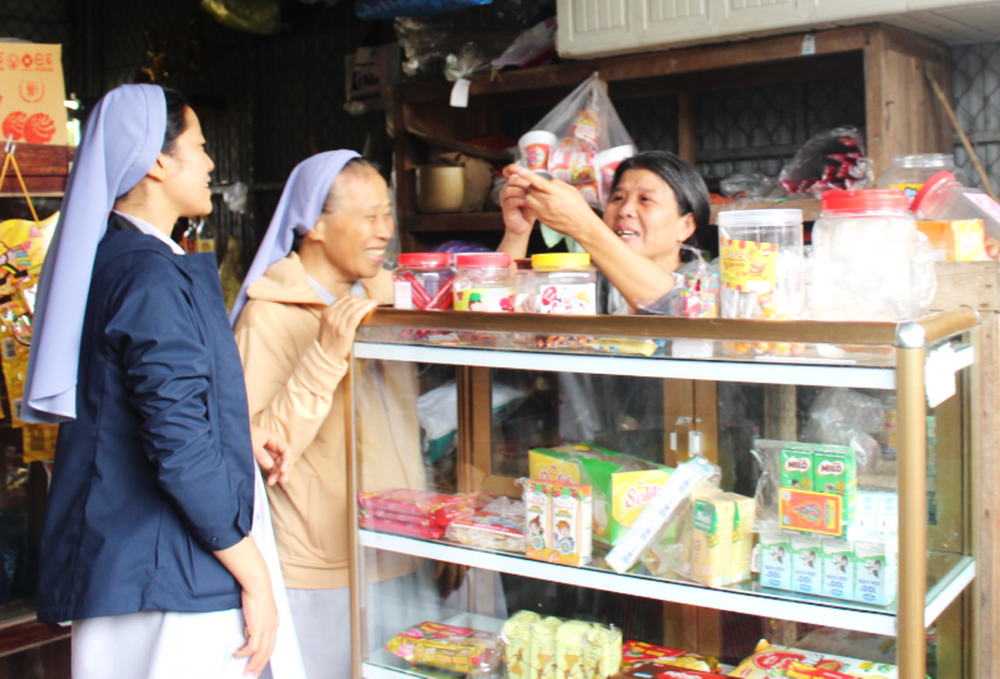
St. Paul de Chartres Srs. Marie Claire Tran Thi Tuyet (left) and Marie Monique Nguyen Thi Thanh talk with Teresa Nguyen Thi Duoc at her home in Da Nang on April 17, 2026. (Joachim Pham)
Seven-year-old Anna Le Thi Trung Hieu was flying a kite at the end of a dead-end lane, a cemetery at her back, when the Catholic sisters arrived on a day in May.
Her grandfather died of leprosy. Her father died of COVID-19 in 2022. Her mother left in search of a better life.
She now lives with her grandmother, who pedals a bicycle through distant wards each day, selling lottery tickets, and rarely returns before dark. She waits alone, sometimes falling asleep in the chair on the porch.
Hieu is one of dozens of children and grandchildren of patients with leprosy, or Hansen's disease, scattered across wards between Vietnam's central cities of Hue and Da Nang. This population carries not only the physical marks of Hansen's disease but the subtler, more stubborn wound of social exclusion that has followed their families for generations.
Catholic sisters have quietly committed themselves to these people, making regular pastoral rounds long after the world moved on.
"These visits aim to help them recognize the love of God," said Lovers of the Holy Cross Sr. Marie Anna Phan Thi Suong from the Phu Vang community. "What moves them most is being visited, greeted, talked with and touched."
A disease in retreat, but stigma endures
Hansen's is a chronic infectious disease caused mainly by a type of bacteria called Mycobacterium leprae, according to the World Health Organization. It affects people's skin, peripheral nerves, mucosa of the upper respiratory tract and eyes. The disease is curable, and early treatment can prevent disability, according to WHO.
Vietnam has made remarkable progress against leprosy. From more than 1,000 new cases detected nationwide between 2012 and 2016, the country recorded only 38 new infections in 2025 — its lowest figure on record.
The country aims to achieve zero new transmission, zero leprosy-related disability and zero discrimination by 2030.
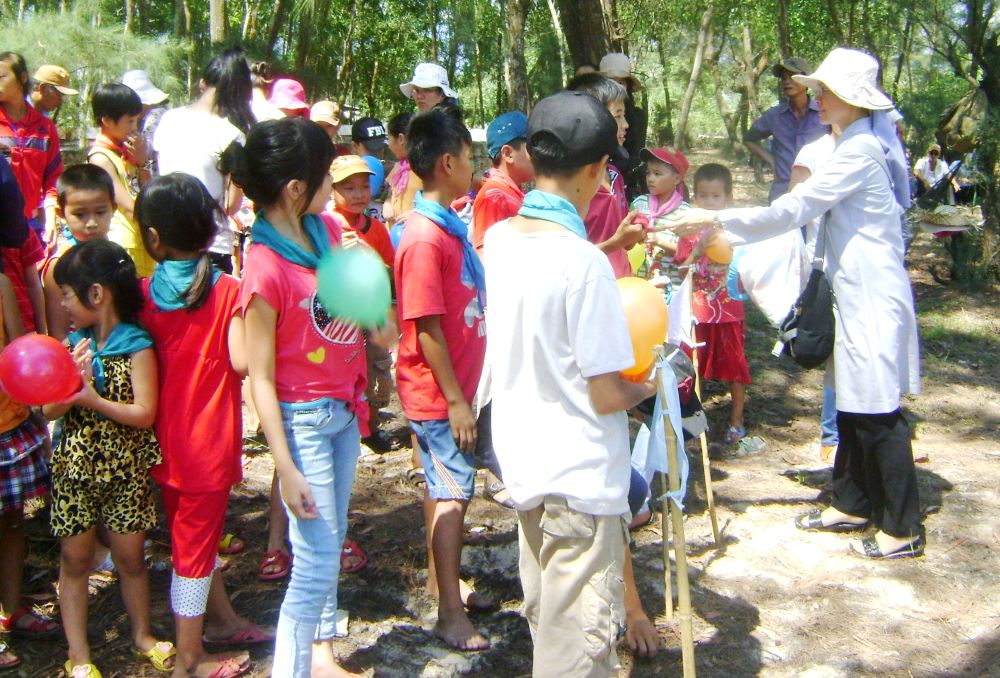
Sr. Marie Martha Tran Thi Tuyet leads games with children of leprosy patients on the beach in Da Nang on May 30, 2026. (Joachim Pham)
About 6,000 patients remain under medical care, most medically cured but living with physical disability from the disease.
Medical milestones, however, have not erased the stigma embedded in daily life.
Le Trai, 82, a Protestant whose hands were permanently deformed by the disease, is among 28 elderly residents at a resettlement area in Da Nang who still bear visible deformity.
He has lived there since 2012, when he and more than 350 leprosy patients and their families were compelled to leave their coastal village of Hoa Van — established in 1968 by American Protestant Pastor Gordon Smith — to make way for a resort development. Those still ill at the time were transferred to medical facilities; the rest were resettled on the outskirts of the city.
Trai said he rarely leaves his neighborhood for fear of discrimination. Once when he ventured out — walking 500 meters (1,640 feet) to watch a lion dance — he stopped to buy sugarcane juice. Other customers, seeing his deformed hands, walked away, he said. The vendor refused to serve him.
"I felt deeply hurt," he said.
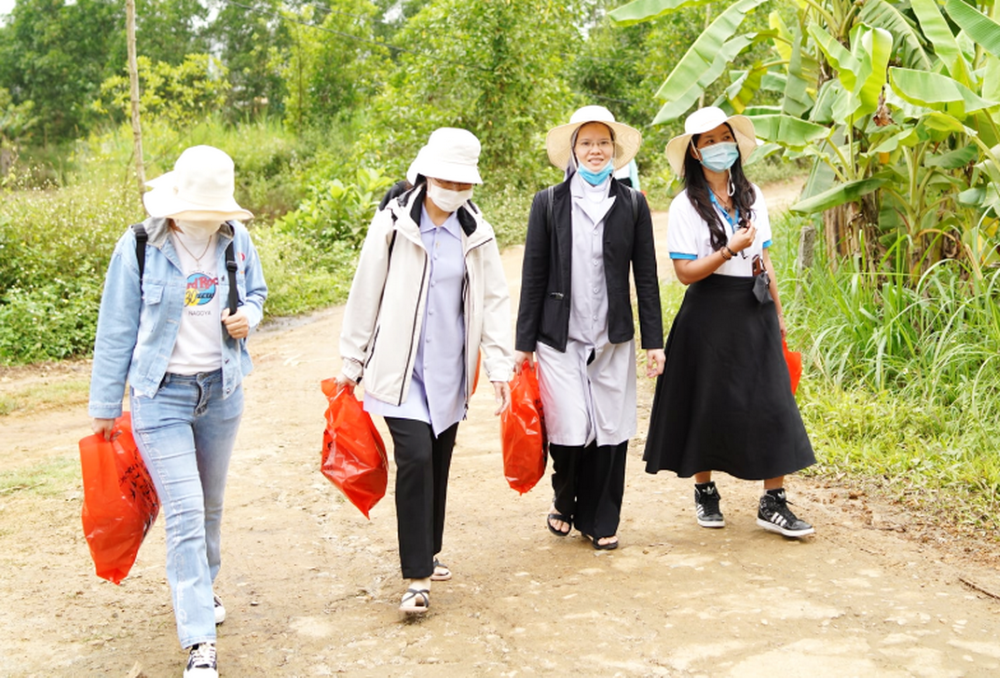
Srs. Anna Truong Thi Thanh (second from left), Marie Martha Tran Thi Tuyet (third from left), and two other volunteers bring gifts to leprosy patients at Thuong Trach village in Da Nang on May 30, 2026. (Joachim Pham)
From rejection to belonging
The resettlement gave displaced residents government land or housing and a small initial allowance, but most were in poor health and without marketable skills.
Teresa Nguyen Thi Duoc, 45, cured of leprosy in 2007, recalled that she tried selling fish door to door to earn money for her only son. Customers refused to buy from her, and employers turned her away, she said.
"Without the help of the sisters, we would not have been able to survive to this day," Duoc said.
After being referred to the Sisters of St. Paul de Chartres, she joined their daily food distribution for cancer patients at a local hospital. The sisters fed her and her son and paid for his schooling.
In 2019, Duoc embraced Catholicism. Benefactors helped her purchase a small plot of land in another ward. There she built a home and opened a neighborhood convenience stall.
When St. Paul de Chartres Srs. Marie Claire Tran Thi Tuyet and Marie Monique Nguyen Thi Thanh visited her on April 17, Duoc was behind the counter serving a customer. "Here I live happily," she said. "My neighbors love me, and there is no discrimination."
A day of visits
On May 30, four sisters of the Daughters of Mary of the Immaculate Conception from Phu Loc in Hue and five volunteers took a bus loaded with cooking oil, sugar, salt, candy and clothing to visit 25 families affected by leprosy living between Lang Co and Hai Van. They sang for patients, distributed gifts, and spent time with their children and grandchildren.
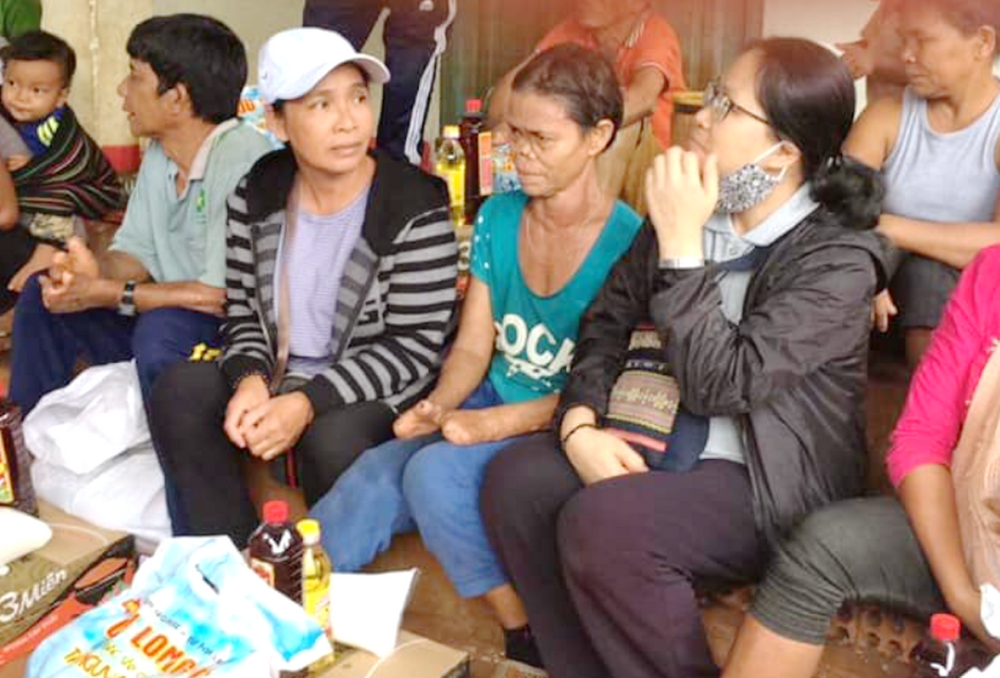
Former leprosy patients receive food and gather around Sr. Mary Magdalene Le Kim Phuong (wearing glasses) in Da Nang on May 30, 2026. (Joachim Pham)
For Le Trai — who lives with his bedridden wife on a state pension of 1 million dong (about $38) a month — the sisters brought wind medicated oil and 500,000 dong (about $19) in cash. "Thank you for traveling such a long way," he said. "We really need this oil when the weather changes."
In the Hai Van ward, the visitors organized games for more than 30 children on summer holiday — sack races, balloon-stomping, tug-of-war — while parents and grandparents looked on.
Daughters of Mary of the Immaculate Conception Sr. Marie Martha Tran Thi Tuyet noted that in 10 years of visits, this was the first time the sisters had played with the children; previous trips had always fallen during school terms.
Tuyet observed that the children were open, confident and free — "thanks to equal treatment at school" — while their grandparents carried the internalized anxiety of people who had spent their lives facing stigma.
Advertisement
Hieu danced and played alongside the sisters for the first time that day. "I like playing with my friends in the jumping, cat-and-mouse, and balloon games," she said, still beaming.
She is one of 100 primary-school students in difficult circumstances whom the sisters support with scholarships.
The touch that heals
Suong's community has coordinated care for about 30 leprosy patients since 2000 — visiting eight times yearly, distributing rice, cooking oil, cash, clothing and blankets. They also provide coffins for those who die in poverty.
The sisters have also baptized five newborns, taken in seven orphaned children with disabilities and awarded scholarships to 26 students in need.
Among those they visit is Nguyen Quoc Tuan, 17, who contracted the disease from his grandparents. He was cured in 2018, though his skin still flares in the dry season.
His feet are contracted; he cannot stand. His father left them. His mother grows rice and weaves brooms to sell between harvests, raising him alone.
Agnes Do Thi Vinh, 64, contracted leprosy from her parents and lives alone on a state allowance of 800,000 dong monthly (about $30), supplemented by 500,000 dong (about $19) and 20 kilograms (44 pounds) of rice each month from the sisters.
After the 2020 floods swept away her door, bed and blankets, the sisters helped her start a chicken flock. She now keeps more than 50 birds and earns nearly 500,000 dong a month from their sale.
Tuyet carries a memory from Advent 2025. Visiting an 82-year-old woman bedridden with leprosy, she gently lifted her upright with both hands and fed her sweet pastry.
"Empathy is the thread that connects us to them," Tuyet said. "It eases their loneliness. That woman has spoken of that warm embrace again and again — because it brought her back to smiling."
Showing up
The challenges are constant. Some families live at the far end of villages, reachable only on foot along winding paths. Elderly patients without phones must be located by asking neighbors. The sisters themselves struggle to raise donations. "But because of charity, we keep trying to overcome these obstacles," Tuyet said.
What matters, Tuyet explained, is showing up — year after year, during every season, over difficult roads, with whatever they have to bring. For the people they minister to, their constancy is something the world has not always given them.
"These visits aim to help them recognize the love of God," Suong said.