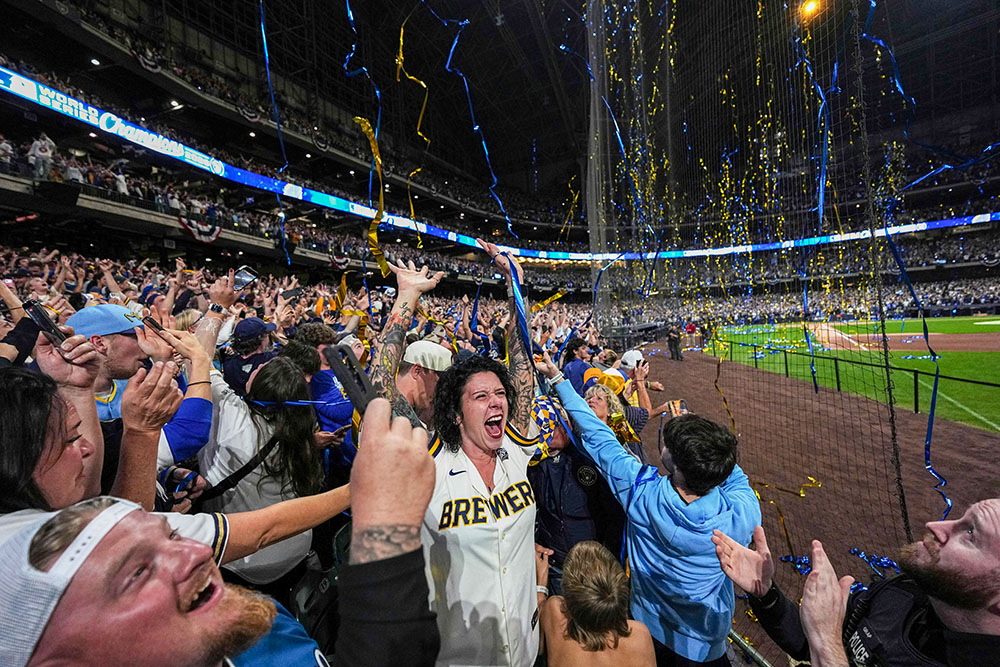
Fans cheer during a watch party at American Family Field after the Milwaukee Brewers defeated the Tampa Bay Rays in Game 5 of baseball's World Series, Wednesday, Oct. 28, 2026, in Milwaukee. (AP/Ross Harried)

by Sr. Jane Marie Bradish
I will admit to being a casual sports fan, with the exception of American football, but this year is different. This fall, I've been all about baseball's World Series, because my hometown team, the Milwaukee Brewers, just won the title last night, beating Florida's Tampa Bay Rays. Yay home team!
I can see the Brewers' stadium from my residence and drive by it often, and always pass it on my way to and from the motherhouse. The last time they were in the World Series was in 1982; I was a new college freshman. The series went to seven games and the hometown team lost. Even so, the city hosted a "welcome home" parade for the team.
Fast-forward 44 years. Professional sports are much different than when I was growing up. Most obviously, the money involved is staggering. The hometown team is considered a "small market," with payroll under $200 million. Trips to experience a game are no longer affordable for many, even during the regular season. Tickets for the World Series cost thousands of dollars and secondary market tickets even higher.
So what does this have to do with anything? The excitement of the playoffs, going up against teams with more well-known players and salaries double and triple what our team has, has made a noticeable difference in the city. Neighbors greet each other with "Did you see the game?" instead of ignoring each other. The Milwaukee Bucks, our NBA team, moved the start time of their first home game to accommodate the baseball game; there were fans who attended both.
Advertisement
Local establishments hosted watch parties for minimal cost, some even outside, which is challenging in late fall weather. The stadium sold $15 tickets to watch the broadcast on its jumbotron. Imagine 30,000 people sitting around an empty field, basically watching the game on TV.
Somewhat tongue in cheek, the city's mayor wrote a "please excuse" note for anyone who needed an excuse to miss work or school to attend the festivities. The school where I minister relaxed the dress code for everyone to include Brewers shirts as a way of showing support to the team.
The local media tracked down the Brewers chaplain, interviewing him and photographing his custom vestment displaying tastefully hidden state of Wisconsin and Brewer's logos.
The archbishop of the Milwaukee Archdiocese and the bishop of the St. Petersburg Diocese, which includes Tampa, had a friendly wager benefiting their respective branches of Catholic Charities. The art museums in both cities were offering to loan a Monet to the winning city for a special exhibit.
I personally heard from my sisters throughout the country, as it's hard not to notice the World Series.
I've yet to hear complaints, but I'm sure there are reasons folks could complain. For example, while I can see the stadium from home, I've not really been affected by the noise or traffic. I wasn't being asked to work overtime, like the first responders for crowd control and safety, or to delay my work, like the highway construction crews were to keep easy stadium access open.
There are also issues with the obscene amounts of money involved in professional sports. Imagine for a moment what one game's salary for one player, roughly $34,000, could do for your congregation or ministry.
In a world so tired by never-ending war, famine, politics, divisive everything, there is something refreshing about people coming together to celebrate. The national media pundits didn't take our team seriously. They even made insulting remarks about how the manager brought his children to the post-game press conferences, something I find wholesome. There is something to be said about standing on the sidewalk with complete strangers cheering yourself voiceless to celebrate.
Will the world still be in peril when the championship festivities end? Yes. But maybe, just maybe, the people of "Small-waukee," as we are often disparagingly known, will take those happy memories and celebrations and move them forward into everyday life. Maybe neighbors will continue to talk with each other. Maybe local establishments will find additional inexpensive ways to gather people together. Maybe we can find ways to celebrate while also working to address the world's concerns. Stranger things have happened.