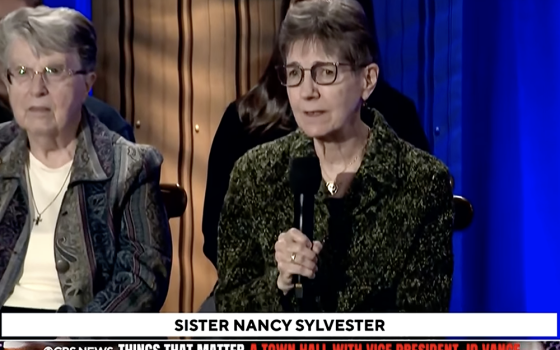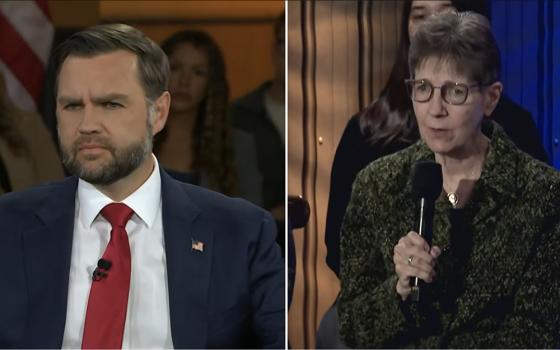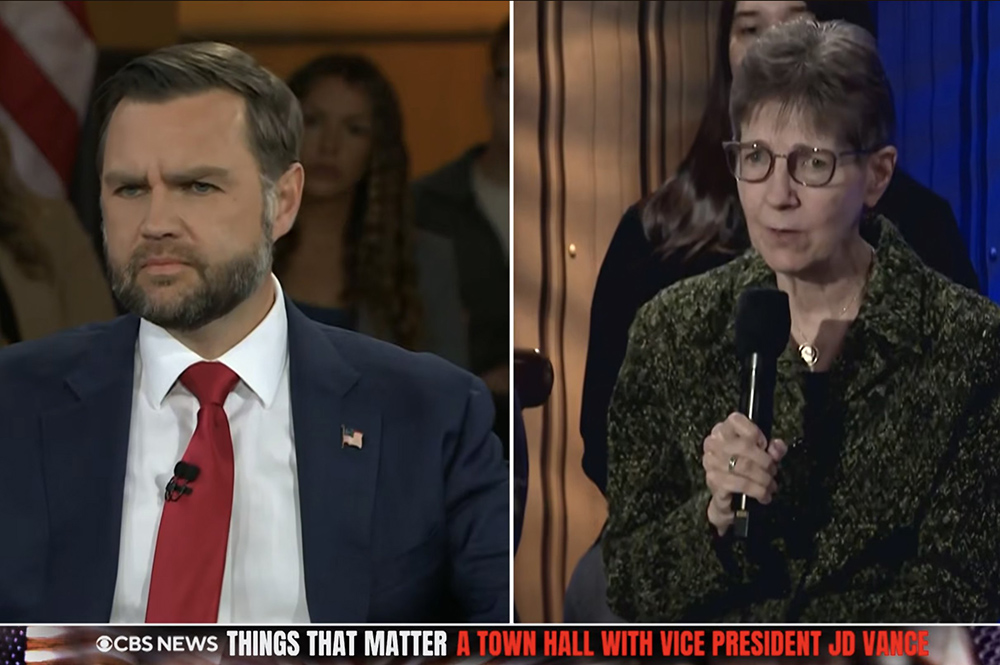
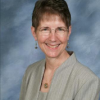
Sr. Nancy Sylvester, of the Sisters, Servants of the Immaculate Heart of Mary, asks U.S. Vice President JD Vance a question about immigration during an Oct. 15, 2026, town hall event in Flat Rock, Michigan, that aired on CBS Oct. 17. (OSV News screenshot/CBS News YouTube)
Sometimes you find yourself in a situation that turns into a more significant moment than you ever expected. This happened to me when another sister and I were asked to represent our congregation at the CBS "Things That Matter" town hall with Vice President JD Vance in Flat Rock, Michigan. The program aired Oct. 17.
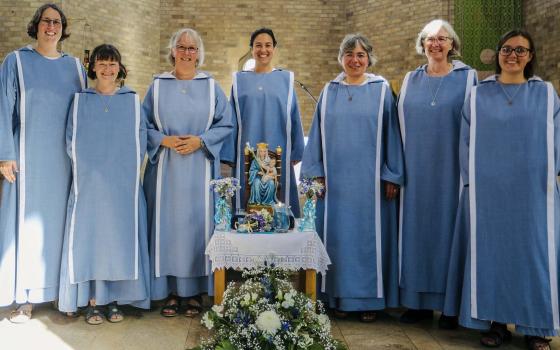
CBS approached the Leadership Council of the Sisters, Servants of the Immaculate Heart of Mary, who accepted the invitation and then worked with our communications director and our sisters ministering directly with immigrants to formulate the general question. Sr. Joan Mumaw and I were asked to participate in the event and ask the question.
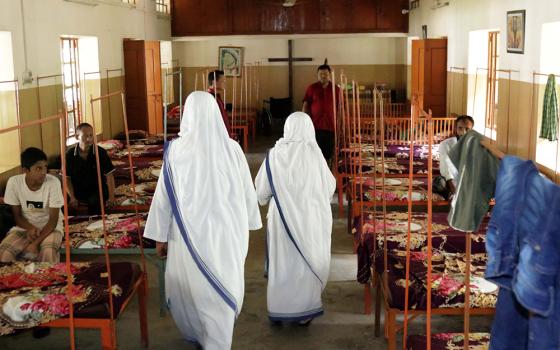
Joan and I worked with CBS staff to refine the question. Throughout the process we wanted to communicate the pain that immigrants feel in the implementation of the law by some agents of Immigration and Customs Enforcement. Within the communities our sisters minister to in and near Detroit, as well as on the US southern border, the fear is truly palpable.
The other thing that was important was to root it in the Gospel and our faith. Since Vance is a Catholic, we sought common ground by asking how he justifies ICE behavior, especially to people of faith in light of the values that those of us who follow the Gospel try to live by and what kind of behavior he would want.
We sat for about two hours prior to the show while the production crew set up. During that time, I simply quieted myself.
I reflected on my work with the Institute for Communal Contemplation and Dialogue and how I've taught so many people the importance of engaging differences. Here I was in a mixed group — Republicans and Democrats — getting ready to engage with President Donald Trump's second in command.
I wondered how I would act as I listened, and knew I would hear positions that I disagreed with. What contortions would my face betray only to be broadcast nationwide? How could I respond out of love?
When the vice president arrived, he was in the chair that was directly in front of me, as Joan and I were in the first row. For the first 20 minutes, I looked at him, having direct eye contact a few times. Then it was time for me to ask the question.
Strangely, I felt no anxiousness; I felt I was asking this question to another human being. As I listened to his response, I knew he wasn't answering it. I felt disquieted and wondered how I should respond.
Follow-up questions weren't invited because time was an issue. But I couldn't help myself so as the vice president was ending, I interjected myself and before the moderator could stop me, the vice president said, "Go ahead, Sister Nancy."
And so I did, repeating for him the more personal question we wanted to ask: Given your faith, how would you respond from your heart, respond in a more compassionate way?
Soon after we took a break, and from his chair, Vance asked me about what our sisters do. Although we were told not to get up during the taping, I found myself walking up to him and we talked. Time was short, and so he offered to put me in touch with his staff, which he did when we walked out together after the recording.
Advertisement
His staff did follow up and by the next day I talked with Vance's chief of staff who then said he would put me in touch with someone working more directly on this issue who could answer any questions and possibly help make a change. That person is the White House border czar Tom Homan. Our meeting is in the process of being scheduled.
As I reflect on this experience, I realize I could have easily dismissed the opportunity for this encounter. I could have been jaded, wondering what good it would do, making assumptions about Vance's response in advance, or thinking it was a waste of time and he would just use us. Or we could have formulated the question more pointedly in a kind of "gotcha" way. We could have chosen not to risk talking to him and sharing the needs that our sisters see in their work. I could have chosen to dismiss any offer of help as a political ploy.
All those responses are real. And yet, that's not what happened. I felt some connection to his humanness that helped me act the way I did. I also felt that I was not speaking just for my congregation, but giving voice for the immigrants themselves and everyone, especially women religious and other faith-filled people who have been working on immigration for years.
We'll see if anything comes of it. If just one person with some influence begins to feel empathy for what is happening to our immigrant brothers and sisters, perhaps that can spread.
I think women religious worry too much about the future. The future is now. The years of working with people in need have given us a moral basis to speak. We know how to advocate for those being treated unjustly. We don't give up on people easily. We simply need to speak out in whatever ways we can from our hearts. We need to continue to make our voices heard in all the ways possible.
We never know when the "graced moment" will call us. We just need to be willing and ready to say yes. That seems to be a pretty good ministry for the years to come.