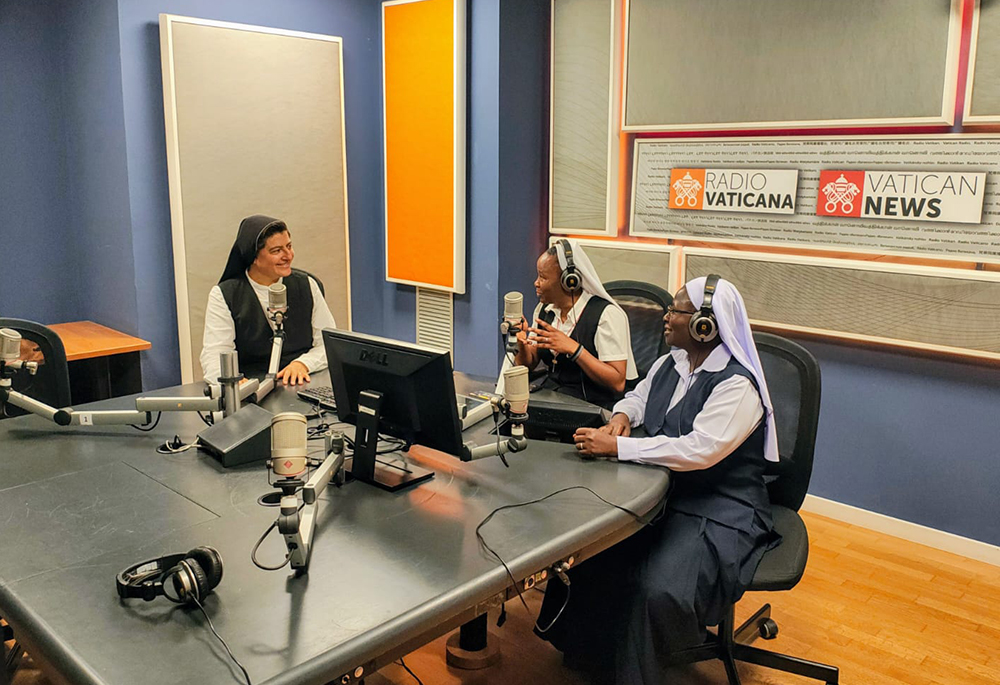
Srs. Rocío García Villegas, Christine Masivo and Angella Rwezaula, participants in the Pentecost Project, are pictured during their communications training at the Vatican News studios in the Dicastery for Communication at the Vatican. (Courtesy of Sr. Rocío García Villegas)
Sr. Rocío García Villegas
It all began in 2023. That year, I visited several missionary communities within my congregation, the Daughters of Mary Immaculate of Guadalupe, with the intention of documenting the ministries they do. One of these communities was La Grandeza, Chiapas, where I lived for a month to conduct interviews, do research, and spend time with the people.
The sisters' day began at 5 in the morning. They would leave home in a van to travel the mountain roads and pick up the children living in remote communities. They took them to the school they themselves had founded through great effort. There, they provided the children with intellectual, moral and spiritual education, as well as the bread they needed to start their day.
It was there that I discovered a reality I had been unaware of until then: hungry children, communities marked by poverty, drug trafficking, and precarious educational conditions — but also strong, tireless women who stood by their people, giving of themselves without rest. It had a profound impact on me to discover how my sisters devoted themselves in this way. They were sisters from my own congregation, and yet I had been unaware of that reality.
Over time, I encountered similar situations in other places and with other congregations. I then began to ask myself what I could do through communication. I realized that not only was the dedication of so many sisters unknown, but so were the lives of the people with whom they walked. Their stories were rarely heard, and in the end, I couldn't help but wonder: Who cared about them?
That question was what led me to devote a good part of my time to telling stories and training myself to do so in the best way possible. Three years ago, I found in the Pentecost Project — an initiative of the Dicastery for Communication with the support of the Conrad N. Hilton Foundation (a major funder of GSR) — a space to begin this journey of formation. Little by little, new opportunities arose to participate in international projects and publish some of my stories in Vatican News.
Recently, I also had the opportunity to experience the pope's communications firsthand during my internship, from May to July 2026, at the Spanish-language editorial office of the Dicastery for Communication in Rome.
Advertisement
This journey has allowed me to learn to see things differently and to tell these stories with deep respect, seeking to highlight hope in the midst of suffering. In these stories, I have discovered the cry of Christ, who continues to call for justice and love. At the same time, I have also discovered the meaning of my vocation to communication. I have learned that I am neither the protagonist of the story nor the tireless missionary who must take center stage, but simply the window through which the world can see Christ walking with his people: "the poor."
While writing an article, I've come to understand that behind every published word there are real people, each with their own realities, problems, quests, and experiences of God. And perhaps one of the most powerful aspects of this process is conducting interviews, because in them people open their hearts and share a part of their lives and their dreams.
I remember, for example, putting together an article dedicated to migration in the context of Mexico City. During an interview, a migrant woman from Venezuela wept deeply with me. She shared her many questions for God and the sufferings she had endured during her journey through the Darien Gap and along Mexico's southern border.
This interview, like many others, sometimes fills me with outrage and other times with a deep strength to continue sharing their realities. I don't create content with the goal of making it go viral. I seek to open a window so that anyone, from anywhere in the world, can learn about the infinite ways in which God continues to pour out mercy and hope, even against all odds.
For me, communication is, above all, learning to see: to see what often remains hidden, to listen to those who are rarely heard, and to share their stories with others to raise awareness and foster collaboration.
I believe there are new ways to be an apostle today: carrying a cellphone, a computer, a microphone, or a camera and putting them at the service of the stories of those who have known pain but have also witnessed mercy and hope.
This is my way of being a missionary, of living out my consecrated vocation, of contributing to the kingdom of God, and of finding meaning in my calling as a communicator. Because there are stories that don't seek the spotlight; they just need someone who has the courage to stop, look at them, and not walk right past them.
This column was originally published in Spanish on Sept. 4, 2026.