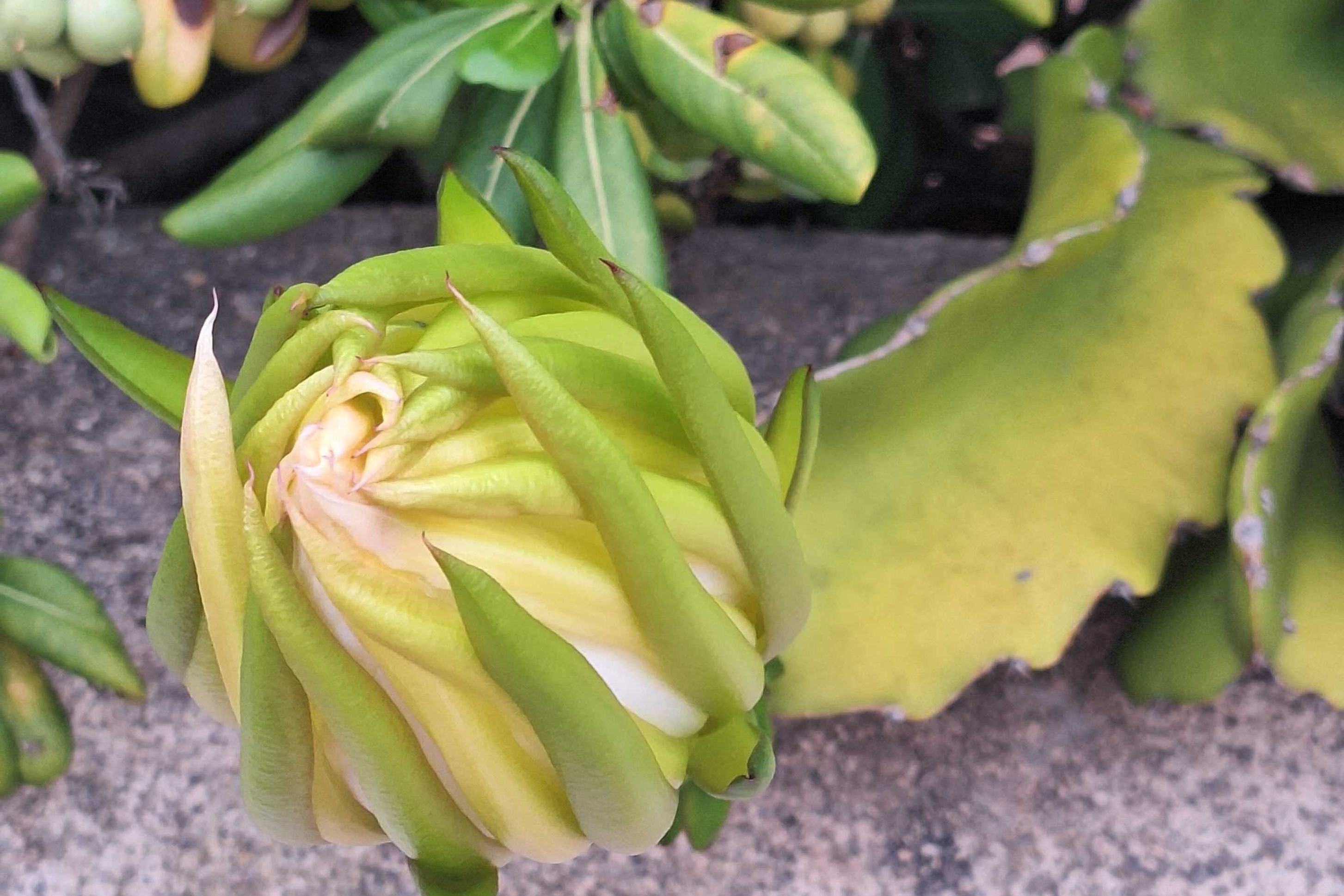
Sr. Magda Bennásar's Queen of the Night cactus appears ready to bloom in her home in Mallorca. This flower blooms for less than 24 hours and opens during the night. (Magda Bennásar)
by Sr. Magda Bennásar
Contributor
It is late, but this is our hour. It is late, but this is all the time we have to shape the future. It is late, but we are the ones who must make this late hour count. It is late, but it is dawn if we persevere a little longer.
Bishop Pedro Casaldáliga
The words of our brother, teacher and poet-bishop Pedro Casaldáliga, coming from Brazil, a country that is key to ecological balance, have come to my heart as I reflect on the possible change in the presidency that could affect ecological justice for ecosystems and Indigenous populations.
And not only in Brazil. Here in the Mediterranean, where I live, the hot and humid months have become longer. This brings many changes and dangers for biodiversity and the health of vulnerable people. For example, schools, universities and homes now need air conditioning, whereas until recently fans and good building orientation were sufficient.
"It is late, but this is all the time we have at our disposal to shape the future." And from my somewhat troubled heart comes a lament: How to create that future? How can we return to dawn?
The answer comes like the whisper Elijah was waiting for when he sought God in the storm, in the hurricane ... But no, God was not there. Suddenly, he heard something barely audible: a breath, a whisper. He realized it was coming from within — it was God speaking to him at dawn, in that newly awakened state of listening, between night and day, when things begin to take shape between absolute darkness and the first signs of daybreak.
The Elijah within me needs to discern God's whisper. Even if it may be late in my life, that whisper brings me back to the beginning, to what really matters, to the dawn where the day begins, where the heart is reset. My day, our day. My life, our life.
How can we discover this? By bringing balance to our vital axis: the body we have, the spirit we have, and the time we have.
We are the only living beings who are aware that we are conscious. And from this awareness emerges an invitation: find a balance within yourself between the monastic dimension and the activist dimension.
These two energies coexist within the human person: One guides us inward, while the other moves us towards action. Perhaps it is too late for many people to achieve the much-needed balance in their mental and spiritual health. But it is not impossible if, as the poet-bishop tells us, we persevere a little longer.
Mother Nature accompanies us and helps us through this process. Nature, which did not burn in the countless fires that raged this summer, devastating thousands upon thousands of hectares in Spain alone, accompanies us this autumn with its beauty and melancholy, inviting us to discover the wise balance of our vital axis.
Out in the natural world, where life unfolds, autumn begins in the Northern Hemisphere. By itself, without pushing or forcing anything, this wonderful season leads us to "let go of dead leaves" and enter a time of greater interiority and, as a result, of gestation and rest. Nature settles down and becomes dormant, while the city grows increasingly energized and frantic with activity.
On a social level, this is understandable: Our entire lives and activities become more outward focused. But what about our hearts and minds?
This is the time to nurture our monastic side, precisely when work and social commitments are at their busiest. Let us begin by bringing balance to our inner selves by caring for our monastic archetype: our innate need for silence and connection with the transcendent.
This balance between our inner and outer lives is essential for our whole being to be integrated in a healthy way. I am not referring to prayers; I am referring to long periods spent alone in the silence where God dwells, in your inner cell, in nature or in your room.
I am referring to quietly listening to your own heartbeat and to God's heartbeat in the silence of your inner universe, where everything and everyone is bustling with activity, but where you also know that if you allow yourself to be carried away by the impulse to save the world, you may burn out. And in this respect, Mother Nature offers us many clues to help us recover our vital energy.
For example, go for a walk, treading on sacred ground, and learn from the wisdom of nature, which is never in a hurry, respects its cycles and transforms itself according to the dictates of the climate. Nature does not try to "do more"; nature simply "is." And it does not burn out; we burn it, just as we burn ourselves out when we fail to take care of ourselves.
Advertisement
What does it mean to burn out? How do I know if I am burning out?
Burnout is a state of physical, emotional and mental exhaustion caused by prolonged exposure to stressful situations.
Emotionally, it produces a profound feeling of having no energy left to carry on. We begin to feel distant and detached from the people we work and live with. We withdraw into ourselves.
We experience a strong sense of ineffectiveness and failure, along with a loss of confidence in our own abilities. Physically, we may experience chronic fatigue, sleep problems, headaches and muscle pain.
These are some of the symptoms that can help us recognize when we need to take care of certain aspects of ourselves.
It is in our hands to do something about it. And this is where our deepest freedom becomes evident: Make our time a priority. Learn to say no. Balance time spent in silence, at work, in commitments and in leisure activities, especially in nature. Create your own mini monasteries at home and in your surroundings; invite people to share moments of silence there and begin to remove the barriers between sacred and secular spaces.
Mother Nature, in her healthy balance, teaches us, shows us and gives us this gift. Through her cycles, she points the way towards balance. Now, in autumn in the Northern Hemisphere, she tells us to let go of what is dry and old, and to gather our energy for a new period of gestation, whose first signs we will not see until next spring. And those who are in springtime, let yourselves be filled with the beauty of this new dawn in your lives.
Happy autumn in the North and happy spring in the South.
This column was originally published in Spanish Oct. 28, 2026.