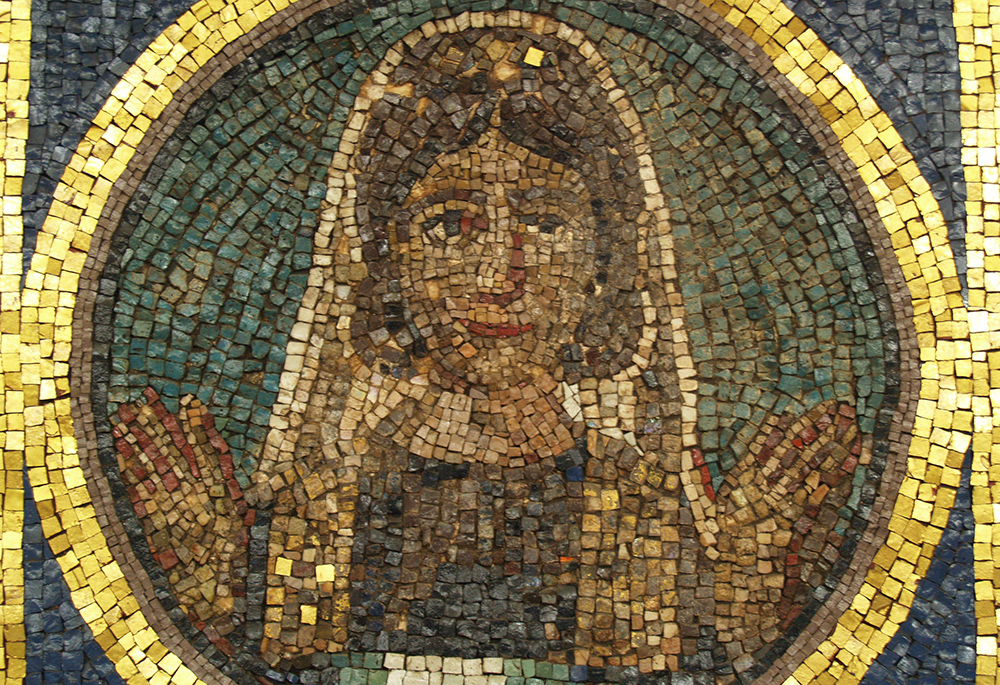
A woman is depicted at prayer in an ancient Christian mosaic seen in the Vatican's Pio Cristiano Museum. (Wikimedia Commons/Miguel Hermoso Cuesta)
by Rhina Guidos
After the Vatican in late 2023 gave no definitive answer on whether women could be ordained deacons, Jayne Prior stopped going to Mass in a Catholic Church.
"I'm not going to continue to support an organization that isn't treating women appropriately," Prior told Global Sisters Report. "I was just like, there's no hope this is going to happen in my lifetime and I was done. There is no reason on earth for women to not be deacons … so, yeah, that was the straw that broke the camel's back, I think."
Prior, a lifelong Catholic, joined the Episcopal Church the following year, even though she said "the Catholic Church is so much a part of who I am." She's still involved with the Ignatian Spirituality Center of Kansas City, and treasures her kinship with Maryknoll missionary circles. But when it came to the lack of action on women deacons after the Vatican's 2021-2024 synod consultation process, "it was like a flip just switched," she said.
Her reaction sounded much like the responses Jane Cavanaugh synthesized March 8, International Women's Day, at Holy Trinity Catholic Church in Washington, D.C. Cavanaugh, of Discerning Deacons, an international organization working toward the ordination of women to the diaconate, read the parish's reactions to a December 2025 Vatican report from a papal commission that answered what the synod couldn't: It did not recommend the ordination of women as deacons in the Catholic Church.
'I do believe we're going to see women deacons in my lifetime. I believe it in my bones.'
—Joanna Arellano-Gonzalez
"You felt [the report] was 'dismissive, irrational, impractical, insulting, depressing, disheartening, disappointing and embarrassing.' And you were 'frustrated, hurt, appalled, stuck, angry, distressed, confused and annoyed,'" Cavanaugh said, reading pages of the parish's feedback. "We share your concerns."
But there's hope to be found, she offered, and much of it comes from consecrated life thousands of miles away in South America.
Though some have criticized people who support women being ordained to the ministry, saying that it's a Western obsession, or that "only white women in the U.S. care about being deacons," take a look at South America's Amazon region, Cavanaugh said.
"The Amazon is leading the whole world in the [women's] diaconate movement, because they have women who have been granted … [permission] to go into the spaces where there are no priests, and there, they are really doing diaconate work," she said. "This is an exception, but we want to increase that. We're behind them. They are the leaders in this."
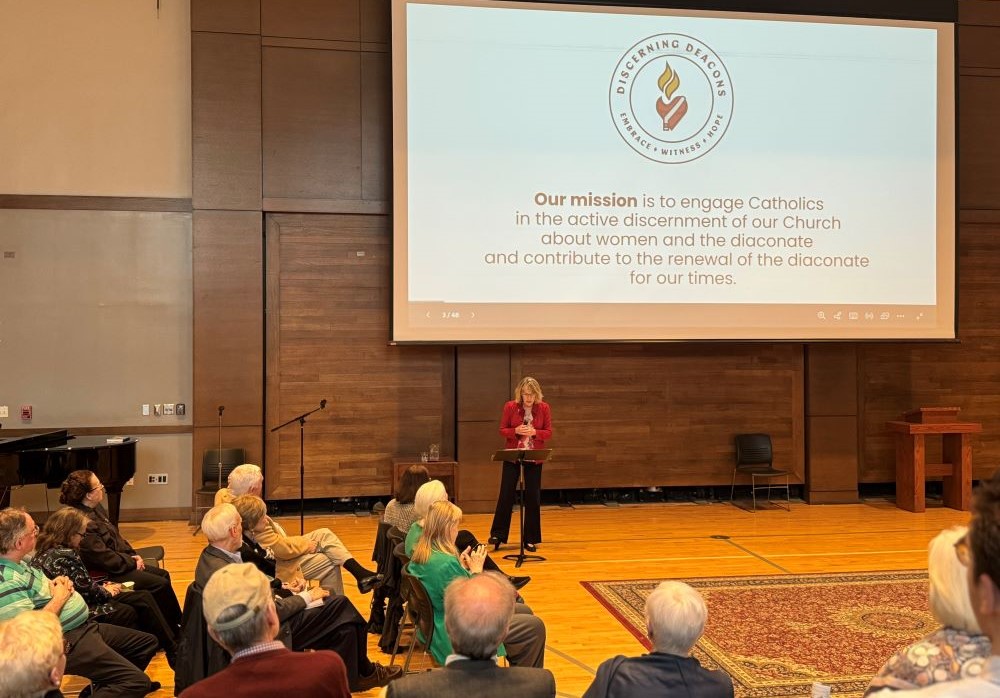
Jane Cavanaugh, of Discerning Deacons, spoke March 8, 2026, at Holy Trinity parish in Washington about updates on women's ordination to the diaconate. While many have been discouraged by a December papal commission report that did not recommend the ordination of women deacons, there is hope to be found in Latin America, Cavanaugh said. (GSR photo/Rhina Guidos)
"Women's diaconate already exists as a daily service and as a baptismal vocation," said Fr. José Luís Loyola, president of the Confederation of Latin American and Caribbean Religious, known as CLAR, the largest group of women and men religious in Latin America. But it is not an official status nor are the women ordained.
In a video in early March introducing CLAR's special magazine devoted to women in ministry, Loyola said that while the church's discernment on women deacons remains an open issue, a deep conviction has surfaced because of it.
"Without the full participation of women, the church cannot fully reflect the face of Christ," he said.
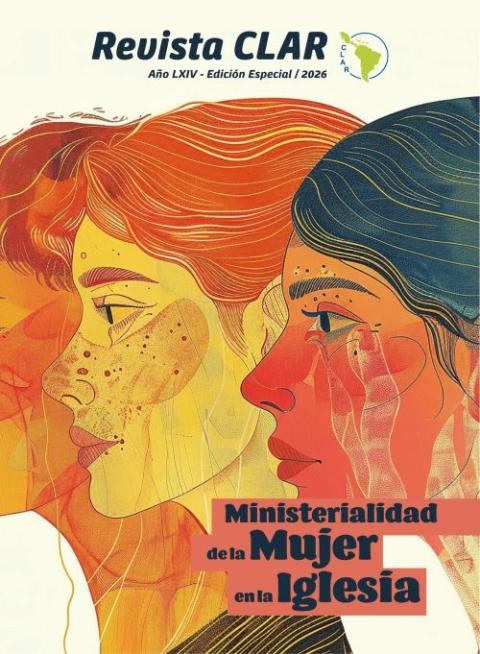
The Confederation of Latin American and Caribbean Religious, known as CLAR, dedicated its March 2026 issue to women in church ministry. The issue features articles by women religious and theologians related to the women in the diaconate. (Courtesy of CLAR)
Some panicked about the December announcement by the Petrocchi Commission, the 10-person group that studied the possibility of women deacons. But Cavanaugh said the commission's December recommendation is not the final word.
"It did knock the wind out of a lot of people's sails," she said. "But the Petrocchi Commission has completed its work and will not meet again. This is a consultatory commission. It is not a decision-making commission, and [Discerning Deacons] just decided not to give it too much weight."
What the organization pays attention to, she said, is paragraph 60 in the final synod document issued in October 2024.
It says that "there is no reason or impediment that should prevent women from carrying out leadership roles in the Church: what comes from the Holy Spirit cannot be stopped. Additionally, the question of women's access to diaconal ministry remains open. This discernment needs to continue."
"That is papal magisterium … the Petrocchi Commission is not papal magisterium," Cavanaugh said.
Sr. Maria Luisa Berzosa, a Catholic sister who was a synod consultor, wrote in CLAR's magazine on women that the female diaconate may not just be an ecclesial issue but a cultural one as well.
"At the synod, we found that some churches are more mature in advancing the request for women's ordination, while others are not yet ready," said Berzosa, of the Daughters of Jesus in Spain.
In South America, support for women deacons has come from the top. Prelates like Brazilian Cardinal Cláudio Hummes, who died in 2022, pushed for stronger leadership roles for women, and in 2019 told Catholic News Service that, particularly in the Amazon region, women play a special part in faith communities.
"Many are at the forefront of their [church] communities in the absence of priests," he said.
It's a sentiment that continues with Peru's retired Cardinal Pedro Barretto, a Jesuit who serves as president of the Ecclesial Conference of the Amazon (CEAMA). The South America-based organization is trying to make inroads on the issue.
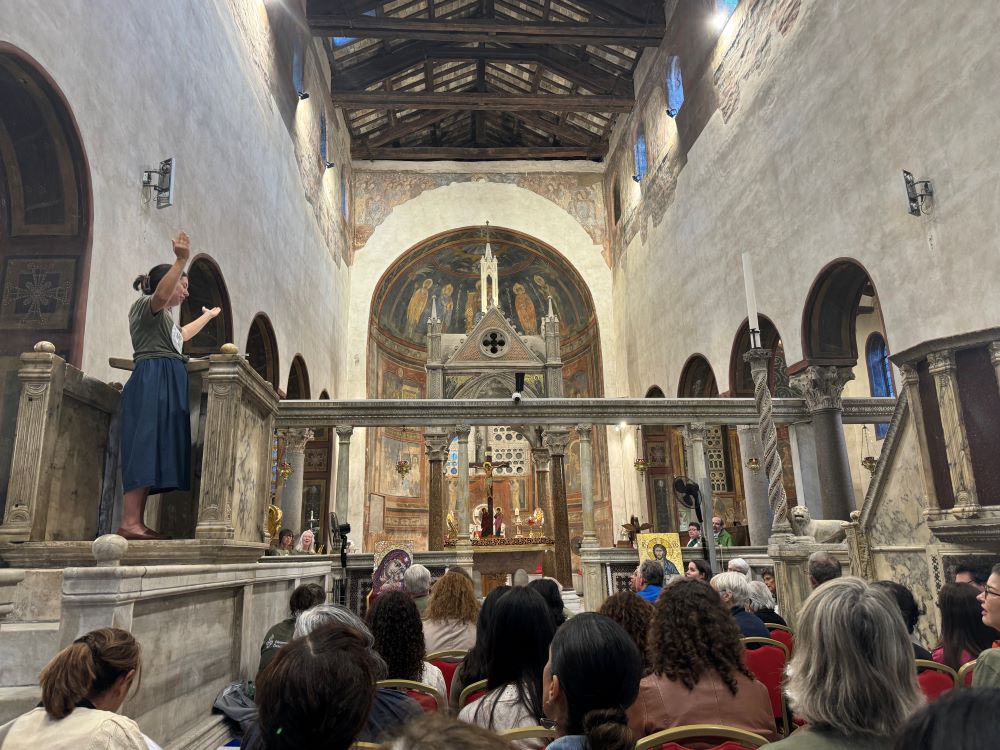
Allison Beyer of South Bend, Indiana, leads a group of pilgrims as they sing a psalm Oct. 6, 2024, at the Basilica of Santa Maria in Cosmedin during a pilgrimage to Rome for groups from the Ecclesial Conference of the Amazon (CEAMA) and Discerning Deacons. Both groups advocate for the ordination of women deacons. (GSR photo/Rhina Guidos)
Franciscan Sr. Laura Vicuña Pereira Manso, CEAMA's vice president, called on International Women's Day for meaningful and real inclusion of women in the church's decisions as well as "restoration of the female diaconate," saying there's precedent since St. Phoebe is mentioned by St. Paul the Apostle as a "diakonos," or deacon, in his letter to the Romans.
"The inclusion of women in all ecclesial spaces is key to the transformation of the church," she said. "This requires a true pastoral and synodal conversion that recognizes the charisms and ministries that many women already exercise, based on their baptismal dignity."
But not everyone feels that way.
"In some places, it seems as if women, we're a threat," said Berzosa, of Spain.
That's why it's important for the church to continue to dialogue, she said, and avoid using labels such as "progressive" or "conservative," taking into account the variety of cultures the Catholic Church operates in.
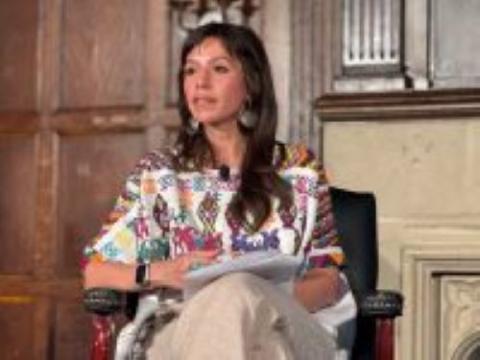
Joanna Arellano-Gonzalez said during a March 9 panel on leadership at Georgetown University in Washington that she sees more women occupying important positions in ecclesial structures. She said she believes women’s ordination will happen in her lifetime. (GSR photo/Rhina Guidos)
At a March 9 event at Georgetown University in Washington highlighting the leadership of Catholic women, panelist Joanna Arellano-Gonzalez, of Chicago's Coalition for Spiritual and Public Leadership, said she already sees more women leading ecclesial structures. For her, the question of ordaining women deacons is not whether it will happen, but when.
"I do believe we're going to see women deacons in my lifetime," she said. "I believe it in my bones."
Some like Prior no longer pay attention to what the church rules on the issue. For a long time, she said, she believed it was important to stay in the Catholic Church to change it, but now, as a practicing Episcopalian she no longer struggles with a structure that seems resistant to women in a spiritual setting.
"There's nothing inherently different with women's capacity to lead or preach or understand God that is different from men," she said.
Advertisement