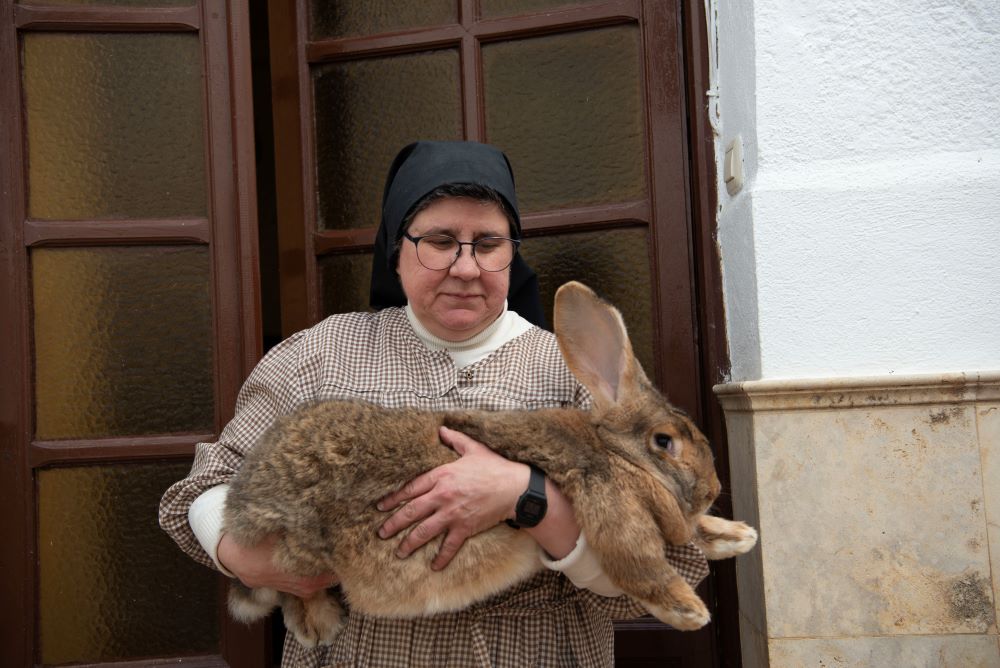
Franciscan Sr. Consuelo Peset Laudeña shows one of the Spanish Giant rabbits the cloistered community breeds at the Convent of St. Anthony of Padua in Central Spain. The rabbits are at risk of extinction. (Lissette Lemus)

by Lissette Lemus
Sr. Consuelo Peset Laudeña's morning routine is not what one would typically expect from an abbess. Before prayers and breakfast, she heads to inspect, one by one, cages housing 35 giant rabbits and their young inside the Convent of St. Anthony of Padua in Central Spain.
At 54, Peset leads the group of Franciscan sisters who have taken on the mission of conserving Spain's giant rabbit, a breed in danger of extinction.
This breed is not only a genetic heritage belonging to Spain but also part of the country's historical memory, the abbess said: During the Spanish Civil War and the postwar period, raising them was crucial to feeding families and orphanages in times of scarcity.
"Many families have managed to get by thanks to this animal, and now it seems we are forgetting that part of our history," she told Global Sisters Report.
'We have to protect creation.'
—Sr. Consuelo Peset Laudeña
Peset said that in Spanish regions such as Valencia, Madrid and Asturias, numerous farms kept up to 300 breeding females, which made it possible to feed a large number of people, especially those orphaned during the war.
The breed, a cross between the Flanders Giant and Spanish brown-type females, can weigh up to 20 lbs. and has a high reproductive capacity, as each female can bear up to 22 pups per month.
Maricarmen Pleite Orozco, a volunteer at the convent, recalled having tasted meatballs made of rabbit's meat and described it as white, juicy and very flavorful.
According to data from the Interprofessional Organization for Farm-Raised Rabbit Meat, rabbit meat is lean, rich in protein, and contains high levels of phosphorus, selenium, potassium and vitamins — qualities that help prevent childhood obesity, anemia in adolescents, high cholesterol and gout.
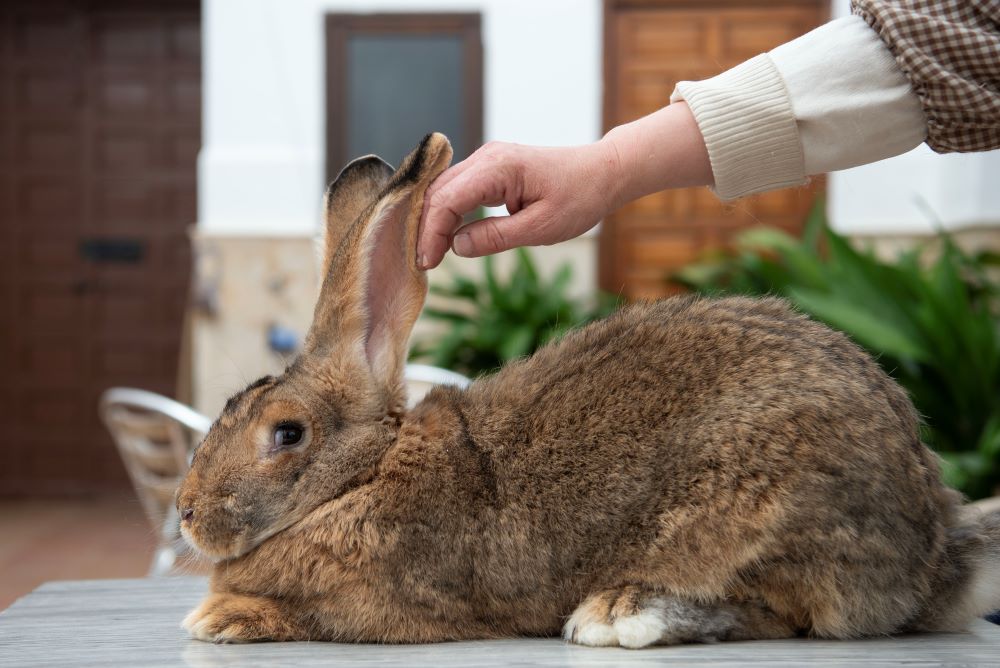
The Spanish Giant rabbit can weigh up to 20 pounds. Its meat was used to cope with food shortages in the postwar period. (Lissette Lemus)
Raising the animals at the convent began more than 30 years ago when Peset's parents gave her a pair of rabbits for personal consumption. However, a decade ago, the initiative took a new turn toward conservation when the sisters discovered the breed was at risk of extinction.
"We contacted an association, I sent some photos, and they told me, 'You have a spectacular animal, and it's endangered,' " she recalled.
Although Peset was not leading the convent at the time, her community agreed to participate in the recovery, breeding and study of the rabbit.
To do so, they obtained permits from local authorities and set up a small farm, with an initial investment of about 5,000 euros, or about $5,700.
Since then, the breeding system has changed. Now, each animal must have a pedigree, a feeding log, and have adequate space and ventilation.
Of the 11 sisters in the cloistered community, three are dedicated to caring for the farm. Thanks to her training as a veterinary assistant, Peset assesses the animals' health every morning and can detect if one is sick by the smell of its urine.
"I do a visual check. I take a walk around and see which animals are listless or lethargic, and if any have died in the nests, they must be removed immediately," she said.
In the afternoon and evening, additional checks are conducted to ensure that the rabbits with young have enough food and that the animals have not chewed through the water systems.
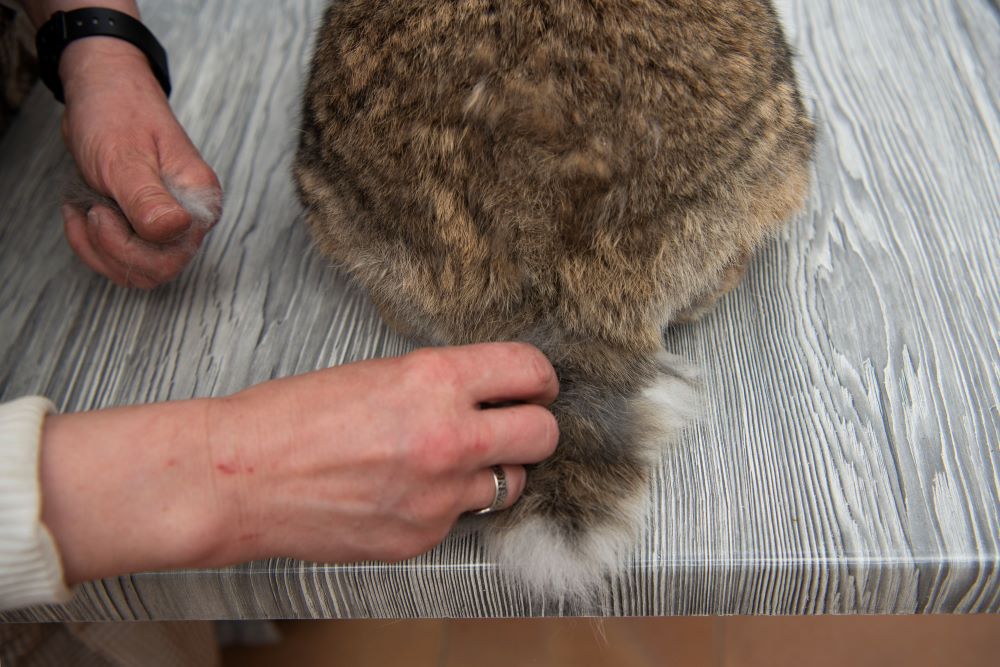
The nuns at the Convent of St. Anthony of Padua in Central Spain groom the rabbits' coats as part of their daily care, but when the animals are young, the fur is left in the nest to help keep them warm. (Lissette Lemus)
Unlike traditional breeding, conservation requires stricter conditions such as ventilated spaces, appropriate cages and temperature control.
"Rabbits start to suffer at 26 degrees [Celsius]; they tolerate the cold well, but not the heat," the abbess said.
Cleaning must also be rigorous and consistent. Every two days, the convent team performs a general cleaning, and once a week, they dismantle and pressure wash all the cages. When there are young, maintenance is performed daily. The caretakers check the nests, remove dead animals and replace the bedding material — except for the fur shed by the mother, which helps keep the young warm.
As for feeding, rations of hay, barley and corn are calculated to maintain an appropriate weight. Rabbits with young receive special feed and can eat larger quantities. By the end of March, 90 young had been recorded.
The sisters also have an identification system to prevent inbreeding. Each animal has a microchip with a number that allows its genetic lineage to be traced, key information for controlled breeding.
Limitations
Despite these efforts, the project faces a significant limitation: The rabbits raised at the convent cannot be sold, as the permit granted by the authorities only allows breeding for personal consumption.
To promote conservation, raise awareness and encourage the breeding of this rabbit, the sisters have chosen to donate rabbits to schools, to a theme park in Toledo, and to registered private breeders.
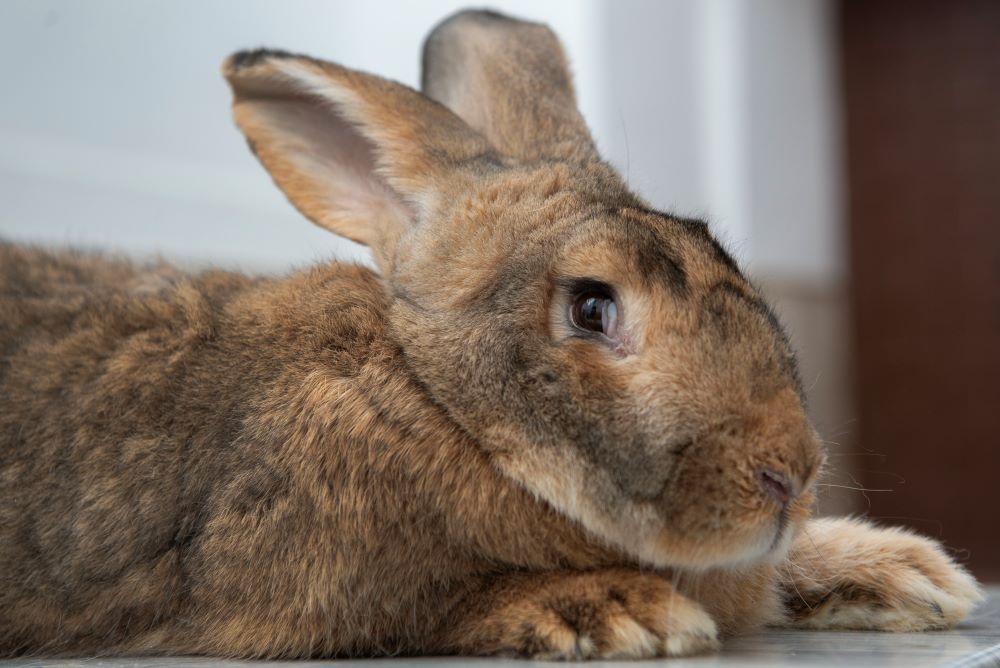
The Spanish Giant rabbit is the result of crossing the Flanders Giant and Spanish greyhound-type females. (Lissette Lemus)
Although breeding at the convent has been self-funded solely through the sisters' labor, last year the local council provided financial support for the first time to renovate the cages, which were in poor condition.
Even so, Peset said she believes the authorities could do more to preserve the breed. That's why she calls on them to "get a little more involved" and issue permits that would provide an economic engine.
"They could help us obtain permits to do many things, because if this animal doesn't have an economic outlet, people won't be encouraged to raise it," she said.
Like many religious communities, to meet their financial needs, the sisters also make artisanal sweets and ice cream that they sell in a shop next to the convent. The variety of products includes traditional sweets.
Despite the difficulties, the abbess said that she will continue the work of preserving the giant rabbit because it aligns with Pope Francis's call to care for nature spelled out in his 2015 encyclical Laudato Si', encouraging Catholics and people of goodwill to care for the environment.
"We have to protect creation," she said. "We are Franciscans. St. Francis is the patron saint of veterinarians, and that is the source of the love and admiration we feel for the Spanish giant rabbit."
This story has been corrected to note this particular rabbit is a breed.
Advertisement