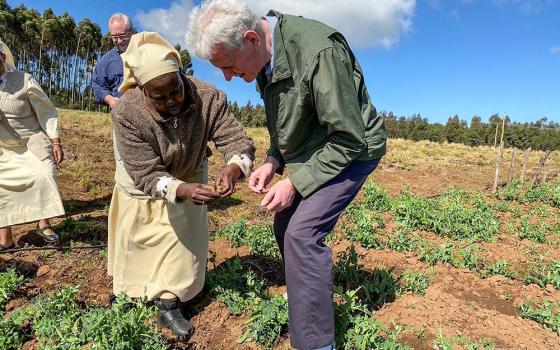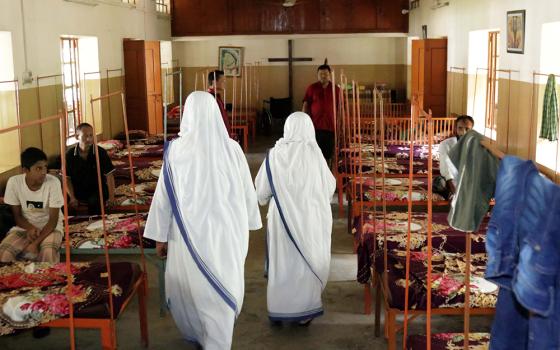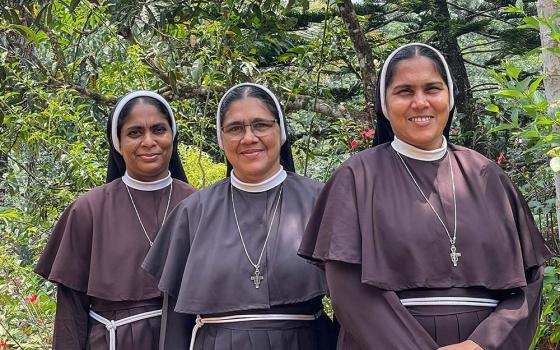
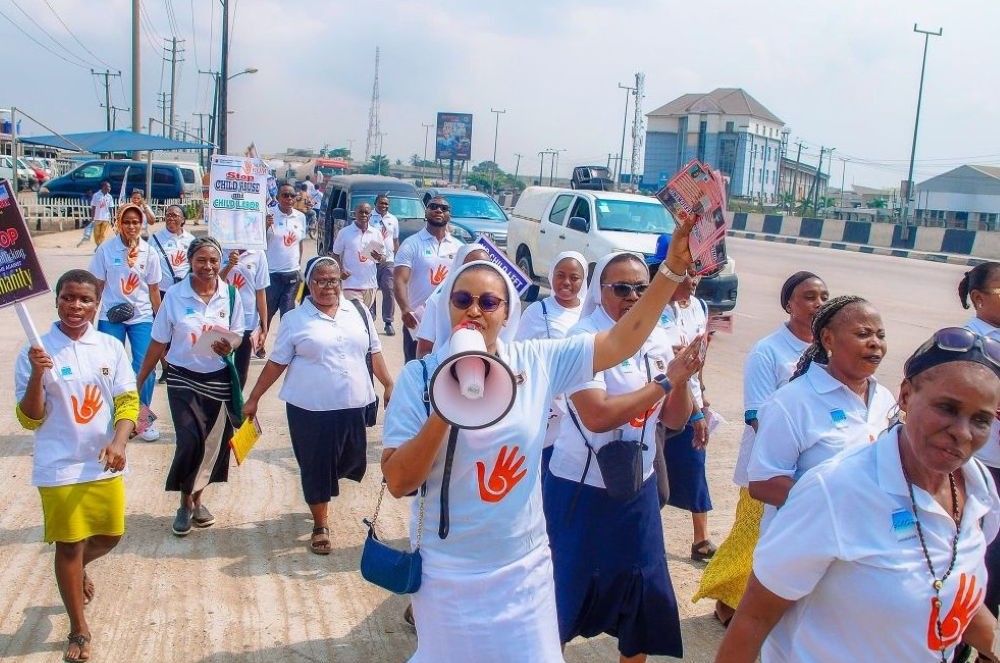
Public demonstrations led by sisters are part of Talitha Kum's education and public awareness efforts. The sister-led anti-trafficking network operates in 113 countries. (Courtesy of Talitha Kum)

On the eve of the United Nations' World Day Against Trafficking in Persons, the sister-led anti-trafficking network Talitha Kum said it reached 1.21 million people globally in its ministries in 2025, a nearly 30% increase from 2024.
The increase reflected expanded prevention, survivor protection, access to justice, advocacy and international partnerships, according to the report released July 29.
"For our global network, hope is lived and shared every day in every survivor accompanied, every young person empowered, every community strengthened, and every act of solidarity that restores dignity and freedom," Maryknoll Sr. Abby Avelino, Talitha Kum's international coordinator, said in the report.
Talitha Kum also expanded into Malawi, Botswana, Lesotho and Eswatini, bringing its presence to 113 countries. Its work was carried out by 6,387 sisters and partners and supported by 882 women's congregations and 100 men's congregations, reflecting growing participation by religious communities.
But while such figures are noteworthy, Talitha Kum emphasized that "behind every number is a person, a family and a community," the report said. "These figures represent lives touched, communities mobilized, and hope restored."
That theme was also highlighted in the group's July 29 webinar.
Linda, an Indonesian survivor, said she was lured to the Philippines in 2023 with false promises of employment before being forced to work in an online scam center. After escaping with Talitha Kum's assistance — living for a time in a sisters' convent for safety — she returned to Indonesia and now helps build the United Resilience Network for trafficking survivors in Asia-Pacific. She said that it is important for survivors like herself to be involved in anti-trafficking efforts.
The need for working in partnership was embraced by webinar participants, including Sr. Nina Krapić, the deputy director of the Holy See Press Office, and Sr. Roxanne Schares, the executive secretary of the International Union of Superiors General, or UISG.
Krapić, a member of the Congregation of the Sisters of Charity of St. Vincent de Paul of Zagreb, said that those in consecrated life, working together and in partnerships with others, can enter spaces others can't and "make God's love visible to all."
"It has been a hard journey … a complex, difficult journey," Schares, a School Sister of Notre Dame, said of sister-led anti-trafficking efforts in 2025, noting the ongoing challenges of trafficking that have been exacerbated by climate change, wars and economic inequality.
But the work of Talitha Kum has shown "the revolution of Christ's love," she said, quoting St. Oscar Romero. "Hope does not disappoint."
It may not, but Avelino warned that organized online scam operations across Southeast Asia have become one of today's fastest-growing forms of trafficking, with thousands of young people — like Linda — deceived by false job offers and forced into cyber-enabled crime.
Avelino called such crimes among "the most urgent and alarming forms of exploitation" in the world today.
Citing statistics from the International Labor Organization, as well as the International Organization for Migration, Talitha Kum said that as many as 50 million people now live in "situations of modern slavery worldwide," with some $236 billion generated annually as a result of such exploitation.
Avelino lauded the work of the Youth Ambassadors who are helping Talitha Kum's prevention efforts; such work continues to be the coalition's largest area of activity. "Young people are not only the future," she said, "they are also part of the solution."
Prevention activity, Avelino said in the webinar, reached nearly 930,000 people in 2025, about a one-third increase over 2024.
"Through awareness campaigns in schools, parishes, clinics, traditional and social media, street theatre, and community events, Sisters, Youth Ambassadors, and partners provided vulnerable populations with information and tools to recognize and avoid trafficking risks," the statement said.
Advertisement