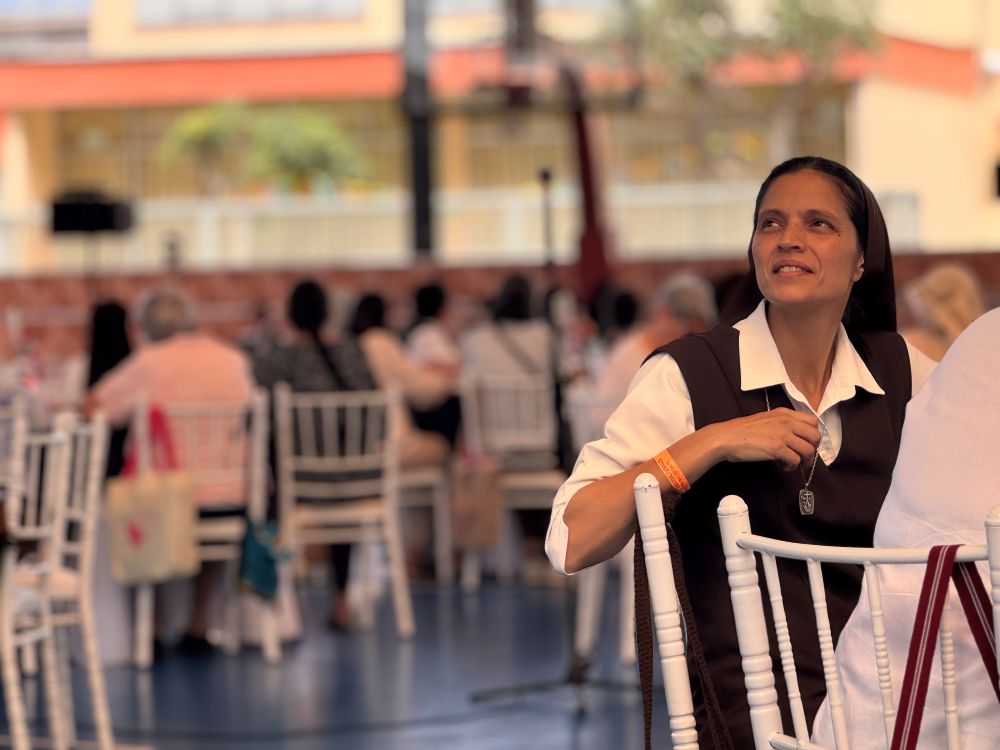
Carmelite Missionary Sr. Alejandra Sanabria Conejo smiles Nov. 14, 2026, at the Colegio de Jesus in Lima, Peru as she watches a video on a large screen showing older sisters from various congregations living together in a home for nuns who need care in Rome. (GSR photo/Rhina Guidos)

by Rhina Guidos
Latin America's VI Congress on Consecrated Life made an urgent plea to the more than 700 participants who gathered Nov. 13 to 15 — virtually and in person — to discuss urgent changes that may affect consecrated life in the region.
"We've addressed issues that concern all of consecrated life, such as charisms, congregations and structural changes … how we're going to move forward," said Sr. Lidia Martínez of Guatemala, who participated in the three-day meeting in Lima. "And I think one of the important questions has been: How do we open ourselves to the Spirit? Where are we headed in these times we are living through?"
Facing declining numbers, despite the need to accompany more and more people suffering from poverty, forced migration, authoritarian regimes and environmental degradation in the region, those attending the meeting organized by the Confederation of Religious Men and Women of Latin America and the Caribbean, or CLAR, reflected on the future.
"What implications does this gathering have for how we live? For how we organize and serve?" asked Sr. Inés Zambrano, first vice president of CLAR.
Zambrano, a member of the Missionary Sisters of Mary Immaculate and St. Catherine of Siena, spoke at an open-air venue filled with religious sisters and brothers from nearly every corner of Latin America, the Caribbean, and a few from the United States. There, she emphasized that the focus of the congress arose as a response to the concerns facing religious communities, to the questions raised by various congregations and — in particular — to better respond to the cries of those they accompany daily.
"Brothers and sisters, we are gathered at this congress by a demanding call," Zambrano said. "We have embraced it because there are realities in our communities that we can no longer put off, to which we cannot remain indifferent. Many sisters and brothers carry out the mission with admirable generosity, but we also sense that there is weariness."
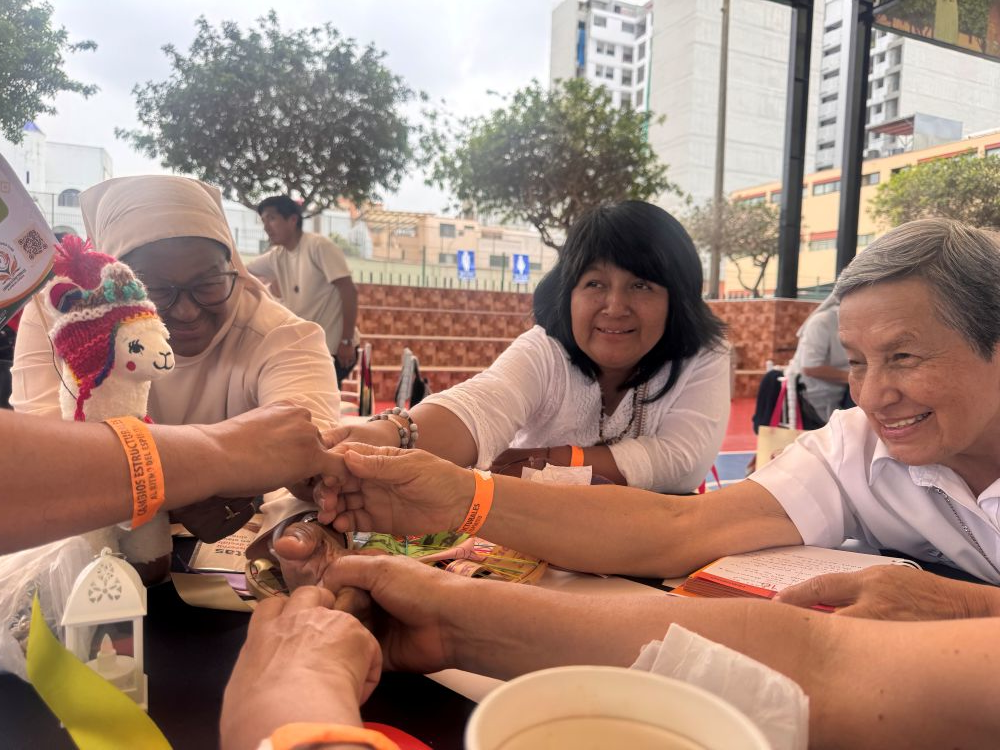
A group of sisters and a religious brother take part in an exercise about tension Nov. 15, 2026, at the Colegio de Jesus in Lima, Peru, during the last day of the VI Congress of Religious Life organized by the Confederation of Latin American and Caribbean Religious. (GSR photo/Rhina Guidos)
Martínez emphasized the urgency of the changes during the congress titled "Structural Changes in Step with the Spirit."
"There are structures that no longer work," she told Global Sisters Report Nov. 15. "A mission that used to be carried out by 15 [sisters] is now carried out by three. In other words, it's an excessive workload. And we want to be able to do everything, but there are things that are done halfway, not as they should be done."
Possible changes include sharing the work with other groups, including other congregations or laypeople.
"I've really appreciated that most of us are being called to work with laity, which is a challenge because we have to let go of the barriers we've built up," Martínez said. "How are we going to exercise this leadership that is in service — to the kingdom, not to aggrandize ourselves or our congregation?"
"We're exploring how we'll work across congregations, but also with laity who are leading in a healthy way," she said.
Zambrano spoke of CLAR's desire to create spaces where those who fear taking new paths can freely express their concerns; however, if such concerns existed, few spoke of them during the gathering.
"How we wish this gathering could be a space where we can acknowledge our fears — perhaps even find answers — but not continue to shut ourselves away in them, and listen without fear to what the Spirit is stirring among us," she said.
They spoke not only of changes in the division of labor but also of other important and tense aspects of religious life: the maintenance of ministries or missions, their aging communities, the clamor of new generations of religious asking to be heard, as well as "ways of exercising authority that require a profound review," Zambrano said.
"And both outside and inside our communities, there are wounded lives awaiting care, justice and truth. Not everything that has sustained us until now can continue to sustain us. Recognizing this requires gratitude for our history and the freedom to listen to the present," she said.
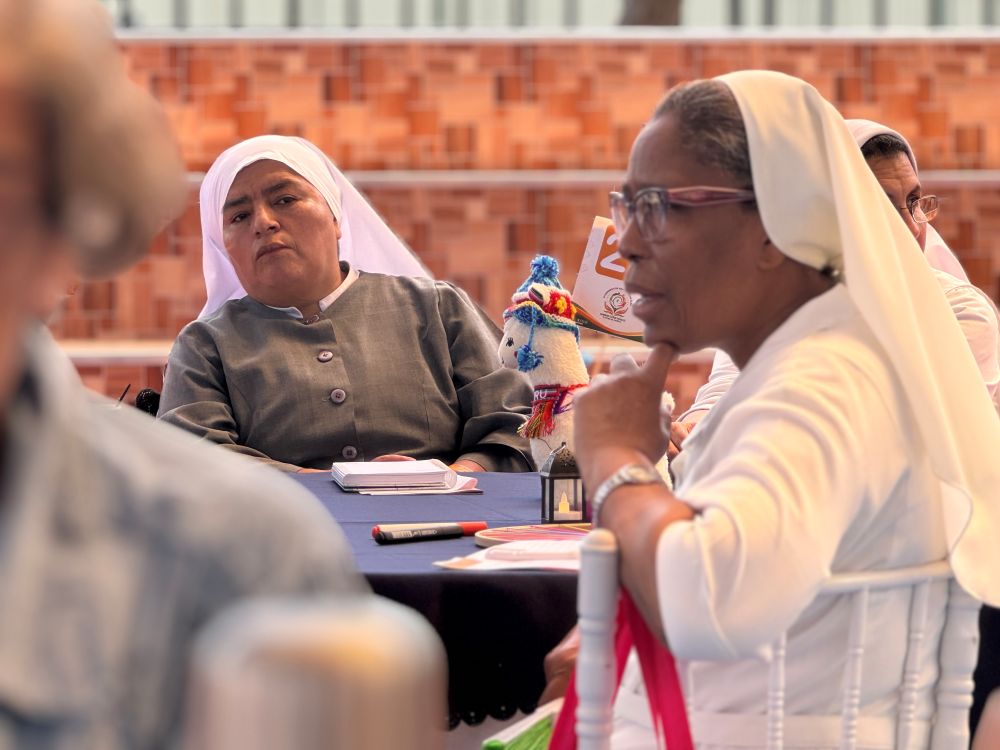
Sr. Martha Mestanza Zavaleta, left, listens to members of her table as they talk about synodality Nov. 13, 2026, at the Colegio de Jesus in Lima, Peru, during the first day of the VI Congress of Religious Life organized by the Confederation of Latin American and Caribbean Religious. (GSR photo/Rhina Guidos)
Sr. Daniela Cannavina, CLAR's general secretary for 2020-2024, said the moment religious life is facing presents opportunities to be faithful to their lives as consecrated men and women in different ways.
"As so many times before in history, God goes before us and leads us toward uncharted horizons, urging us once again to embrace the reality of an ever more radical fidelity to the Gospel," she said. The movement currently underway is a call to conversion guided by the Spirit, and is "a conversion that touches our way of relating to one another, of exercising authority, of discerning, of embracing the mission, and, ultimately, of understanding a new way of being members of the church and a new way of living the consecrated life."
Cannavina, a Capuchin Sister of Mother Rubatto, was one of the first women in the history of the church to participate in a global consultation process known as the synod, and she asked that the women and men in the room recognize the Gospel's call for change.
"It demands that we break free from the cycle of self-referentiality — that vortex that pulls us toward the center and keeps us spinning in circles, repeating by rote the same answers to a world that has changed," she said.
Some of the speakers emphasized the importance of the synod on synodality, the process launched by Pope Francis in 2021. Synodality calls for "walking together" among members of the church, where responsibility is shared and the goal is to create a horizontal model of authority rather than a hierarchical one.
Participants heard stories of congregations that have implemented new ways of operating and living — including joining forces and collaborating on projects with other congregations or groups — as well as stories of laypeople who have shared in a congregation's mission work.
Between presentations, participants were asked to reflect on questions such as: What are we grateful for? What do we need to let go of? What is being called to emerge from above?
Despite the good that some structures of the past have brought, some said, those in consecrated life must free themselves from the shackles of the past to offer their lives to God and humanity in a better way.
Advertisement
Franciscan brother and theologian Michael Moore said that recognizing the Spirit's movement in religious life and structural changes means following the same dynamic that Jesus followed 2,000 years ago in the face of the religious structures of his time — structures that did not humanize, did not liberate, and instead oppressed.
"Today, as religious men and women, we must apply this to our context and ask ourselves: Which structures liberate us? Do they speak to us of the kingdom? Do they help us free ourselves from everything that is against the kingdom?" he said.
Despite the challenges, Sr. Gladis Montesinos Sollo, a Carmelite Missionary in Bolivia, said attending the conference was an opportunity for renewal.
"I meet people with whom I connect with — people who are interested in this, people who don't want to remain stuck in inertia, who don't want to stay in their comfort zones … but who want to renew themselves; they want more," she said of CLAR.
"We are on this shared journey, this journey that Pope Francis invited us to walk together [and which continues with Pope Leo]. So, it renews me deep inside, it helps me greatly, it restores my enthusiasm and hope, and it renews my deepest dreams because I see that we still have wants, we still dream, and we are still striving to respond to the Lord at this moment in history."