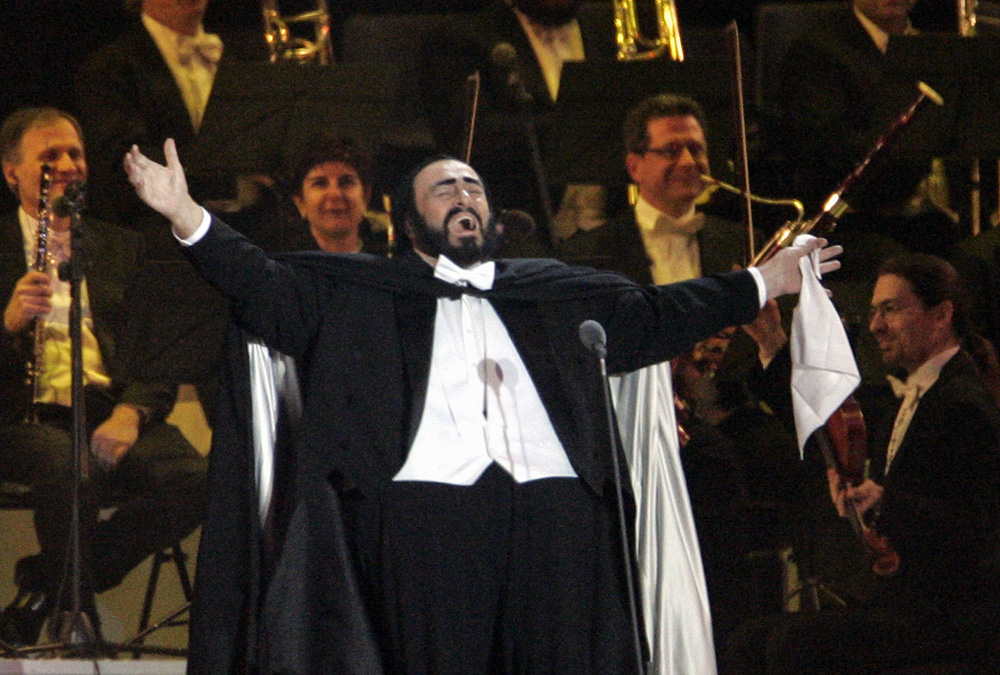
Tenor Luciano Pavarotti performs during the opening ceremony for the 2006 Winter Olympics in Turin, Italy, Feb. 10, 2006. (AP/Matt Dunham)

by Sr. Margaret Cessna
I was in the kitchen doing dishes when the sound stopped me. Froze me in place. I went to the living room to check it out. I knew the face and the voice but not the song. So of course, I had to know what sound could stop me cold like that, leaving me just standing in wonder at the beauty.
I did look it up. It was Feb. 10, 2006, the opening of the Winter Olympics in Turin, Italy. Native son Luciano Pavarotti welcomed the world to his homeland and to the beauty of his music by singing "Nessun Dorma." Since that day, whenever I have the opportunity, I listen to his magic, and my spirit responds every time — no matter what the world is doing to my mood or spirit. At the time, it seemed as though an actual choir of angels was singing just on the other side of my kitchen counter. That is the power and magic of music. I never did finish the dishes.
"The Mission" was a film that came out in 1986. It was set in the 1750s as Spanish Jesuits traveled to the Paraguayan jungle to convert the native Guaraní to Christianity. There was a scene in which the natives slowly sneaked past Father Gabriel as he sat on a huge boulder in the jungle and played his oboe. The Guaraní crept by him quietly, at first out of view of the black-robed Jesuit. It was clear to the viewer that they were captivated by the soothing oboe. In this scene, it was music that converted them, not fear of the black robes.
Advertisement
To this day, listening to the music from that movie tames my soul and lifts my spirit as well. I relax and listen as the weight of my world, perched on my shoulder, takes flight and leaves me with a brighter outlook. Music does that for me — words or no words. Music helps me hold on when, at times, it would be easier to let go.
I try to understand the magic and the power in everyday words, but none seem to fit. It was clear in the film that the Guaraní were somehow transformed by the beauty of the sound. Music is a gift of and for the spirit. Music is beyond everydayness. Could it be eternal?
Music is not the only beauty that can give us relief. Five hundred twenty-five years ago, a young man picked up a hammer and chisel and went to work on a block of marble. Chip by chip, he not only showed that he understood the power of loss and grief, he showed what it looks like.
Michelangelo was only 24 years old when he started work on the Pietà. For more than 500 years, the entire world has cherished this gift of what that boy — not yet a man — captured in our hearts and imaginations: to show us that we are never alone in the depth of our sorrow. That there is a way to breathe again. Rising from grief is possible. There is life beyond pain.
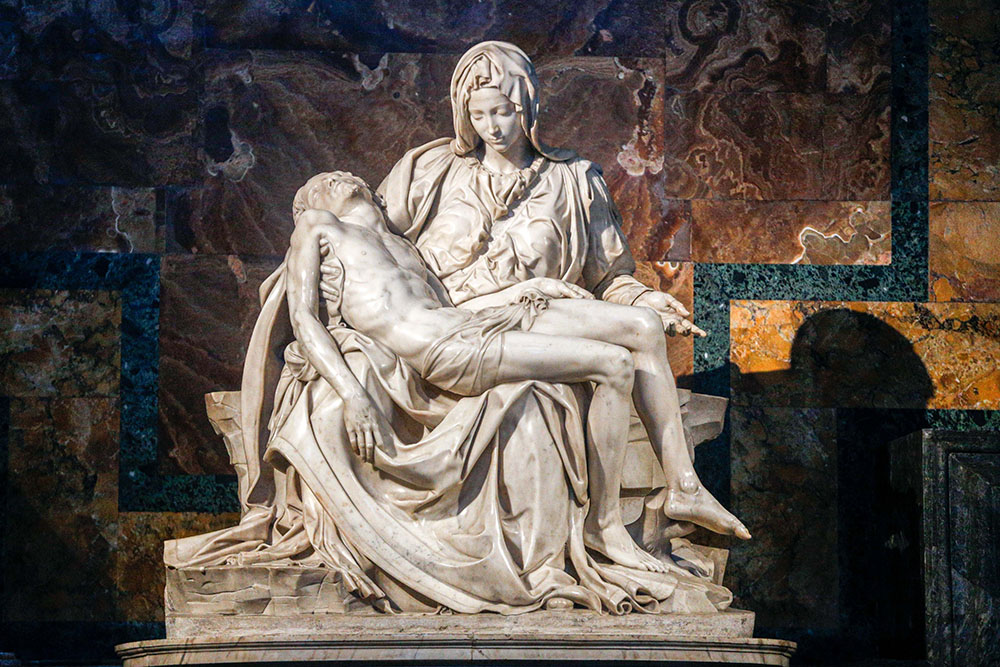
Michelangelo's Pietà is seen in St. Peter's Basilica at the Vatican. (CNS/Lola Gomez)
Gabriel's oboe and Pavarotti's "Nessun Dorma" do not have the same effect on everyone who hears them. But somewhere out there, I believe, is beauty for every soul that needs transforming. Such is the gift of the artist, the composer, the painter.
Art is, in a special way, a spiritual language. It can be prayer, or grace, or a path to a deeper understanding of how beauty can save the world. If we allow it to have its way, it can be a great reminder for us, on any dreary day, saving us from giving in to darkness or grief on a day that is in need of the warmth of the ever-present sun and the ever-present grace that is there for each of us to claim as our own.
We all have a right to the path to beauty that can inspire and transform, that can ease pain even during a moment of loss or grief.
All praise and deeply felt gratitude to the artists, the composers, the performers — to all those who, in their generosity, share with us these gifts that enrich our very lives.
Art is perhaps as close to heaven as we will ever get.