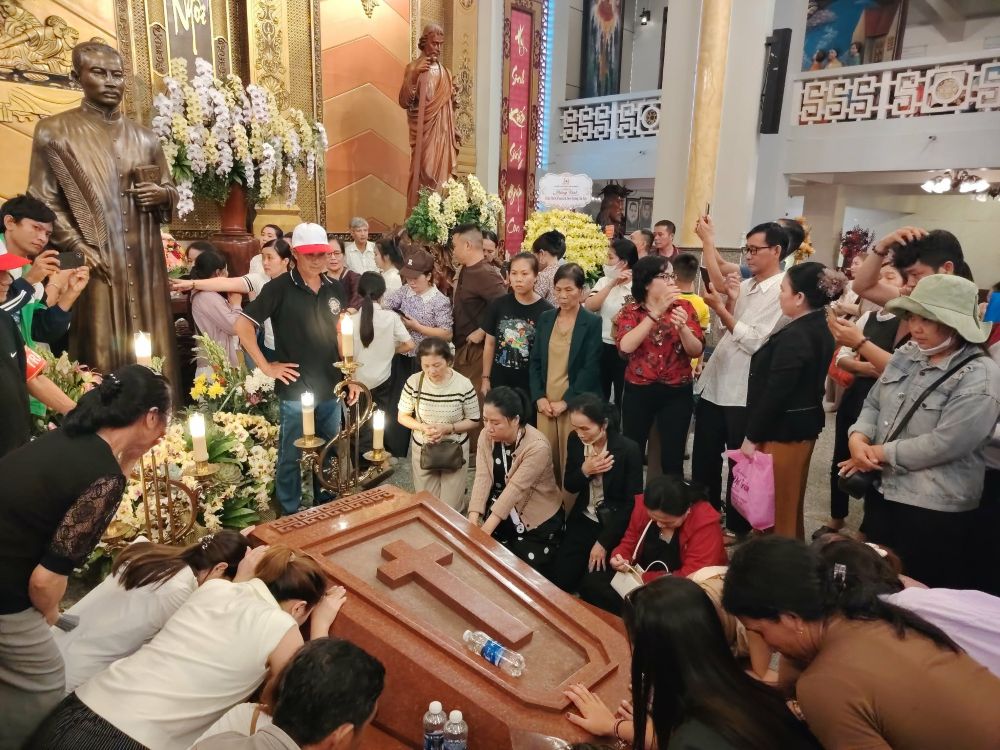
Pilgrims pray by the tomb of Blessed Francis Xavier Truong Buu Diep at Tac Say Pilgrimage Center in Vietnam's Mekong Delta on July 1, 2026. (OSV News/Joachim Pham)
by Sr. Hoa Nguyen
On April 13, Pope Leo XIV told journalists on the papal flight to Algiers, where he began his 10-day visit to four African countries, that he planned to continue speaking out against the U.S.-Israeli war on Iran after receiving incendiary comments from U.S. President Donald Trump.
Leo said, "I will continue to speak out loudly against war, looking to promote peace, promoting dialogue and multilateral relationships among the states to look for just solutions to problems." Indeed, this brief but courageous statement echoes Leo's choice of name, which evokes the era of Pope Leo XIII, who is recognized for his emphasis on Catholic social teaching, social justice and human dignity.
As the church commemorates the beheading of John the Baptist (Aug. 29), recorded in the synoptic Gospels — Matthew 14:1-12, Mark 6:14-29 and Luke 9:7-9 — we are challenged to choose between speaking the truth and remaining complacent. John the Baptist lost his life when he refused to compromise with Herod Antipas, but he courageously confronted Herod, saying, "It is not lawful for you to have your brother's wife," according to Jewish law (Mark 6:18). John the Baptist stands for the truth.
In contrast, Herod does not even dare to accept the truth in his heart. Mark 6:20 clarifies that although Herod fears John, he likes to hear John speak as he "knows him (John) to be a righteous and holy man." Herod fails to listen to what he knows from his heart.
This is a human struggle: John the Baptist had the courage to speak out for the truth; Herod recognized that truth and knew John was telling it, but fear, pride and a disordered desire to protect his image in front of people led him to choose silence and do injustice. The questions raised are whether we are in Herod's shoes and why we have remained silent when we know the truth. Is it not the same struggle we face every day?
The beheading of John the Baptist evokes a reflection on how I might be trapped in a culture of "It is not my business." If I remain silent when I know the truth, incidents like John's martyrdom can continue to recur in different forms in our society. Creative courage is the key word. This is the courage that challenges us not to be content with our own business and not to neglect injustice in our own community, across workplaces and schools, or even within the family. It becomes imperative to break the cycle of complacency when we know the truth regarding contemporary ethical problems.
A story of Fr. Francis Xavier Truong Buu Diep, whose beatification Mass was presided over by Cardinal Luis Antonio Tagle on July 2 at Tac Say Pilgrimage Center, Vietnam, reflects this key word: courage.
Advertisement
Diep was a Vietnamese Catholic priest martyred for his faith 80 years ago. Serving as a parish priest of Tac Say Parish in Bac Lieu province during the instability of the aftermath of World War II, Diep was a shepherd not only for the Catholics but for everyone, especially non-Catholics, the poor and those in need. As conflict grew between Vietnamese nationalist forces and returning French authorities, Diep was advised to leave his parish for safety, but he refused, saying that he would not leave his flock and that if he died, he wanted to die among his flock.
In 1946, he was arrested along with more than 70 parishioners. Soldiers planned to kill them all, but Diep said he was their shepherd and asked to die in their place. The soldiers released his parishioners and took him away. The next day, his parishioners found him dead in a nearby pond. He had been beheaded, and his body, stripped of his clothes, bore multiple wounds. Diep chose courage over comfort and safety for himself. On Nov. 25, 2024, Pope Francis formally announced that Diep was killed out of hatred and that he courageously died for the faith.
About 70,000 Vietnamese people, including Catholics and people from other faiths, for the first time, witnessed the beatification ceremonies in their own country. At this beatification ceremony in Vietnam, Tagle described Diep as a witness to the faith and a martyr of the church. Tagle said, in his homily, that Diep's life was a gift not only to the church in Vietnam but also to the wider church and to humanity.
Tagle also challenged those participants that day: "The world needs true martyrs and bearers of truth. Let us not add to the increasing number of messengers of falsehood, hatred, division and violence." He boldly encouraged Catholics to imitate Diep, who remains a testament of pastoral courage, solidarity with those in need, and fidelity to the faith amid political chaos, to dare to live and die for the truth.
In his response to Trump Leo echoes Micah 6:8, which says, "He has told you, O mortal, what is good; and what does the Lord require of you but to do justice, and to love kindness, and to walk humbly with your God?"
Just as John the Baptist lived his courage and faith, which involved trusting in God to live the truth despite uncertainty and suffering, Leo invites and challenges us to be courageous and not remain silent when we know the truth.
Reflecting on stories and words of John the Baptist, Diep and Pope Leo, I am mindful of two things: The human struggle is real; it is very difficult to speak the truth when we know something is wrong because standing for truth can harm us immediately. Second: We live in a culture consumed by technological advancement, success and performative achievements; it is easy to choose comfort over courage, safety over risk.
In this culture, John the Baptist challenges me to live justly and courageously through action, love and humility, as the prophet Micah urged people years ago, and this challenge remains vibrant. Diep assured me that living courageously can be as simple as holding compassion that moves one to act justly and preventing or speaking out against wrongdoing. Leo inspires me to take courage from these two and their commitment to stand for the truth despite the pressures and trials that can be brought against them.
May this courage continue to be nurtured within me, so that I shall find strength to live this commitment in my daily decision-making.