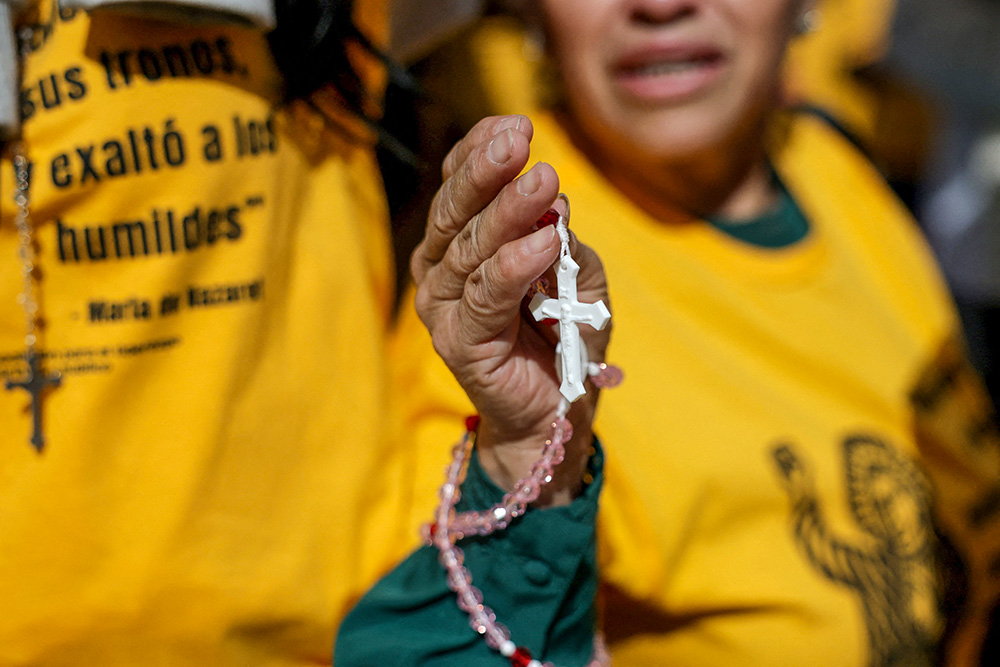
A woman holds a rosary as members of a Catholic group take part in a eucharistic procession near the U.S. Immigration and Customs Enforcement (ICE) Broadview facility in Chicago Oct. 11, 2025. (OSV News/Reuters/Jeenah Moon)

by Sr. Kari Pohl
Contributor
The phone rang at 10 p.m. on Thursday, July 31. Something was happening in Ambridge, Pennsylvania. Armed, masked men, unmarked cars, and police in uniform were converging at Fifth and Merchant Streets. An ICE raid? At the Latin American grocery store? At this hour? Don't they close at 9? More calls followed.
Two sisters who live in Ambridge and a third from a nearby borough went to see for themselves. Others gathered, bearing witness and documenting what unfolded. Within hours, more than a dozen people were arrested or detained. One man was taken from a car with children inside. The more I learned about what happened that night, the more angry and helpless I felt.
The next day, the Beaver County District Attorney denied that the action was an ICE raid, instead calling it a "saturation operation" involving several local and county agencies. Still, local media confirmed that Homeland Security, ICE and U.S. Customs and Border Patrol were also involved.
This happened in a town with fewer than 7,000 people, in the middle of the night. History weighs heavily here, though. For context, Beaver County has lost about 20% of its population since the 1970s and, according to the 2020 census, is over 85% white. Yet in recent years, Ambridge has been attracting many Latin American immigrants, bringing new life and businesses, including the grocery store I mentioned.
Unfortunately, mass arrests and detentions targeting newly arrived people of color aren't new here. What happened in Ambridge this year reminded me of the story of the 1933 Beaver County deportation. On a cold January night, police raided a dance party attended by Black men and women who had come as part of the Great Migration to work on the nearby Montgomery Lock and Dam. Dozens were beaten, jailed, then driven under armed guard to the West Virginia border where they were ordered to walk across the state line and leave Pennsylvania, or risk two years in jail if they returned.
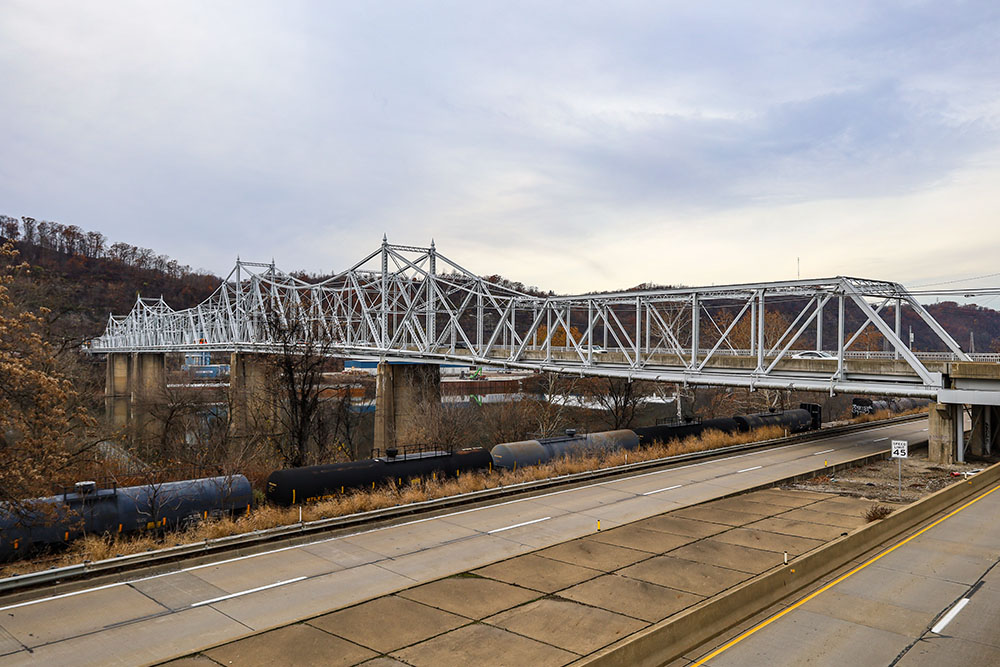
Ambridge-Aliquippa Bridge over the Ohio River between Ambridge and Aliquippa, Pennsylvania, in 2025 (Wikimedia Commons/Antony-22)
Reflecting on this, I see a painful pattern repeated — clear messages about who is welcomed and who is not. Like the 1933 deportation, the 2025 event made headlines. Both were displays of power and exclusion. While no one in Beaver County is admitting to inviting ICE to this latest operation, they somehow knew to come that night.
The day after the "saturation operation," one of our sisters gathered with others and began leading weekly prayer services outside of Pittsburgh's ICE office. They have continued into the winter months.
I was asked to lead one of the services in August. As I prepared, I thought of the sorrowful mysteries of the rosary. I look at the state of immigrants — not just in the United States, but in various (maybe even most) countries around the world — and I can't help but think that these times are calling for something more: a rosary rooted in Jesus' own story of migration.
I searched online, hoping that someone had already created one. Finding nothing, I wrote my own. From this corner of southwestern Pennsylvania, I invite you to pray with me these migration mysteries, with brief reflections to guide your heart. As we move into Advent, I encourage you to consider your own as well.
The First Mystery: The Holy Family seeks refuge in Egypt (Matthew 2:13-15).
The warning came suddenly — they likely had no time for goodbyes. Under threat, they fled Bethlehem in the dark, crossing into a foreign land where they had no family or safety. Imagine for a moment their fear and resolve, running from violence to seek refuge. How often do migrants today face that same unknown?
Advertisement
The Second Mystery: Jesus is baptized in the Jordan River (Matthew 3:13-17; Mark 1:9-11; Luke 3:21-22; John 1:28-34).
Borders have always shaped human experience. Like many rivers marking modern borders between Costa Rica and Nicaragua, or Mexico and the U.S., the Jordan River also served as a border in Jesus' time. Baptized there, Jesus stepped into a place of division and union, a border river that was neither "here" nor "there" yet was simultaneously both here and there. Jesus reminds us that while migration may involve crossing lines, it is also about transformation, belonging, and especially God's presence in the in-between. How have you experienced God's presence in places or times of transition or movement?
The Third Mystery: Jesus crosses into Samaria (John 4:1-43).
In the Gospel passage, it is noted that Jewish people did not share things in common with Samaritans, yet Jesus decided to travel through Samaria anyway. There, he had an encounter with a local Samaritan woman, who convinced him to stay not one, but two days. It takes courage to cross a barrier, just as it takes courage to welcome the stranger. What is it like to experience welcome or extend it to others?
The Fourth Mystery: Jesus has a life-changing encounter in Phoenicia (Matthew 15:21-28; Mark 7:24-30).
In Phoenicia, Jesus meets a woman from outside his group. At first, he resists helping her — yet her faith and persistence eventually persuade him to go beyond his own people. I think about those times when I've been challenged to move beyond the comfort of what I perceived to be "my" group. By doing so, I was able to catch glimpses of how expansive God's love really is.
The Fifth Mystery: Jesus identifies himself as an outsider (Matthew 25:31-45).
Jesus promises his presence among us in those who suffer — those who are hungry, thirsty, imprisoned, and displaced. He calls us to see him in the newcomer and in the marginalized. I pray that God may continue opening my eyes and that those who hold power may also come to recognize Jesus' presence in those who are so often ignored and even disparaged in our world.