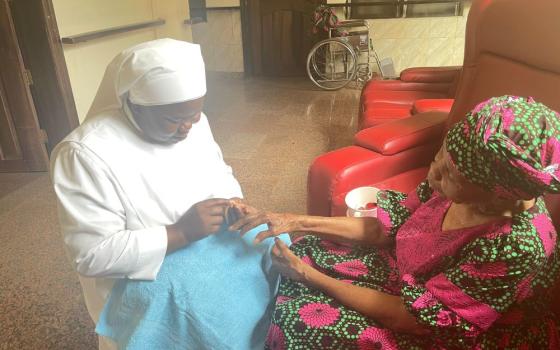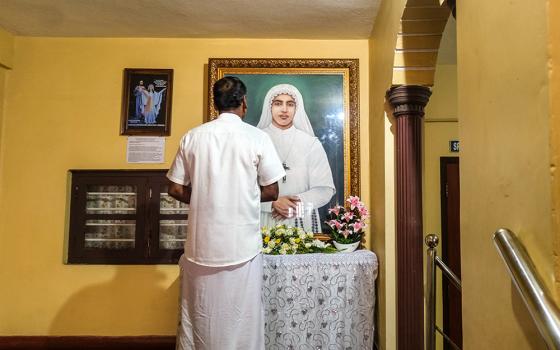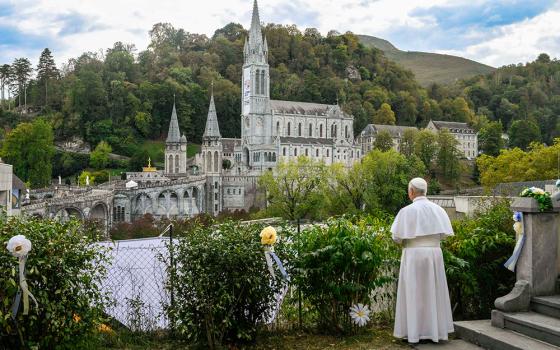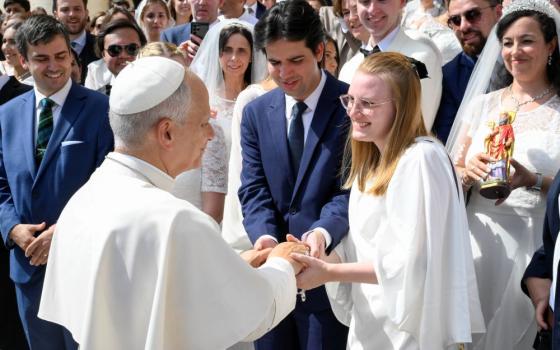
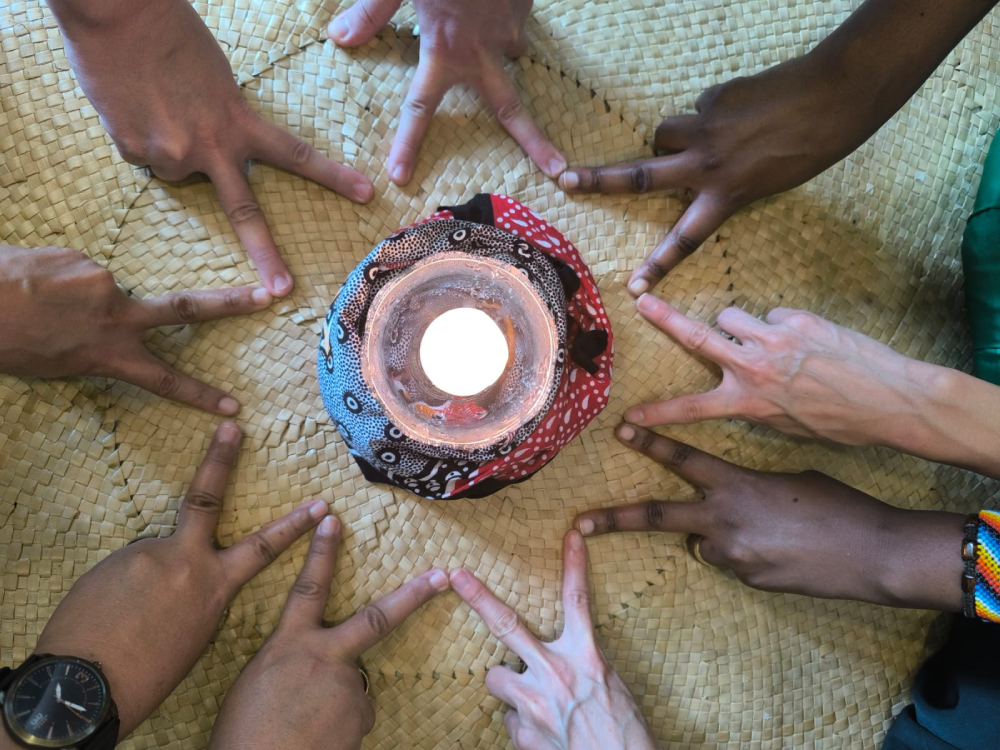
The hands of sisters from the Philippines, Myanmar, Mozambique and Latin America encircle a symbolic representation of the light of Jesus, showing unity in the richness of diversity. (Flying in V Formation)

by Flying in V Formation
During a conversation with an African sister about the importance of strengthening unity in our congregation, she shared with me the African philosophy of Ubuntu, a way of understanding life that comes from several peoples of southern Africa and is expressed in Bantu languages. Its meaning, "I am because we are," touched me deeply. It reminded me that who we are is shaped by our relationships with others and that none of us walk through this world alone.
Since that day, Ubuntu has become an invitation for me to build more sisterly relationships and to deepen my sense of belonging to one missionary family.
This conversation was one of many experiences I have had in recent months while sharing daily life with sisters from different parts of the world. Although I have lived in intercultural communities for many years, this time has changed the way I see. Listening to my sisters' stories, learning how they understand life, how they relate to others and how they encounter God has opened my eyes to riches I did not know before.
One of the greatest gifts has been discovering the many ways faith can be lived through different cultures. The sisters from Vietnam, for example, have shown me how living their Catholic faith in the midst of other religious traditions has strengthened their identity as Christians.
In the Philippines, I was surprised by how often I heard the words po and opo when people greeted someone or made a request. Over time, I learned that these expressions are a way of showing respect for another person. I was also moved by seeing young people gently take the hand of an older person and bring it to their forehead as a way of asking for a blessing. It showed me another beautiful way of expressing affection and honoring those who have walked before us.
Not all differences were easy to understand at first. Sometimes I interpreted the silence of some sisters as a lack of interest, when in reality it was their way of showing respect. I was also confused by the way the sisters from India moved their heads when responding to a question. I expected the usual up-and-down motion that means "yes," but they gently moved their heads from side to side. During those first days, I found myself asking the same question several times because I had misunderstood their response.
Something similar happened when some sisters corrected me about the way I laughed. My first reaction was to feel hurt and wonder if they did not accept me as I was. Later, I came to understand that they came from cultures where discretion and silence are valued in shared spaces, and that their way of offering correction was different from what I was accustomed to. That experience taught me to pause, ask questions and seek understanding before making assumptions.
Advertisement
This is what intercultural living does: it challenges us. It invites us to open our hearts and minds to receive what another sister, her culture and her life experience can bring into our own lives. Community living already has its own challenges. When we add different cultural expressions, ways of communicating and language barriers, we need patience, humility and a willingness to keep meeting one another.
I often remember the advice of a sister who once told me, "If you want to truly live this encounter, pay more attention to what unites us than to what separates us." Her words continue to accompany me whenever I encounter a difference that is difficult to understand.
Daily life in community also reveals these cultural differences in simple ways. Living in Asia introduced me to a way of eating that was very different from what I experienced growing up. Rice is present in many meals, sometimes three times a day. Fish is a regular part of the cuisine, and ginger, which I had only known as an ingredient in tea, became one of the main flavors I encountered in many dishes. I also noticed that people usually do not greet one another with hugs unless they are close family members. During the sign of peace at Mass, they bow to one another as a gesture of respect. In my Latin American culture, however, affection is often expressed through hugs, a warm embrace or holding someone's hand.
My African sisters have also taught me another way of praying. Singing, drumming and dancing are part of the way they praise God and express their faith. It is a way of praying and living.
Living far from Latin America has helped me appreciate parts of my own culture I once took for granted. I have learned to treasure the closeness that shapes our relationships, our openness in expressing affection, our strong sense of community and the solidarity that naturally emerges, especially in difficult times. I have also come to value our ability to celebrate life even in the midst of hardship. Through my encounters with other cultures, I have also come to understand that my Latin American identity is an essential part of the missionary woman I am today.
This time has taught me a great deal, especially about the art of listening. I have learned to listen without preparing my response or making quick judgments, but with the desire to truly understand. Every sister carries a story, a culture, wounds, values and experiences that deserve to be welcomed before they are interpreted. This awareness has helped me respond with greater empathy, strengthen trust and nurture more authentic relationships.
Today I understand that intercultural living does not mean leaving behind who we are. Instead, it invites us to share our gifts with one another and to receive the gifts others bring. I am increasingly aware that diversity is not an obstacle to mission or community life. It is a privileged place where God teaches us how to build community.
Whenever I remember the words of that African sister: "I am because we are," I realize that they express better than anything else the gift that intercultural living has been in my missionary journey.