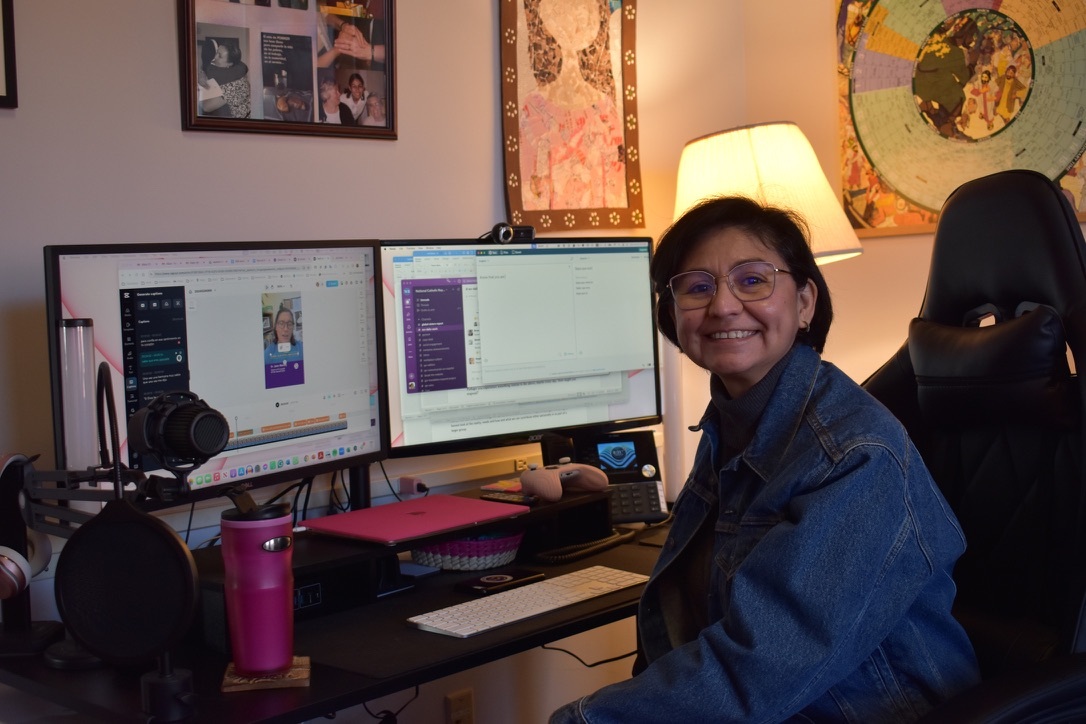
Sr. Helga Leija in her office as columns editor for Global Sisters Report and GSR en español (Courtesy of Helga Leija)
by Sr. Magda Bennásar
Contributor
One day, out of the blue, I received a message from Sr. Helga Leija, the columns editor for Global Sisters Report: "Can I call you?"
"Yes, of course," I replied.
Shortly afterward, she called me and blurted out: "I'm leaving GSR!"
Oh, no! was my first reaction. We had previously discussed her doubts about her wonderful future plan to carry out ministries in her Benedictine monastic community. Her decision to leave GSR had been made, thought through, and discerned over a long and sufficient period of time. And I respect it, even though I am saddened by it.
I met her almost five years ago when GSR was considering the possibility of launching a Spanish-language edition in light of the evident need of the Spanish-speaking community worldwide — and specifically within religious life, which is so diverse and rich across the different countries of Latin America and in Spain.
We both helped with some of the preparatory work for GSR en español alongside the charismatic Gail DeGeorge, who was then the editor-in-chief of GSR. The GSR team soon recognized Helga's talent, her complete bilingualism, her tireless energy, and her unique contribution as a religious sister to a magazine for women religious. And they hired her to lead the GSR en español project, while continuing with GSR in English, with the help of others who contributed mainly with translations, some editing, and finding photos for the columns and the "La Vida" section ...
As she told us in her farewell letter, her time at GSR has coincided with her process of experiencing monastic life firsthand and discerning her future: a beautiful yet challenging journey for every sister and brother who chooses a period of exclaustration to, in many cases, begin a search for another community that, at this vital moment, better responds to their needs and vision for the future.
And so it was for Helga. At the Monastery of St. Scholastica in a small town in Kansas, she found her tent of encounter under the wings of Benedictine hospitality — a hospitality that grows more necessary with each passing day.
Today, the compass of her life is pointing her toward other ministries that spring from the Benedictine monastic heart. And we thank her for her faithfulness and, once again, for her determination to prepare for her new ministry by drawing on her many talents.
Amid all this movement of the Ruah in her life — during these years in which I have come to know her and regard her as a friend — I have seen one determination: her concern for the Hispanic community, whether in religious life or in the lives of ordinary communities that are persecuted and mistreated today.
Advertisement
Faced with this situation of injustice and persecution, I see Helga as the Canaanite woman in Matthew 15:21-28. She insists to Jesus that foreigners, too, have a right to the crumbs that fall from the table. And Jesus is amazed by her — so much so that the woman's attitude draws from him one of the most beautiful phrases in the Gospel: "Woman, you have great faith! Let it be done for you as you wish" (Matthew 15:28).
And there goes her heart and her talent! Now, she will not only devote herself to editing and translating texts written by sisters who recount their struggle for justice and evangelical love in their columns, but she will set the entire table — not just the crumbs — for so many brothers and sisters seeking meaning and nourishment from the Word.
That is why, although her departure pains me, I am proud of her journey, and I believe this is how all of us who love her feel. Because it is not a step backward into comfort, but a step forward to be a pioneer of a ministry in her monastery that will welcome both locals and foreigners alike, that is what the Canaanite woman asked for and we continue to ask for it, especially women committed to the church.
Women aren't allowed to preach in the temple, but no one stops us from doing so in houses of spirituality or in homes — just as the early Christian communities did, spreading the Gospel throughout the entire Mediterranean basin in less than 20 years after Jesus' death. And no, they didn't have cars, or internet, or even bicycles. Their strength came from within, from a personal and profound experience of the risen Christ. It is this strength that Jesus discovers in the Canaanite woman and in other biblical women who, through their faith, change history.
That is what we wish for you, Helga. You are going to change the history of your monastery because you will be the first to offer an ongoing program for those seeking the crumbs; I know you will seat them at the table. And we thank you for this and will walk with you through the process.
All that remains is to thank you infinitely for your tenacity and perfectionism in your meticulous work with the prayed-over, lived and written word of the sisters who are on the front lines. Thank you.
And in the meantime:
May the earth make way before your footsteps.
May the wind always blow at your back.
May the sun shine warmly upon your face.
May the rain fall gently upon your fields.
And until we meet again,
may God gently hold you
in the palm of His hand.—Irish blessing
Shalom, sister.
This column was originally published in Spanish Sept. 2, 2026.