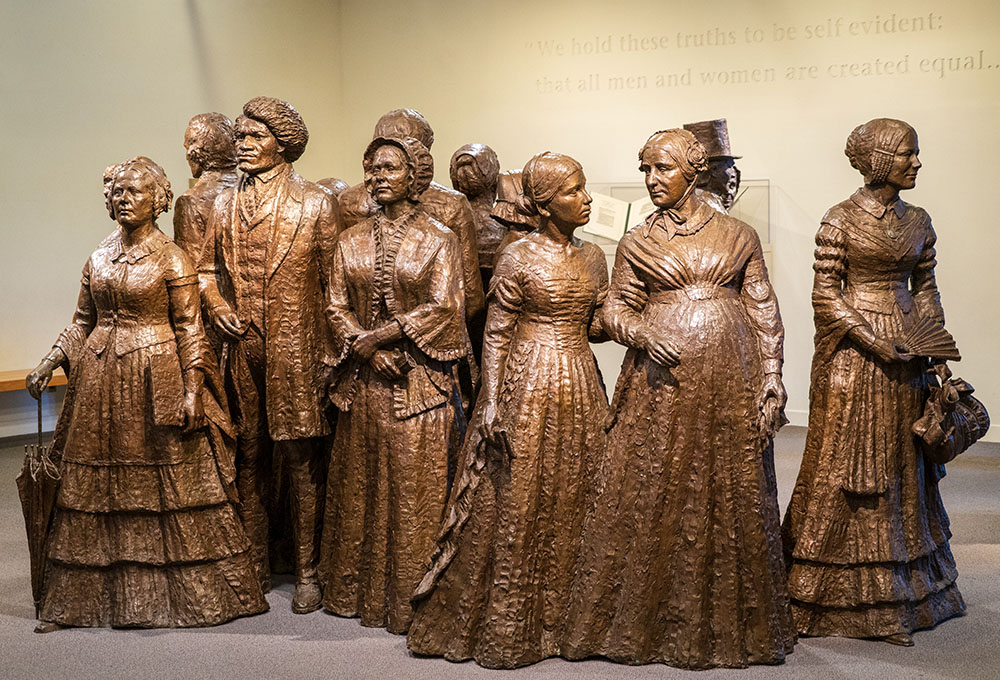
"The First Wave" bronze statues at the Women's Rights National Historical Park in Seneca Falls, New York, depict organizers and attendees of the First Women's Rights Convention in 1848. (National Park Service)
Lucretia Mott, Martha Wright and Elizabeth Cady Stanton. Do you recognize those names? Perhaps if I added Susan B. Anthony to the list you might take a good guess. These were women who began and worked tirelessly for women's rights, which eventually led to women getting the right to vote.
Recently, I had a chance to visit Seneca Falls, New York, which was the site of the First Women's Rights Convention in 1848. On July 19-20 of that year, more than 300 people attended this convention held in the Wesleyan Chapel, which had been formed by local Methodists who opposed slavery. Today, after a varied life, the original structure has been carefully restored. The National Park Service, entrusted with the care and preservation of the chapel, keeps the doors open and offers talks to the thousands of visitors.
As one such visitor, as I entered and sat in a pew, I knew I was on hallowed ground. I looked up and around the three-sided balcony and felt the women and men participating in the convention talking spiritedly — sometimes arguing and often pointing to supporters and those who opposed their position. I could imagine Frederick Douglass, a former slave and an abolitionist leader, standing tall and seconding Stanton's controversial motion for the right of women to vote. Allowing their energy to seep into me stirred the flame of my passion for equal rights for all peoples.
As a National Park Service brochure for the First Wave Statue Exhibit states:
The guiding theme of the Convention presented in the "Declaration of Sentiments" declared that "all men and women are created equal." The document went on to demand equal rights for women in property and custody laws, educational opportunities, and participation in the church, professions, and politics.
This Convention was the beginning of a seventy-two year battle to gain the right for women to vote in the United States. Despite the active leadership of Elizabeth Cady Stanton, Lucretia Mott, and Martha Wright, many people still do not know who these women, or their male supporters, were.
Seventy-two years of consistent writing, talking, marching, being arrested, because you believed that all men and women are created equal and that the laws and policies of our country should embody that belief and secure those rights for everyone. It is certainly a lesson for us today.
Advertisement
We have forgotten, or perhaps never really knew, the struggle for the right to vote. It wasn't easy in this country. Over the years, there was much pain and struggle that began with the abolitionists and the suffragists finding common cause and continued as civil rights proponents and feminists learned to see their goals as mutually beneficial. Much was achieved within these last decades, but the work is not finished.
I found myself thinking we can't forget this core belief that all men and women are created equal. A belief that faith reveals to us in so many different ways. In 1848, it was Quakers like Mott and Anthony who gave voice to these rights and contributed mightily to the anti-slavery and women's rights movements of that time.
Yet, today within the public arena and sadly within some faith communities, we are experiencing a critical case of amnesia, as rhetoric, policies, history are being framed within what feels like a reversal to what the United States has stood for and been working toward since its beginnings.
A good example is the legislation entitled the SAVE Act, which despite its name doesn't save the right to vote but puts significant blocks trying to prevent citizens from voting. This is one, if not the key legislative initiative that President Donald Trump is pressuring Congress to pass.
Here in the United States, the midterm elections will soon happen. Our right to vote needs to be exercised once again. I invite us all to take time to enter into contemplation as we prepare for these elections.
After your sit, try to experience the privilege it is to vote. Try to experience that we are all created equal. Try to imagine a society that upholds that belief for a future that so many have worked for and that is desired by all those "yearning to be free." Then make the decision and exercise your right to vote.