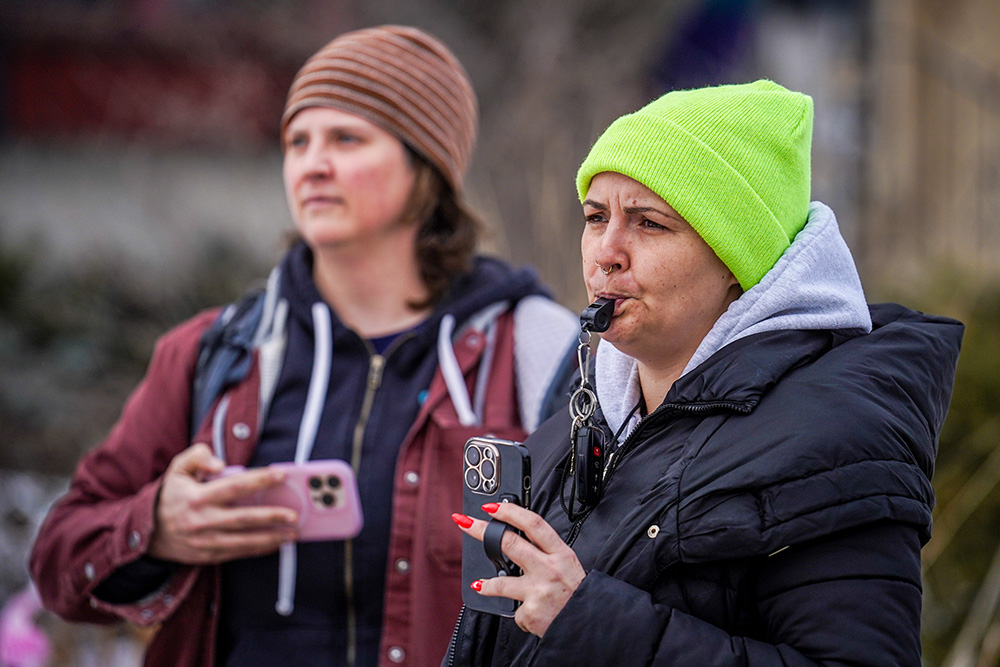
Observers blow their whistles while federal agents conduct immigration enforcement operations on Feb. 5, 2026, in Minneapolis. (AP/Ryan Murphy)

Most recently, when I've been invited to give a presentation, I'm asked to talk about hope. For too many of us, the kind of changes we are experiencing politically, culturally and economically are overwhelming. All the ways we used to try to effect change seem no longer to work. The speed and breadth of the changes keep spinning us around, making us dizzy, wondering, "What can we do? What should we focus on?"
Earlier this month when I was on retreat, I was praying Teilhard de Chardin: A Book of Hours, and I found myself reflecting on two of his thoughts in relation to hope.
The first was: "We must add one stitch, no matter how small it be, to the magnificent tapestry of life."
The second was: "If it is true that the development of the world can be influenced by our faith, then to let this power be dormant within us would indeed be unpardonable."
As I prayed with these insights, I started feeling that we need to turn around how we are looking at hope. Literally and figuratively.
It is as if we are standing, looking back at all that has gone on these past months. We preferred what was, and too often our hope is rooted in a specific outcome within a definite time frame.
I think we need to turn around. We need to face forward, acknowledging all that has gone on, and consciously live out of love, reminding ourselves that we already have within us the hope that we need.
Rooted in faith, we pray with Jesus that God's reign may come on earth as it is in heaven. We believe there is meaning to our lives and who we are and what we do helps create our emerging future. We need to believe that together we are creating a collective transforming energy in our world.
I find examples of this as people have been responding to Immigration and Customs Enforcement raids.
People have been acting out of love. They have been acting as neighbors to one another.
Watching one's neighbors, both U.S. citizens and immigrants, become the victims of the unjust, illegal and immoral behavior of too many ICE agents has provoked an outrage that touches into some of our deepest civic and faith beliefs — to respect and love one's neighbor.
We see in Minneapolis what we can do when faced with such injustice. We act as neighbors.
Advertisement
When those who are potential targets for ICE are afraid to go out, neighbors shop and buy food for those individuals and families. When they are fearful of being assaulted on their way to work or to school, neighbors drive them to where they have to go. Scared that people will be pulled over or unjustly detained, neighbors organize to stand watch and are ready to alert others through a literal whistle-blowing network.
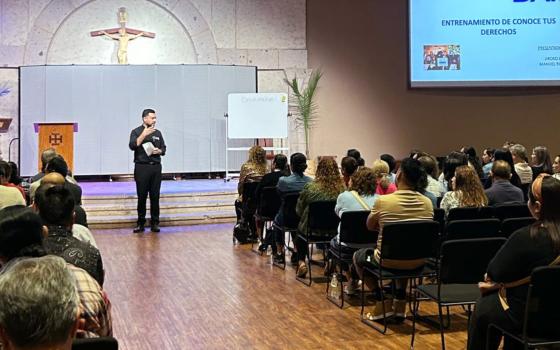
Education is being offered through many organizations to learn how to record abuses that we see. What we can take pictures of legally; what rights we have if caught in a volatile situation; how we operate within the law to protect the values that this country has advocated for decades to safely allow people to come to the U.S. and find a new life.
This complements other ways of acting out of love — nonviolent demonstrations, writing and advocating to political officials to change policies and behaviors.
This is what neighbors are doing and what we all can do.
I picture what is happening as a force moving forward into 2026. Alerting us to the danger of inertia and despair and witnessing to hope that flows from love. It is calling us to our better selves — calling us to be neighbors to one another.
Each of us needs to add our stitch to the tapestry of our emerging future. As we do it together, we witness to the hope that the 'kindom of God' is being lived on earth. A kindom of compassion, mercy, justice, peace and love.
The artist Corita Kent created a piece that said, "Hope is the memory of the future ... have a hand in it." May our contemplative sitting continue to open ourselves to creating a future out of love.