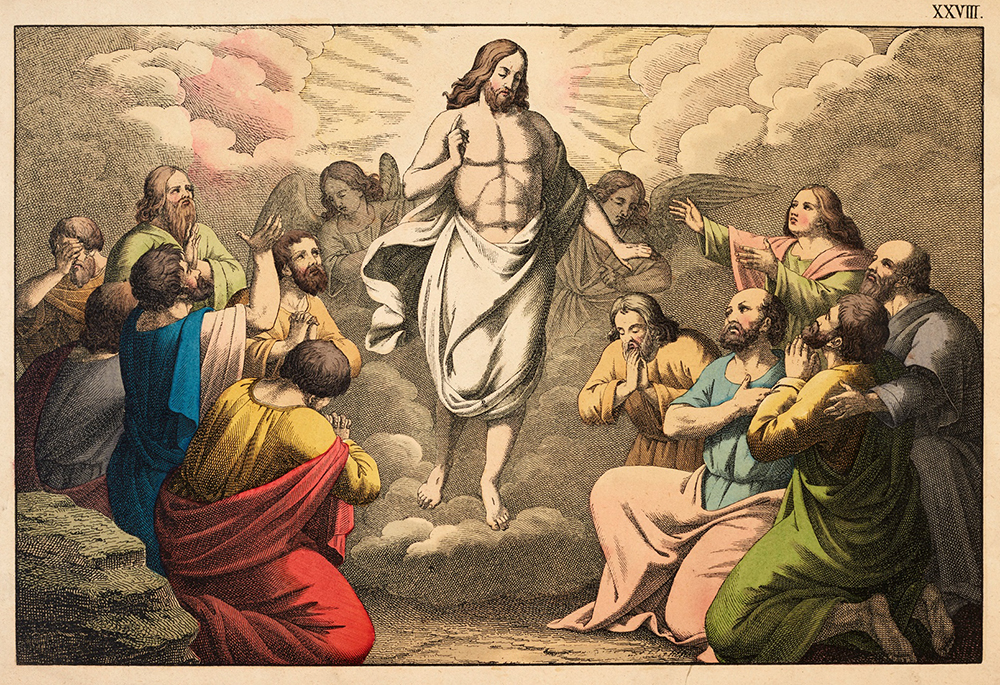
"Ascension" (1879), painting by Theodor Eckardt (Artvee)

by Heejung Cho
Editor's note: Welcome to Theologians' Corner, where each week a different woman theologian from around the world offers a fresh reflection on the Sunday readings.

The Ascension of the Lord
May 14, 2026
The Ascension is often imagined as a moment that draws our eyes upward. The disciples stand gazing into the sky, watching as Jesus is taken from their sight. It is a powerful image, but also a revealing one.
The question posed to them interrupts this posture: "Why are you standing there looking at the sky?" It is not only a question about movement, but about orientation. To look upward is not a neutral act. It can reflect a deeper longing of seeking direction, clarity, authority and control from above. Even in this moment, the disciples remain shaped by such expectations. They are still asking about the restoration of a kingdom, still hoping for resolution in terms they can recognize. Their gaze reveals not only longing, but also a desire for certainty.
The Ascension gently unsettles this instinct. Jesus does not direct their attention upward, but outward. "You will be my witnesses … in Jerusalem, in all Judea and Samaria, and to the ends of the earth." This movement is not simply geographical expansion. It is a crossing of boundaries. The mention of Samaria is not incidental. It names a place of tension, difference and long-standing division. To be sent to Samaria is to enter into relationship where it is most difficult. It is to move beyond familiarity into spaces marked by suspicion and history. In this sense, the Ascension is not only about being sent, but about where we are sent. The direction of discipleship is not upward toward control, but outward toward encounter.
This outward movement becomes even clearer in the Gospel of Matthew. When the disciples meet the risen Christ, they worship, but they also doubt. Faith here is not pure certainty, but a mixture of trust and hesitation. It is precisely in this space that Jesus speaks: "All power in heaven and on earth has been given to me. Go, therefore …"
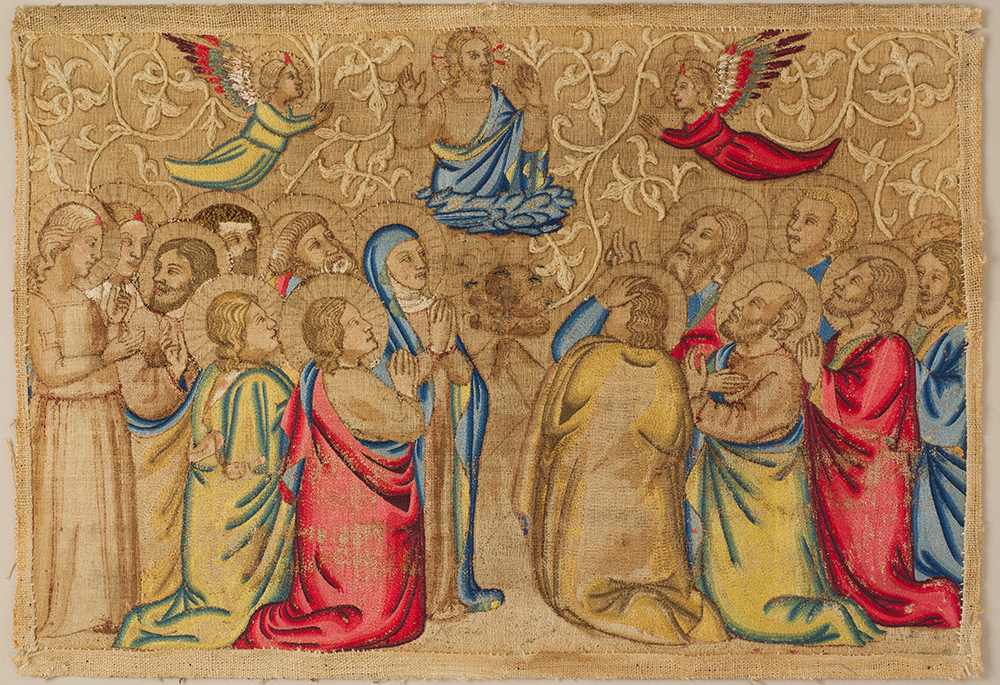
"The Ascension," 14th-century Italian embroidery (Metropolitan Museum of Art)
At first, this sounds like a command grounded in power. Yet what follows reveals something different. Jesus does not send the disciples out to impose or to dominate. He sends them to make disciples, to baptize, and to teach in a way that reflects how he has lived among them. His authority is not exercised from a distance, but through presence.
The final promise makes this clear: "I am with you always." This is not a statement of control, but of accompaniment. The one who sends them also remains with them. Mission, then, is not a project carried out from above, but a shared journey. It unfolds in relationship, in proximity, and often in uncertainty. This reframes what it means to be a witness. Witness is not first about speaking from a place of certainty. It is about remaining present, especially where difference and tension exist. It is about allowing encounter itself to become the place of transformation. As the disciples move outward, they do not simply change others; they are changed as well.
Advertisement
We live in a world that is deeply connected and yet profoundly divided. We share spaces, physical and digital, but often remain distant from one another's lived realities. It is possible to stand close and yet never truly encounter. In such a context, the temptation is real: to remain at a distance, to hold on to certainty without entering into relationship, to look upward for clarity rather than moving outward in trust. The Ascension interrupts this pattern. It calls us to move outward, not to claim space, but to enter it. Not to impose, but to accompany. Not to stand above, but to remain with.
And yet, accompanying is not something we learn only in theory. Many communities, particularly those who have lived at the margins, have long known that faith is lived in the midst of difference, in the everyday work of building trust, staying present, and choosing relationship even when it is hard. They are not simply recipients of mission. They teach us what solidarity looks like when it is embodied rather than merely spoken, and they remind us that mission is never a one-way movement. The places we are sent to are not empty. They are already inhabited by the presence of God, already alive with a wisdom that calls us to listen before we speak.
In this context, the question remains: "Why are you standing there looking at the sky?" It asks where we are looking, and where we are willing to go. The Ascension is not an invitation to remain still waiting for direction from above. It is a commission to move outward into the world as it is: fractured, beautiful and full of God's hidden presence. To follow Christ is to live this movement as a way of life. It is to trust that his presence is not found in distance or certainty, but in the courage to remain in relationship, especially where it is hardest. We are not left behind. We are sent, and we are accompanied.