
Chapel exterior, St. Mary's Abbey in Glencairn, County Waterford, Ireland (Julie A. Ferraro)

by Julie A. Ferraro
As a Benedictine oblate, the dynamics of the Divine Office — or Liturgy of the Hours — as practiced in various monasteries has fascinated me for quite some time. Perhaps this is because I've also been involved in reformatting office books for Benedictine communities. How each approaches the psalms, canticles, hymns and prayers is unique.
Over much of the past year, I've been in Ireland. Thanks to generous Benedictine hospitality, I've spent time at the Monastery of the Immaculate Conception at Kylemore Abbey in Connemara, County Galway; Glenstal Abbey near Limerick; and the Cistercian (Trappistine) St. Mary's Abbey — also known as Glencairn Abbey — near Cork. Since all three are located well off the beaten track in the gorgeous Irish countryside, it's a challenge just to reach the sites, but worth the effort.
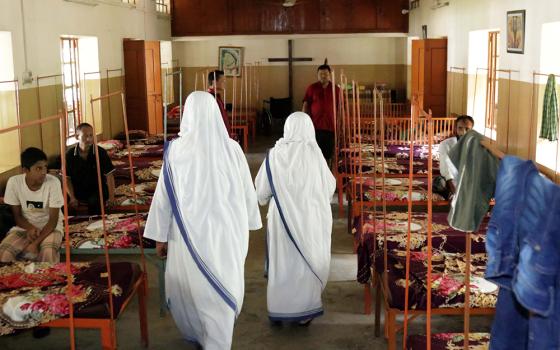
From Glenstal's traditional Gothic interior to St. Mary's starkness, more identifiable with the Trappists, the liturgical spaces reflect the unique "flavors" of their respective religious communities. While the Kylemore Benedictines have a new monastery, their chapel remains in transition — the converted gymnasium from their former boarding school — with hopes for an actual church structure to be built in the future.
But, here's the other challenge I faced: a real sense of culture shock in sitting among the congregation during prayer in these chapels.
Because these monasteries are in an English-speaking country, I was very surprised at the differences in approach to liturgy from monasteries in the United States.
At Kylemore, for instance, at Sunday vespers and on feast days that include memorials and solemnities, the services use Latin antiphons, as well as psalm and canticle translations. For the monks at Glenstal Abbey, Latin is standard during their evening prayer. At Glencairn, however, everything is in English, except for an occasional Marian hymn.
For all three monasteries, Gregorian chant forms the basis of the singing, too.
I'm a child of the '70s. I started playing guitar at Mass in fifth grade. I carried my father's guitar, in a heavy wooden case, two blocks to St. John the Baptist Catholic School when daily Mass was still a part of the regular schedule. We sang "Get Together" by Chet Powers, "Blowin' in the Wind" by Bob Dylan, "Here We Are" by Ray Repp and other upbeat hymns composed in the wake of the Second Vatican Council.
Mass was a joy for me then; I felt really part of a worshipping community.
As the years passed, the St. Louis Jesuits entered the scene, with their lyrics more scripturally based, but equally uplifting. I retained the calluses on my fingertips as I continued playing at folk Masses — graduating to a 12-string guitar — and also to the organ.
Advertisement
Latin vanished from U.S. liturgies that I attended, and I really didn't hear much about the "traditional" Latin Mass until well into the new century.
Certain factions of the Catholic Church believe young people are drawn to the mystery and beauty of Latin in liturgy. It seems so in parts of Ireland, too. Others hold that offering prayer in the common language makes it more prayerful and more comprehensible.
For me, the question is: How can you send prayers heavenward if you don't know what you're praying for?
But, then, faith has always been about logic, in my book. It's not a "feeling-based" experience. Emotions should, overall, have very little to do with faith. If a person relies on emotions as the foundation of their faith practices, they'll find themselves on quite the roller coaster ride.
Faith is concrete and needs to be understood with a certain clarity and constancy. There's nothing wrong with vocalizing, "God, I'm having a tough day, give me strength." It doesn't need to be couched in flowery Latin to be effective.
Still, I concede different people — and Benedictine communities — view their liturgies in ways that include promoting the mystery of the Incarnation and lively, down-to-earth celebrations of Christ with us. I respect those choices, though I might not be comfortable participating in a sung Latin Mass with lots of "smells and bells."
What I found in these Irish religious communities that observe the Rule of St. Benedict, though — as in the dozens I've visited in the States: Choices are available for the faithful to find what they seek, whatever their preferred style of worship. It may involve experiencing a degree of culture shock, but everyone will eventually find their "safe harbor" where they can approach God on the level that suits them best.