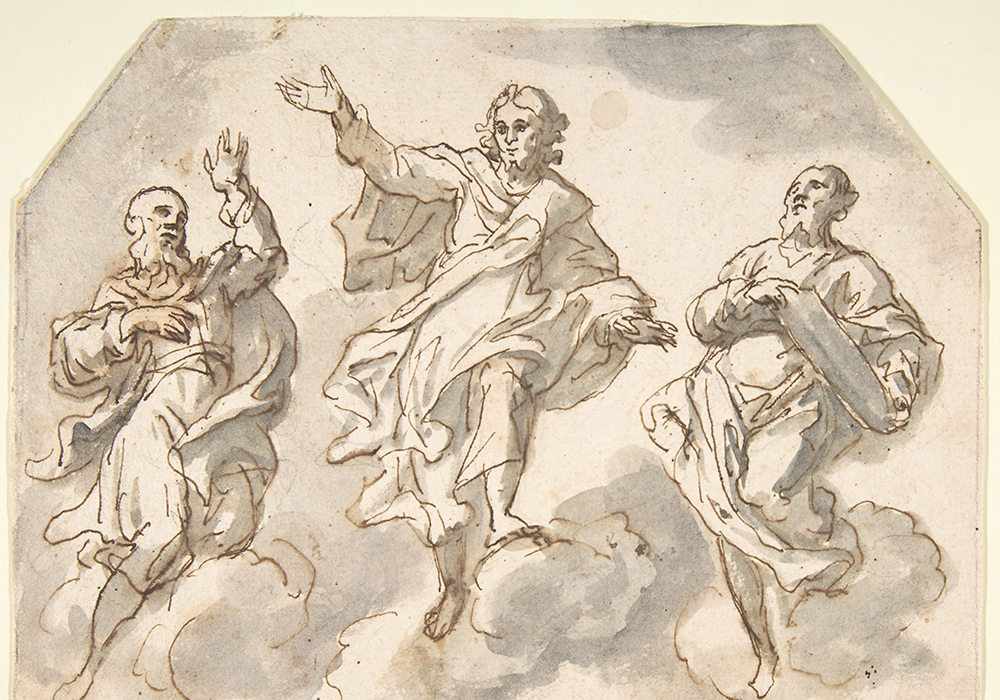
"The Transfiguration," an Italian 1565-1608 drawing by Francesco Curia (Metropolitan Museum of Art)

by Heejung Cho
Editor's note: Welcome to Theologians' Corner, where each week a different woman theologian from around the world offers a fresh reflection on the Sunday readings.

Feast of the Transfiguration of the Lord
August 6, 2026
On the high mountain, the disciples see the face of Jesus become radiant, shining like the sun. Moses and Elijah also appeared, conversing with Jesus. Peter then gives voice to a deeply human longing. "Lord, it is good that we are here." He wants to stay, to build, to give permanence to what he has witnessed.
Most of us would recognize this desire. We have felt it in rare moments of clarity when God feels close and we want to remain there. In the presence of mystery, Peter reaches for something tangible. He wants to name and organize the experience by building a structure around it. This may reflect not only a desire to preserve something beautiful, but also our discomfort with what we cannot contain. A tent gives mystery boundaries and makes it manageable.
Yet while he is still speaking, a voice comes from the cloud: "This is my beloved Son, with whom I am well pleased; listen to him." Peter wants to build, but the voice tells him to listen.
The disciples then fall to the ground in fear. What began as an experience of beauty becomes a moment of vulnerability. Then Jesus draws near and touches them. "Rise, and do not be afraid." The glory of Christ does not remain distant or overwhelming. It draws near, becomes a touch and restores them to their feet.
Peter shows how difficult listening can be. We are rarely content simply to receive; we feel compelled to speak, respond or act. Yet listening requires us to accept that we do not fully understand. It requires the humility to pause before deciding how to respond and to remain open to what may challenge us.
Advertisement
Faith does not confine God within the boundaries of our certainty. Instead, it draws us more deeply into relationship with the living God, who always exceeds the boundaries we draw and the structures we build.
The Church, like Peter, has not always found it easy to listen. At times, especially when Christian mission became intertwined with colonial expansion, missionaries approached peoples and cultures more ready to speak and act than to listen and learn. Proclamation risked becoming associated with cultural authority, leaving too little room to recognize the ways the Holy Spirit was already present and at work among peoples created in the image and likeness of God.
The temptation to replace listening with control has taken new forms in our technological age. Algorithms predict, data classifies and artificial intelligence promises to make more of human life visible and knowable. These tools can serve the common good, but they can also encourage the illusion that people can be fully processed, categorized and managed.
Pope Leo XIV reminds us in Magnifica Humanitas that no system, however sophisticated, can exhaust the mystery of a human life. Created in the image and likeness of God, every person possesses a dignity that no measure of efficiency, productivity or technological capability can fully capture. The danger is not technology itself, but the desire to overcome uncertainty by reducing others to what we can know and control.
Acknowledging the temptation to seek certainty through control is an important part of the church's ongoing conversion toward listening. The recent synod on synodality reflects a renewed desire to become a more listening church, attentive to the people of God and open to communal discernment in the Holy Spirit. This synodal journey recognizes listening as an ongoing conversion shaping the church's mission, relationships and structures.
The Transfiguration speaks directly to this journey. The voice from the cloud simply says, "Listen to him." As Christ's disciple, the church must continue to listen to him and allow its actions to be shaped by his example. The transfigured Jesus draws near, touches those who are afraid and raises them without diminishing them. To listen to him is to learn how to draw near to others with the same humility.
Peter wanted to remain on the mountain and build around what he had seen. Yet, genuine encounter with the holy does not simply confirm what we already know. It unsettles us, and exposes the limits of our understanding and sometimes brings us to our knees.
When the disciples raise their eyes, the vision has passed, and only Jesus remains. They have glimpsed the divine glory within the one who now leads them down the mountain. Faith cannot remain in moments of spiritual clarity or preserve them as possessions. It must follow Christ down the mountain, taking flesh in listening, humility and encounter. We come down from the mountain not with the certainty that we fully understand, but with a deeper willingness to listen and remain open to those we encounter.