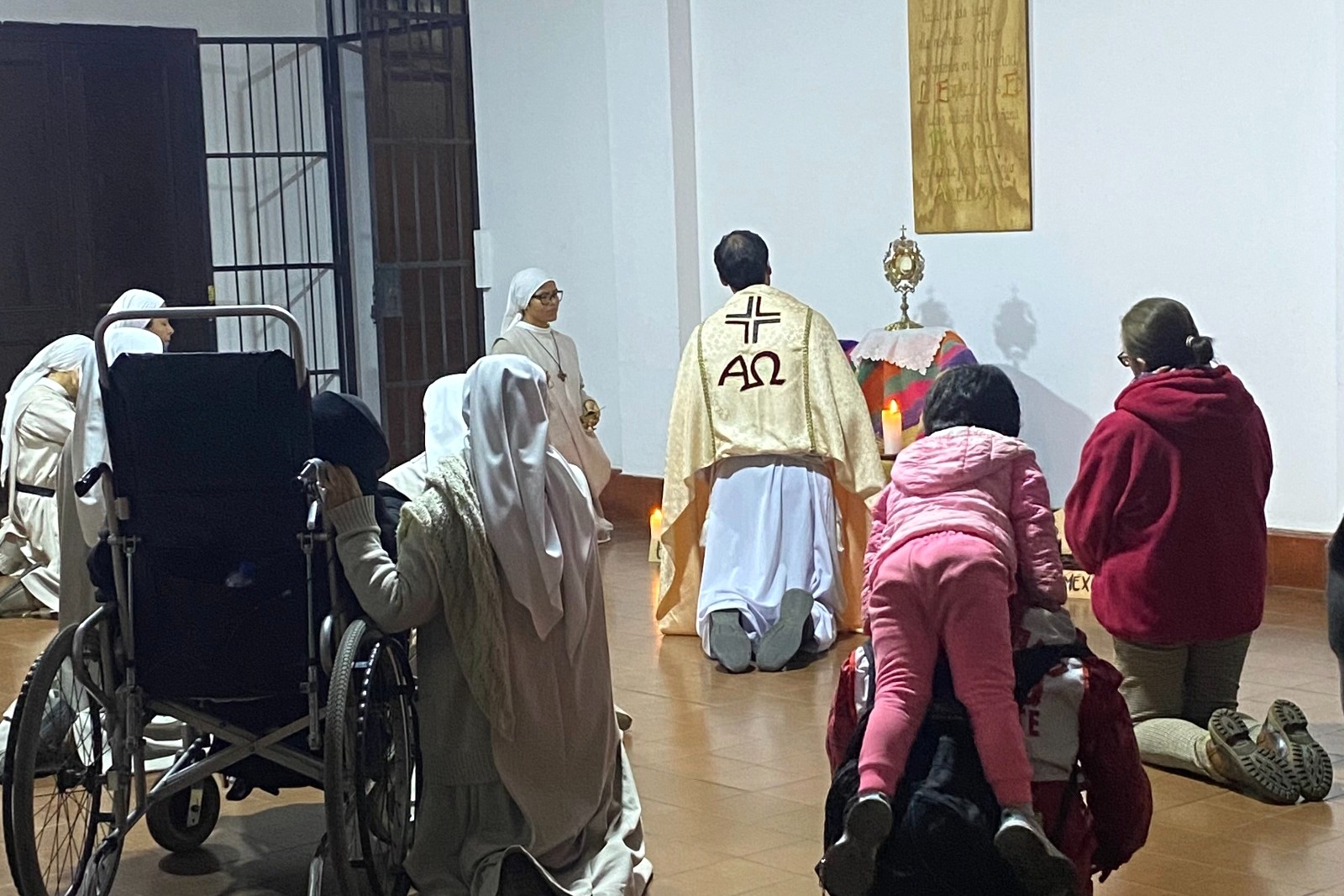
A child the author calls Hope rests on Compassion's back during adoration at the Monastery of the Incarnation in Lima, Peru, in 2025. (Courtesy of Marlene Quispe Tenorio)
Sr. Marlene Quispe Tenorio
Every Sunday at 5:15 p.m., a family arrives faithfully at the church of our monastery. They have made the liturgy, vespers and adoration their spiritual home. I prefer to keep their real names private, but for me they are Compassion, Tenderness and Hope. That is what I call them, because in them I recognize something that transcends the everyday: a living, silent and true parable
Compassion murmurs words that I don't always understand. Tenderness remains silent, as if guarding a mystery. Hope runs between the pews, plays, laughs, asks questions, and then sits with us. We have earned her trust, and she looks at us with affection. She knows we love her, that we celebrate her existence, as she realized when we celebrated her 4th birthday. And every time I see them, I think of the Trinity, of the Holy Family, of that God who makes himself small, vulnerable and human.
Their prayer touches me deeply. All three lie prostrate on the floor. We hear Compassion's cry, begging to be freed from her illness. The little girl, in a clear voice, says, "Don't cry, Mom." Tenderness remains at her side, without saying a word, but his presence is a comfort and support to both of them. And I wonder if what I feel is envy for the authenticity of their prayer, a simple, sincere and trusting prayer, a plea that rises from those who have nothing — neither health nor possessions — but who have everything in God.
Every Sunday, Compassion, Tenderness and Hope come to the monastery: a sick mother, her silent partner, and a 4-year-old girl. Their weekly visit pulls us out of our comfort zone and brings us back to what is essential.
I remember the times Compassion has been hospitalized, harmed by the system, mistreated by men or by her own mental fragility. And how Tenderness has stayed by her side, while Hope became the strength to continue fighting the illness. Compassion gave up being with her daughter so that Tenderness could care for her. Since then, Hope goes to school, is clean and is able to communicate. There is a transformation that cannot be explained with words alone. It is the fruit of a silent self-giving, of tenderness that seeks no recognition.
Still, this family faces rejection. Some people turn away because of their appearance or their unpredictable gestures as they sell candies on the streets. My sisters and I are learning, little by little, to look beyond that. Their actions are master lessons: embracing life, caring for it and fighting so that Hope can succeed, even to the point of renouncing custody out of love. There is a beauty in them that fascinates me, that makes me long for the sincerity and trust with which they draw near to God.
Their weekly visit opens a window in our community. It pulls us out of our comfort zone and brings us back to what is essential. As Pope Leo XIV writes in Dilexi Te: "Contact with those who have no power or greatness is a fundamental way of encountering the Lord of history. In the poor, He still has something to say to us." They are the beloved, the favorites of God, those who experience contempt and know themselves to be fragile. In them I recognize Jesus.
Hope, at such a young age, has developed a fierce instinct to defend her mother. She used to bite or scratch; now she gives kisses on the face. She chatters like a little parrot and asks about everything. She asks for paper and pencil to draw bunnies. Every one of her gestures is a revelation. She teaches me that what matters is not perfection, but affection; that small gestures can soothe pain; that dignity is not measured by appearance, but by the capacity to love and be loved.
In his apostolic exhortation, Pope Leo XIV reminds us: "No gesture of affection, even the smallest, will be forgotten, especially if it is directed to those who live in pain, loneliness, or need." This family confirms this for me every single week. They are a place of encounter, a mirror that reflects God's mercy.
They draw me out of myself. They teach me that faith is not theory, but relationship; that prayer is not ritual, but cry; that community is not a space of perfection, but of welcome. And above all, that God continues to say, "I have loved you" (Revelation 3:9), not to the strong, but to those who prostrate themselves, to those who weep, to those who trust.
That is why, when I see this family come in every Sunday, I feel the Kingdom of God drawing near with fragile steps and bunny drawings. And then I understand that they, the beloved ones, are the true teachers of faith.
This story was originally published in Spanish on Jan. 2, 2026.
Advertisement